
Catalogue Search | MBRL


Are you sure you want to remove the book from the shelf?

{{itemTitle}}
6
result(s) for
"Hasen, Richard L., author"
Sort by:

Plutocrats united : campaign money, the Supreme Court, and the distortion of American elections
\"Campaign financing is one of today's most divisive political issues. The left asserts that the electoral process is rife with corruption. The right protests that the real aim of campaign limits is to suppress political activity and protect incumbents. Meanwhile, money flows freely on both sides. In Plutocrats United, Richard Hasen argues that both left and right avoid the key issue of the new Citizens United era: balancing political inequality with free speech. The Supreme Court has long held that corruption and its appearance are the only reasons to constitutionally restrict campaign funds. Progressives often agree but have a much broader view of corruption. Hasen argues for a new focus and way forward: if the government is to ensure robust political debate, the Supreme Court should allow limits on money in politics to prevent those with great economic power from distorting the political process\"--Jacket.
Book

The Supreme Court and election law : judging equality from Baker v. Carr to Bush v. Gore
In the first comprehensive study of election law since the Supreme Court decided Bush v. Gore , Richard L. Hasen rethinks the Court’s role in regulating elections. Drawing on the case files of the Warren, Burger, and Rehnquist courts, Hasen roots the Court’s intervention in political process cases to the landmark 1962 case, Baker v. Carr. The case opened the courts to a variety of election law disputes, to the point that the courts now control and direct major aspects of the American electoral process.
The Supreme Court does have a crucial role to play in protecting a socially constructed “core” of political equality principles, contends Hasen, but it should leave contested questions of political equality to the political process itself. Under this standard, many of the Court’s most important election law cases from Baker to Bush have been wrongly decided.
eBook

The justice of contradictions : Antonin Scalia and the politics of disruption
\"Engaging but caustic and openly ideological, Antonin Scalia was among the most influential justices ever to serve on the United States Supreme Court. In this fascinating new book, legal scholar Richard L. Hasen assesses Scalia's complex legacy as a conservative legal thinker and disruptive public intellectual. The left saw Scalia as an unscrupulous foe who amplified his judicial role with scathing dissents and outrageous public comments. The right viewed him as a rare principled justice committed to neutral tools of constitutional and statutory interpretation. Hasen provides a more nuanced perspective, demonstrating how Scalia was crucial to reshaping jurisprudence on issues from abortion to gun rights to separation of powers. A jumble of contradictions, Scalia promised neutral tools to legitimize the Supreme Court, but his jurisprudence and confrontational style moved the Court to the right, alienated potential allies, and helped to delegitimize the institution he was trying to save.\" -- Publisher's website.
Book
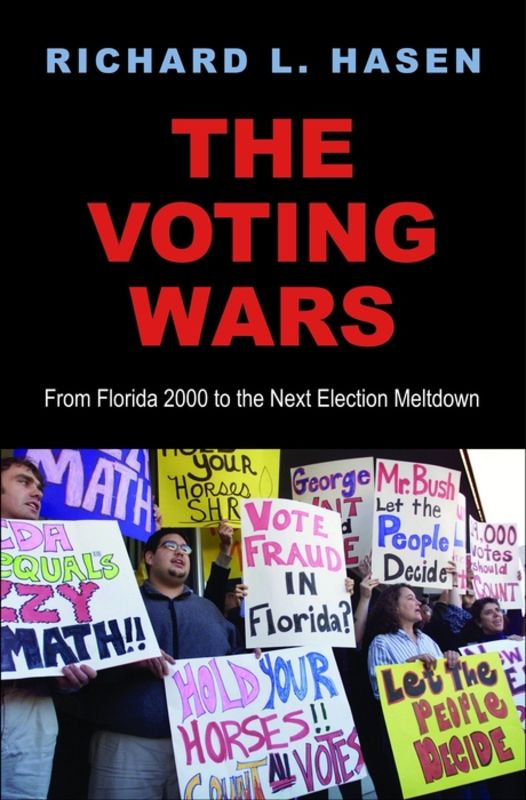
The voting wars : from Florida 2000 to the next election meltdown
In 2000, just a few hundred votes out of millions cast in the state of Florida separated Republican presidential candidate George W. Bush from his Democratic opponent, Al Gore. The outcome of the election rested on Florida's 25 electoral votes, and legal wrangling continued for 36 days. Then, abruptly, one of the most controversial Supreme Court decisions in U.S. history, Bush v. Gore, cut short the battle. Since the Florida debacle we have witnessed a partisan war over election rules. Election litigation has skyrocketed, and election time brings out inevitable accusations by political partisans of voter fraud and voter suppression. These allegations have shaken public confidence, as campaigns deploy \"armies of lawyers\" and the partisan press revs up when elections are expected to be close and the stakes are high.Richard L. Hasen, a respected authority on election law, chronicles and analyzes the battles over election rules from 2000 to the present. From a nonpartisan standpoint he explores the rising number of election-related lawsuits and charges of voter fraud as well as the decline of public confidence in fair results. He explains why future election disputes will be worse than previous ones-more acrimonious, more distorted by unsubstantiated allegations, and amplified by social media. No reader will fail to conclude with Hasen that election reform is an urgent priority, one that demands the attention of conscientious citizens and their elected representatives.Also available: The Fraudulent Fraud Squad, an e-excerpt from The Voting WarsReleased February 2012 9780300187489 $1.99
eBook
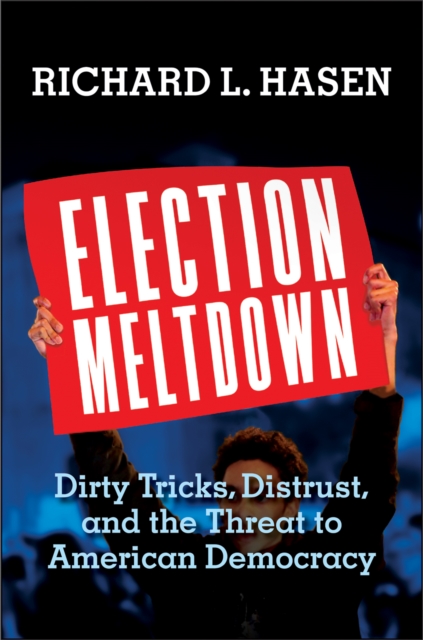
Election Meltdown
From the nation's leading expert, an indispensable analysis of key threats to the integrity of the 2020 American presidential election As the 2020 presidential campaign begins to take shape, there is widespread distrust of the fairness and accuracy of American elections. In this timely and accessible book, Richard L. Hasen uses riveting stories illustrating four factors increasing the mistrust. Voter suppression has escalated as a Republican tool aimed to depress turnout of likely Democratic voters, fueling suspicion. Pockets of incompetence in election administration, often in large cities controlled by Democrats, have created an opening to claims of unfairness. Old-fashioned and new-fangled dirty tricks, including foreign and domestic misinformation campaigns via social media, threaten electoral integrity. Inflammatory rhetoric about \"stolen\" elections supercharges distrust among hardcore partisans. Taking into account how each of these threats has manifested in recent years-most notably in the 2016 and 2018 elections-Hasen offers concrete steps that need to be taken to restore trust in American elections before the democratic process is completely undermined.
eBook
Hazards Remain in Campaign-Fund System
Everything changed Wednesday, when the court decided McConnell v. FEC, a case that probably will be viewed as the most important campaign-finance case since [Buckley]. In McConnell, a 5-4 court majority upheld virtually all of the 2002 McCain-Feingold law's loophole-closing provisions. Reformers should be aware especially of three potential dangers. First, just because a law like McCain-Feingold is constitutional does not mean that it is desirable. We have already seen a somewhat anticipated consequence of the soft-money ban. Big money has been flowing in recent months to groups outside of the political parties to pay for election advertisements. Under the McCain-Feingold law as written, such groups are likely to be subject to disclosure rules but no limits on funding.
Newspaper Article