
Catalogue Search | MBRL


Are you sure you want to remove the book from the shelf?

{{itemTitle}}
38
result(s) for
"Hasik, James"
Sort by:

HOW TO BAIL OUT A DEFENSE CONTRACTOR: CASES ON SECURING A SUPPLY CHAIN IN EXTREMIS
Since passage of the 2011 National Defense Authorization Act, the Industrial Policy office has also managed the overall Manufacturing Technology (Mantech) program, which since 1956 has separately provided longer term investments in manufacturing processes, techniques, equipment, and workforce training. Some bailouts, particularly those of \"depository institutions insured by the Federal Government, are routine and usually proceed according to a prearranged script.\" [...]any defense ministry that relies on domestic industry for armaments may view the problem as supplier management in extremis. Order No. 13,806, 2017). [...]as in the past, the DoD would seek to save programs, preserve industrial structure, and avoid scandals-just with an expanded and perhaps more conscious plan. In reviewing cases, I identify six means by which the government attempted to bail out the companies in question: a price increase in the contract, a loan guarantee, a direct purchase of the product when the product is not strictly needed, advancing progress payments in the contract, other direct cash payments, and a long-term purchase agreement to increase investor confidence and secure financing.
Journal Article

Arms and Innovation
With many of the most important new military systems of the past decade produced by small firms that won competitive government contracts, defense-industry consultant James Hasik argues in Arms and Innovation that small firms have a number of advantages relative to their bigger competitors. Such firms are marked by an entrepreneurial spirit and fewer bureaucratic obstacles, and thus can both be more responsive to changes in the environment and more strategic in their planning. This is demonstrated, Hasik shows, by such innovation in military technologies as those that protect troops from roadside bombs in Iraq and the Predator drones that fly over active war zones and that are crucial to our new war on terror. For all their advantages, small firms also face significant challenges in access to capital and customers. To overcome such problems, they can form alliances either with each other or with larger companies. Hasik traces the trade-offs of such alliances and provides crucial insight into their promises and pitfalls. This ground-breaking study is a significant contribution to understanding both entrepreneurship and alliances, two crucial factors in business generally. It will be of interest to readers in the defense sector as well as the wider business community
Book
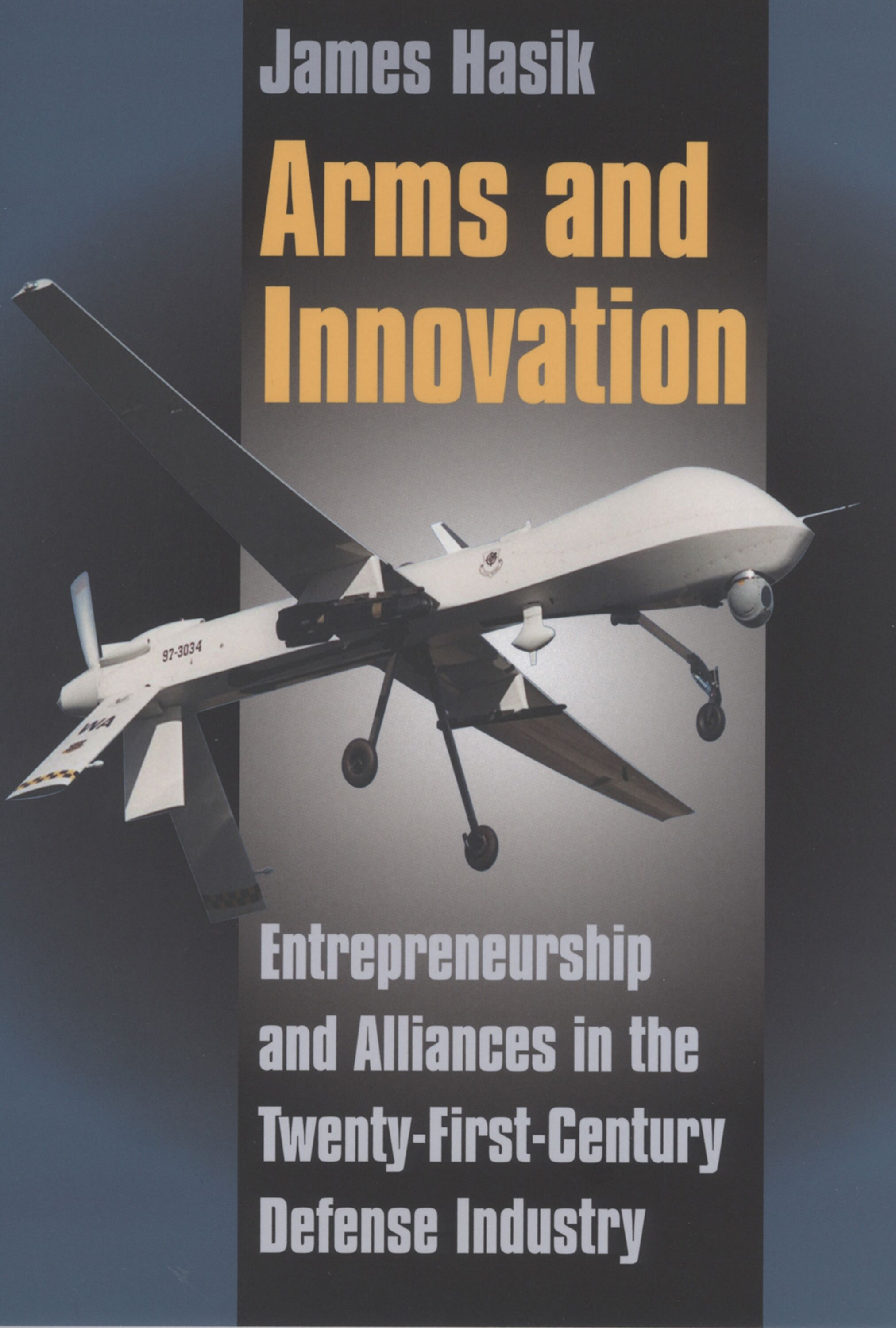
Arms and Innovation
With many of the most important new military systems of the past decade produced by small firms that won competitive government contracts, defense-industry consultant James Hasik argues in Arms and Innovation that small firms have a number of advantages relative to their bigger competitors. Such firms are marked by an entrepreneurial spirit and fewer bureaucratic obstacles, and thus can both be more responsive to changes in the environment and more strategic in their planning. This is demonstrated, Hasik shows, by such innovation in military technologies as those that protect troops from roadside bombs in Iraq and the Predator drones that fly over active war zones and that are crucial to our new war on terror. For all their advantages, small firms also face significant challenges in access to capital and customers. To overcome such problems, they can form alliances either with each other or with larger companies. Hasik traces the trade-offs of such alliances and provides crucial insight into their promises and pitfalls. This ground-breaking study is a significant contribution to understanding both entrepreneurship and alliances, two crucial factors in business generally. It will be of interest to readers in the defense sector as well as the wider business community.
eBook


Beyond the Third Offset: Matching Plans for Innovation to a Theory of Victory
In Nov 2014, Secretary of Defense Chuck Hagel announced the launch of the Third Offset Strategy. Despite official insistence to the contrary, the offset remains substantially a technology strategy, and one largely focused on the interrelated technologies of autonomy and artificial intelligence. While progress in these fields has been brisk, their offsetting qualities are not obvious, and they may not be realms of enduring comparative advantage to the US. If they do prove efficacious, military planners must contemplate profound organizational and doctrinal changes to compensate for rapid change in the ways of war. Whatever the likelihood of future military-technological trajectories, American strategists might consider less expensive and more certain ways of dealing with some adversaries' local superiorities. Here, Hasik discusses the Nation's offset strategies and describes how current innovations supporting the Third Offset Strategy can help the US military win the Nation's wars.
Journal Article
Defense entrepreneurship: how to build institutions for innovation inside the military
Fears of slipping dominance are driving an American push for military innovation. But while the accomplishments of American industry are enviable, not all innovation is grounded in technology or flows from the private sector. The US Armed Forces have a considerable history with internally driven innovation, and today a new class of innovators is emerging within the Services. These public entrepreneurs watch for opportunities, make decisions under uncertainty, and then meld the factors of change in sticky that is, locally commercialized ways. Their entrepreneurship sometimes falters, as the controlling tendencies and vested interests of the bureaucratic apparatus resist. In other ways, however, the rate of recombinant technological change is outpacing the bureaucratic processes of defense planning and acquisition. Firms that do not normally conduct business with defense ministries may be outpacing the record of innovation by traditional contractors in fields such as microsatellites, cyber defense, robotics, and networked communications.
Journal Article