
Catalogue Search | MBRL


Are you sure you want to remove the book from the shelf?

{{itemTitle}}
5
result(s) for
"Haslam, Jonathan, author"
Sort by:

Near and distant neighbors : a new history of Soviet intelligence
\"A revelatory and pathbreaking account of the highly secretive world of the Soviet intelligence services. A uniquely comprehensive and rich account of the Soviet intelligence services, Jonathan Haslam's Near and Distant Neighbors charts the labyrinthine story of Soviet intelligence from the October Revolution to the end of the Cold War. Previous histories have focused on the KGB, leaving military intelligence and the special service--which specialized in codes and ciphers--lurking in the shadows. Drawing on previously neglected Russian sources, Haslam reveals how both were in fact crucial to the survival of the Soviet state. This was especially true after Stalin's death in 1953, as the Cold War heated up and dedicated Communist agents the regime had relied upon--Klaus Fuchs, the Rosenbergs, Donald Maclean--were betrayed. In the wake of these failures, Khrushchev and his successors discarded ideological recruitment in favor of blackmail and bribery. The tactical turn was so successful that we can draw only one conclusion: the West ultimately triumphed despite, not because of, the espionage war. In bringing to light the obscure inhabitants of an undercover intelligence world, Haslam offers a surprising and unprecedented portrayal of Soviet success that is not only fascinating but also essential to understanding Vladimir Putin's power today\"-- Provided by publisher.
Book

Russia's Cold War
The phrase \"Cold War\" was coined by George Orwell in 1945 to describe the impact of the atomic bomb on world politics: \"We may be heading not for a general breakdown but for an epoch as horribly stable as the slave empires of antiquity.\" The Soviet Union, he wrote, was \"at once unconquerable and in a permanent state of 'cold war' with its neighbors.\" But as a leading historian of Soviet foreign policy, Jonathan Haslam, makes clear in this groundbreaking book, the epoch was anything but stable, with constant wars, near-wars, and political upheavals on both sides.
Whereas the Western perspective on the Cold War has been well documented by journalists and historians, the Soviet side has remained for the most part shrouded in secrecy-until now. Drawing on a vast range of recently released archives in the United States, the United Kingdom, France, Germany, Russia, and Eastern Europe,Russia
's Cold Waroffers a thorough and fascinating analysis of East-West relations from 1917 to 1989.
Far more than merely a straightforward history of the Cold War, this book presents the first account of politics and decision making at the highest levels of Soviet power: how Soviet leaders saw political and military events, what they were trying to accomplish, their miscalculations, and the ways they took advantage of Western ignorance.Russia's Cold Warfills a significant gap in our understanding of the most important geopolitical rivalry of the twentieth century.
eBook
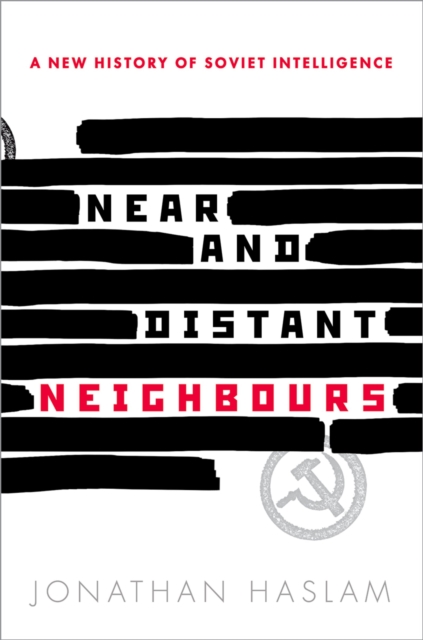
Near and Distant Neighbours
Near and Distant Neighbours is the first ever substantiated and complete history of Soviet intelligence. Based on a mass of newly declassified Russian secret intelligence documentation, it reveals the true story of Soviet intelligence from its very beginnings in 1917 right through to the end of the Cold War. Covering both main branches of Soviet espionage - civilian and military - Jonathan Haslam charts the full range of the Soviet intelligence effort and the story of its development:in cryptography, disinformation, special forces, and counter-intelligence. In a tragic irony, an organization that so casually disposed of others critically depended upon the human factor. Due to their lack of expertise and technological know-how, from early on the Soviets were forced to rely heavily on secret agents instead of the more sophisticated code-breaking techniques of other intelligence agencies. But in this they were highly successful, recruiting spy rings such as the infamous 'Cambridge Five' in the 1930s. Had it not been for Soviet espionage againstBritain's code-breaking effort during the Second World War, Stalin might never have won the victory that later enabled him to dominate half of Europe. Similarly, espionage directed at his allies enabled the Soviets to build an atomic bomb earlier than expected and to take calculated risks in post-wardiplomacy, such as his audacious blockade of Berlin which led to the Berlin Airlift. Khrushchev's denunciation of Stalin in 1956 alienated many of the foreign 'friends' so valued by the Soviet intelligence services. It also made new recruitment of foreign agents much more difficult, as the USSR rapidly lost its glamour and ideological appeal to potential supporters in the West during the 1950s. However, the gap was finally bridged through exploiting greedy and disloyal Western intelligence officers, using blackmail and bribery - and with great success. In fact, it was theultimate irony that the KGB and GRU had never been more effective than when the Soviet Union began to collapse from within.
eBook

EVENTS AND PHOBIAS
The liberal tendency is to treat the East-West conflict in terms of a deviation from the norm. Typifying the flaws in this approach is Mr. [Stephen F. Cohen]'s discussion of ''Cold War Mysteries.'' ''Ever since the cold war began in 1917, unexpected and mysterious incidents have periodically disrupted East-West relations just as they were improving,'' he writes. Unfortunately he then cites ''the forged 'Zinoviev letter,' [purportedly written by the head of the Comintern to the British Communist Party instructing its members to subvert the armed forces] which caused a break in British-Soviet diplomatic ties in 1924.'' In fact the Zinoviev letter caused no such thing, and a breach did not occur until May 1927, more than two years later and certainly not as a result of an ''unexpected'' or ''mysterious'' incident but after the accumulation of grievances on London's part. The most important of these was Soviet support for the British miners' strike in 1926 and aid to the Communist revolution in China.
Book Review
Character strengths and virtues : a handbook and classification
This groundbreaking handbook of human strengths and virtues is the first progress report from a prestigious group of researchers in the Values in Action Classification Project, which has undertaken a systematic classification and measurement of universal strengths and virtues. This landmark work makes possible for the first time a science of human strengths that goes beyond armchair philosophy and political science. The handbook begins with the background of the VIA classification scheme and defines terms before describing in thorough detail the current state of knowledge with respect to each of the 24 character strengths in the classification. Addressing issues of assessment and measurement, practical applications, and directions for future research, this work will demand the attention of any psychologist who is interested in positive psychology and its relevance to clinical, personality, and social psychology.
eBook