Catalogue Search | MBRL


Are you sure you want to remove the book from the shelf?

{{itemTitle}}
9
result(s) for
"Hastings, Max author"
Sort by:


Engaging and Transforming Global Communication Through Cultural Discourse Analysis
Global communication can be difficult in the best of circumstances.The contributors in this book take seriously the premise that one can examine communication within specific global settings and scenes with the goal of ensuring that the meanings made among those within specific communities is more clearly understood.
eBook


The secret war : spies, ciphers, and guerrillas, 1939-1945
An examination of one of the most important yet underexplored aspects of World War II--intelligence--shows how espionage successes and failures by the United States, Britain, Russia, Gemany, and Japan influenced the course of the war and its final outcome.
Book

Overlord : D-Day and the battle for Normandy
Describes the military effort by which the Allies regained the continent of Europe in World War II.
Book
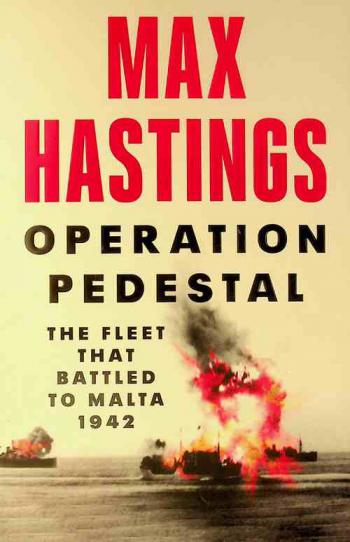
Operation Pedestal : the fleet that battled to Malta 1942
\"In August 1942, beleaguered Malta was within weeks of surrender to the Axis, because its 300,000 people could no longer be fed. Churchill made a personal decision that at all costs, the 'island fortress' must be saved. This was not merely a matter of strategy, but of national prestige, when Britain's fortunes and morale had fallen to their lowest ebb. The largest fleet the Royal Navy committed to any operation of the western war was assembled to escort fourteen fast merchantmen across a thousand of miles of sea defended by six hundred German and Italian aircraft, together with packs of U-boats and torpedo craft. The Mediterranean battles that ensued between 11 and 15 August were the most brutal of Britain's war at sea, embracing four aircraft-carriers, two battleships, seven cruisers, scores of destroyers and smaller craft. The losses were appalling: defeat seemed to beckon. This is the saga Max Hastings unfolds in his first full length narrative of the Royal Navy, which he believes was the most successful of Britain's wartime services. As always, he blends the 'big picture' of statesmen and admirals with human stories of German U-boat men, Italian torpedo-plane crews, Hurricane pilots, destroyer and merchant-ship captains, ordinary but extraordinary seamen. Operation Pedestal describes catastrophic ship sinkings, including that of the aircraft-carrier Eagle, together with struggles to rescue survivors and salvage stricken ships. Most moving of all is the story of the tanker Ohio, indispensable to Malta's survival, victim of countless Axis attacks. In the last days of the battle, the ravaged hulk was kept under way only by two destroyers, lashed to her sides. Max Hastings describes this as one of the most extraordinary tales he has ever recounted. Until the very last hours, no participant on either side could tell what would be the outcome of an epic of wartime suspense and courage\"-- Jacket.

The abyss : nuclear crisis Cuba 1962
\"In The Abyss, Max Hastings turns his focus to one of the most terrifying events of the mid-twentieth century--the thirteen days in October 1962 when the world stood on the brink of nuclear war. Hastings looks at the conflict with fresh eyes, focusing on the people at the heart of the crisis--America President John F. Kennedy, Soviet First Secretary Nikita Khrushchev, Cuban Prime Minister Fidel Castro, and a host of their advisors. Combining in-depth research with Hasting's well-honed insights, The Abyss is a human history that unfolds on a wide, colorful canvas. As the action moves back and forth from Moscow to Washington, DC, to Havana, Hastings seeks to explain, as much as to describe, the attitudes and conduct of the Soviets, Cubans, and Americans, and to recreate the tension and heightened fears of countless innocent bystanders whose lives hung in the balance. Reflecting on the outcome of these events, he reveals how the aftermath of this momentous crisis continues to reverberate today\"--provided by publisher.
BOOK