
Catalogue Search | MBRL


Are you sure you want to remove the book from the shelf?

{{itemTitle}}
23
result(s) for
"Hattam, Robert"
Sort by:

Inclusive education for students with refugee experience : whole school reform in a South Australian primary school
In recent years, there has been an increase in students with refugee experience in the UK, the US, Europe and Australia. These students face many barriers to education, and appropriately educating this diverse student population presents many challenges to schools and education departments. The authors argue that a whole of school approach that includes school structures, culture and pedagogy is needed to provide equity for students with refugee experience. This approach to reform requires that the 'structures and programs [that] are designed for a dominant group', and which disadvantage minority groups, are challenged and changed. Implementing such change raises many practical difficulties, and there are few documented examples of good practice. This prompted the authors' ethnographic study of a South Australian primary school, with a New Arrivals Program, which positions itself as taking a whole of school approach to educational reform for refugees. This article reports on the structural changes the school has implemented in its class organisation, staff roles and curriculum. The authors consider the effects of government funding and neoliberal education policy on these reforms. [Author abstract]
Journal Article

Pedagogies of Non-self as Practices of Freedom
This paper assumes that educators are now involved in a struggle for their souls and for the souls of their students. The idea of the soul in this case is not the religious one, but the soul invoked by Foucault (1977) to name that aspect of self, (subjectivity, psyche) that ‘exists, or is produced … within the body … or born … out of methods of punishment, supervision and constraint’ (p. 29). Neoliberalising social policy not only aims to transform structures and enact new technologies of control but also involves the transformation of values and cultures, and hence the formation of new subjectivities. With that in mind this paper argues for an education understood as experiments with alternative modalities of self-formation (spirituality) that are responsive to the key challenges of our times. The paper experiments with as aphoristic style and hence is structured through six fragments that provide various takes on this problematic, including: an autobiographical moment; a brief rendering of Foucault’s genealogy of the relationship between truth and the subject; Hadot’s genealogy of philosophy; various definitions of spirituality; and an account of Buddhist epistemology that distinguishes knowing and realization. The paper concludes by arguing for a Buddhist inspired pedagogy that is defined in terms of the relationships between teacher, student and realization. From such a perspective, it is not identity work that is the ethico-political project of our times, but of learning how to quite literally get free of our self (ego).
Journal Article

The Palgrave international handbook of education for citizenship and social justice
This state-of-the-art, comprehensive Handbook is the first of its kind to fully explore the interconnections between social justice and education for citizenship on an international scale. Various educational policies and practices are predicated on notions of social justice, yet each of these are explicitly or implicitly shaped by, and in turn themselves shape, particular notions of citizenship/education for citizenship. Showcasing current research and theories from a diverse range of perspectives and including chapters from internationally renowned scholars, this Handbook seeks to examine the philosophical, psychological, social, political, and cultural backgrounds, factors and contexts that are constitutive of contemporary research on education for citizenship and social justice and aims to analyse the transformative role of education regarding social justice issues. Split into two sections, the first contains chapters that explore central issues relating to social justice and their interconnections to education for citizenship whilst the second contains chapters that explore issues of education for citizenship and social justice within the contexts of particular nations from around the world. Global in its perspective and definitive in content, this one-stop volume will be an indispensable reference resource for a wide range of academics, students and researchers in the fields of Education, Sociology, Social Policy, Citizenship Studies and Political Science.
eBook

Thinking Past Educational Disadvantage, and Theories of Reproduction
This article proposes a critique of critical sociology of education as a means of thinking past theories of reproduction which are the doxa for our field. The article problematizes key words such as 'disadvantage' and pursues a critique of reproduction theory, drawing on Rancière's foregrounding of equality as an axiom rather than an outcome. The article goes some way towards showing how we might practically think past theories of reproduction by offering an alternative version of educational equality.
Journal Article
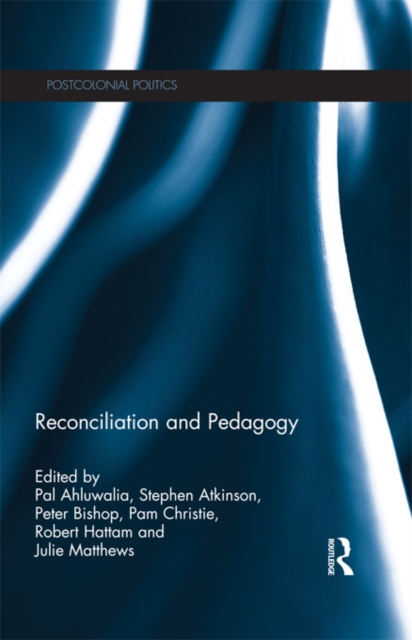
Reconciliation and Pedagogy
Reconciliation is one of the most significant contemporary challenges in the world today. In this innovative new volume, educational academics and practitioners across a range of cultural and political contexts examine the links between reconciliation and critical pedagogy, putting forward the notion that reconciliation projects should be regarded as public pedagogical interventions, with much to offer to wider theories of learning.
While ideas about reconciliation are proliferating, few scholarly accounts have focused on its pedagogies. This book seeks to develop a generative theory that properly maps reconciliation processes and works out the pedagogical dimensions of new modes of narrating and listening, and effecting social change. The contributors build conceptual bridges between the scholarship of reconciliation studies and existing education and pedagogical literature, bringing together the concepts of reconciliation and pedagogy into a dialogical encounter and evaluating how each might be of mutual benefit to the other, theoretically and practically.
This study covers a broad range of territory including ethnographic accounts of reconciliation efforts, practical implications of reconciliation matters for curricula and pedagogy in schools and universities and theoretical and philosophical considerations of reconciliation/pedagogy. It will be of great interest to students and scholars of peace and reconciliation studies, educational studies and international relations.
eBook
Unsettling deficit views of students and their communities
In this paper we explore the possibilities for redesigning pedagogy in the middle years of schooling. We think that the middle schooling movement in Australia is unfinished because the pedagogical reforms promised have been patchy, not well researched and difficult to sustain. As well, middle schooling is a little exhausted because it has failed to respond to changing demographies and youth identities. As a response we argue for school change projects linked to mainstream curriculum change. From a range of conceptual resources we discuss the potential of using a “funds of knowledge” approach and a narrative approach to youth identity work.
Journal Article

'Voiced' Research as a Sociology for Understanding 'Dropping Out' of School
How we obtain more complex understandings of the phenomenon of 'dropping out' of school is one of the most urgent policy and practice issues facing educational practitioners, policy-makers and sociological researchers at the moment, as increasingly numbers of young people fail to complete their secondary schooling. In this paper, we argue that a different 'sociological imagination' is required - one that is simultaneously more attentive to the lifeworlds of young people, that is more reflexive of its own agenda, and that is mindful of the wider politics within which 'dropping out' is being experienced. A heuristic around 'voiced research' is discussed in the context of an Australian study that explored the circumstances of 209 young people who left school prematurely. It is argued that such an approach enabled the phenomenon to be 'named' in a different way, which was more inclusive of the lives, experiences, aspirations and complexities of what was occurring at the point these young people decided to exit school.
Journal Article

Early School Leaving and the Cultural Geography of High Schools 1
Early school leaving is one of the most protracted educational problems around the world, but one of the least understood. Central to the issue itself, is the failure by the educational policy community to have ways of adequately 'naming' the problem. The study reported in this paper examines early school leaving from the position of 209 young Australians who had left school or who were at imminent risk of doing so. While acknowledging the considerable complexity of the decision making processes that lie behind this problem, this article provides a tentative theorising that traverses aspects of what we call the 'cultural geography of the high school' as a partial explanation of what is occurring. The question being pursued was how the culture of the school contributed to or interfered with early school leaving.
Journal Article
Tackling School Leaving at its Source: A case of reform in the middle years of schooling
One of the most pervasive educational issues confronting Australia, and other countries, at the moment is the declining completion rates in high schools. While a period of success was experienced after the Second World War, there is now a pressing need to reform high schools in the ways they connect with young lives. In this paper, we present a 'sociology of the high school' as a way of encapsulating the high school as an institution that: is still largely stuck in a 'continuity of practice' (Elmore, 1987); has an 'attachment to familiar pedagogical routines' (Eisner, 1992); fails to listen to students; is hierarchically structured; treats students in immature ways; is hung up with passing on content; and seems more concerned with insulating itself from, rather connecting with or appropriating, young lives into the curriculum. As an alternative, we examine the notion of middle schooling that requires a version of whole school reform that engages with structures, cultures and changing pedagogy in ways more resonant with, and respectful of, young lives. We examine the tensions and dilemmas experienced at Investigator [1] High School in Australia, and conclude that the centerpiece has to be breaking the mold of the 'scripted' teacher and its replacement by the 'teacher-as-improviser'.
Journal Article

Reconciliation and Pedagogy. Postcolonial Politics
Reconciliation is one of the most significant contemporary challenges in the world today. In this innovative new volume, educational academics and practitioners across a range of cultural and political contexts examine the links between reconciliation and critical pedagogy, putting forward the notion that reconciliation projects should be regarded as public pedagogical interventions, with much to offer to wider theories of learning. While ideas about reconciliation are proliferating, few scholarly accounts have focused on its pedagogies. This book seeks to develop a generative theory that properly maps reconciliation processes and works out the pedagogical dimensions of new modes of narrating and listening, and effecting social change. The contributors build conceptual bridges between the scholarship of reconciliation studies and existing education and pedagogical literature, bringing together the concepts of reconciliation and pedagogy into a dialogical encounter and evaluating how each might be of mutual benefit to the other, theoretically and practically. This study covers a broad range of territory including ethnographic accounts of reconciliation efforts, practical implications of reconciliation matters for curricula and pedagogy in schools and universities and theoretical and philosophical considerations of reconciliation/pedagogy. It will be of great interest to students and scholars of peace and reconciliation studies, educational studies and international relations. This book contains the following: (1) Rethinking Reconciliation and Pedagogy in Unsettling Times (Robert Hattam, Stephen Atkinson and Peter Bishop); (2) Reconciliation as a Resource for Critical Pedagogy (Robert Hattam and Julie Matthews); (3) Beyond Reconciliation: Reflections on South Africa's Truth and Reconciliation Commission and Its Implications for Ethical Pedagogy (Pam Christie); (4) Suffering, Memory and Forgiveness: Derrida, Levinas and the Pedagogical Challenges of Reconciliation in Cyprus (Michalinos Zembylas); (5) \"Walking the Talk\": East-West Reflections on the Wisdom of Remembrance, Forgiveness, Forgetting and a \"Good Enough\" Reconciliation Pedagogy (Claudia Eppert) (6) Disorderly Narratives Public Pedagogies, Popular Culture and Reconciliation (Vicki Crowley); (7) In the Market for Reconciliation? (Donna Houston, Gregory Martin and Peter McLaren); (8) The Reconciliatory Pendulum: Memory, Ceremonies and Pedagogy in the Development of Palestinian-Jewish Integrated Education in Israel (Zvi Bekerman); (9) Growing Understanding: Issues in Mainstream Education in Indigenous and Traditional Communities (Zane Ma Rhea); and (10) Reconciliation Pedagogy in South African Classrooms: from the Personal to the Political (Ana Ferreira, Hilary Janks, Ingrid Barnsley, Charles Marriott, Monique Rudman, Helen Ludlow, and Reville Nussey).
Book