
Catalogue Search | MBRL


Are you sure you want to remove the book from the shelf?

{{itemTitle}}
8
result(s) for
"Hedges, Chris, author"
Sort by:

America : the farewell tour
\"A deep and troubling examination of the dark corners of working-class America, where unemployment and the loss of traditional jobs have produced an epidemic of drug abuse, bigotry, and even suicide, coupled with an urgent plea to rearrange our priorities to address the ills of middle America and emphasize the common good\"-- Provided by publisher.
Book
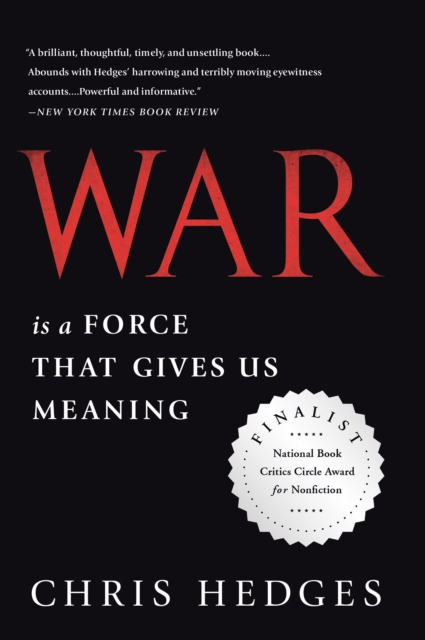
War Is a Force that Gives Us Meaning
As a veteran war correspondent, Chris Hedges has survived ambushes in Central America, imprisonment in Sudan, and a beating by Saudi military police. He has seen children murdered for sport in Gaza and petty thugs elevated into war heroes in the Balkans. Hedges, who is also a former divinity student, has seen war at its worst and knows too well that to those who pass through it, war can be exhilarating and even addictive: \"It gives us purpose, meaning, a reason for living.\" Drawing on his own experience and on the literature of combat from Homer to Michael Herr, Hedges shows how war seduces not just those on the front lines but entire societies-corrupting politics, destroying culture, and perverting basic human desires. Mixing hard-nosed realism with profound moral and philosophical insight, War Is a Force that Gives Us Meaning is a work of terrible power and redemptive clarity whose truths have never been more necessary.
eBook

War is a force that gives us meaning
A veteran \"New York Times\" war correspondent presents a thought-provoking reflection on how life is lived during times of war, and tackles the ugly truths about humanity's love affair with war, offering a sophisticated, intelligent meditation on the subject that is also gritty, powerful, and unforgettable. Hedges, a long-time foreign correspondent for The New York Times, draws on his own experiences in Latin America, Bosnia, and elsewhere; treatments of war in literature; and historical events to examine the way human beings experience war and to suggest that war gives rise to dangerous myths of the nobility of the cause. He argues that there are very few people who are not susceptible to the allure of war, but that, in the end, war becomes a contest between eros and thanatos, in which thanatos comes out on top all too often.
Book
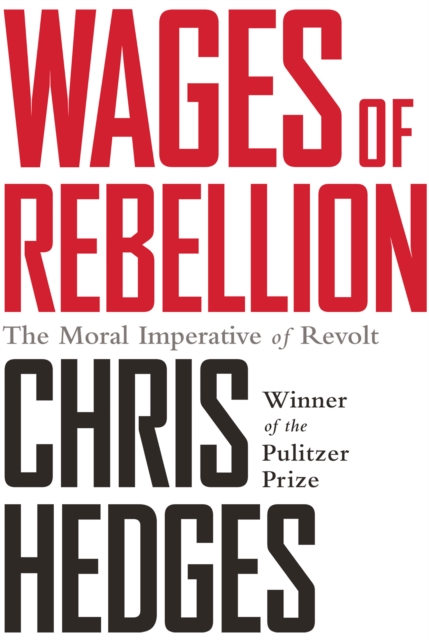
Wages of Rebellion
In the face of modern conditions, revolution is inevitable. The rampant inequality that exists between the political and corporate elites and the struggling masses; the destruction wreaked upon our environment by faceless, careless corporations; the steady stripping away of our civil liberties and the creation of a monstrous surveillance systemall of these have combined to spark a profound revolutionary moment. Corporate capitalists, dismissive of the popular will, do not see the fires they are igniting. In Wages of Rebellion, Chris Hedgesa renowned chronicler of the malaise and sickness of a society in terminal moral declineinvestigates what social and psychological factors cause revolution and resistance. Focusing on the stories of radicals and dissenters from around the world and throughout history, and drawing on an ambitious overview of prominent philosophers, historians, and novelists, Hedges explores what it takes to be a rebel in modern times. Hedges, using a term coined by the theologian Reinhold Niebuhr, cites sublime madness\" as the essential force that guides the actions of rebelsthe state of passion that causes the rebel to engage in an unwavering fight against overwhelmingly powerful and oppressive forces. From South African activists who dedicated their lives to ending apartheid, to contemporary anti-fracking protestors in Canada, to whistleblowers in pursuit of transparency, Wages of Rebellion shows the cost of a life committed to speaking truth to power and demanding justice. This is a fight that requires us to find in acts of rebellion the sparks of life, an intrinsic meaning that lies beyond the possibility of success. For Hedges, resistance is not finally defined by what we achieve, but by what we become.
eBook

America : the farewell tour
\"A deep and troubling examination of the dark corners of working-class America, where unemployment and the loss of traditional jobs have produced an epidemic of drug abuse, bigotry, and even suicide, coupled with an urgent plea to rearrange our priorities to address the ills of middle America and emphasize the common good.\"--Publisher information
Book

Collateral Damage
Collateral Damage brings together testimony from the largest number of on the record, named, combat veterans who reveal the disturbing, daily reality of war and occupation in Iraq. Through their eyes, we learn how the mechanics of war lead to the abuse and frequent killing of innocents. They describe convoys of vehicles roaring down roads, smashing into cars, and hitting Iraqi civilians. They detail raids that leave families shot dead in the mayhem. And they describe a battlefield in which troops, untrained to distinguish between combatants and civilians, are authorized to shoot whenever they feel threatened.
eBook


Doctors at War
Doctors at Waris a candid account of a trauma surgical team based, for a tour of duty, at a field hospital in Helmand, Afghanistan. Mark de Rond tells of the highs and lows of surgical life in hard-hitting detail, bringing to life a morally ambiguous world in which good people face impossible choices and in which routines designed to normalize experience have the unintended effect of highlighting war's absurdity. With stories that are at once comical and tragic, de Rond captures the surreal experience of being a doctor at war. He lifts the cover on a world rarely ever seen, let alone written about, and provides a poignant counterpoint to the archetypical, adrenaline-packed, macho tale of what it is like to go to war.
Here the crude and visceral coexist with the tender and affectionate. The author tells of well-meaning soldiers at hospital reception, there to deliver a pair of legs in the belief that these can be reattached to their comrade, now in mid-surgery; of midsummer Christmas parties and pancake breakfasts and late-night sauna sessions; of interpersonal rivalries and banter; of caring too little or too much; of tenderness and compassion fatigue; of hell and redemption; of heroism and of playing God. While many good firsthand accounts of war by frontline soldiers exist, this is one of the first books ever to bring to life the experience of the surgical teams tasked with mending what war destroys.
eBook