
Catalogue Search | MBRL


Are you sure you want to remove the book from the shelf?

{{itemTitle}}
45
result(s) for
"Hellwig, Birgit"
Sort by:
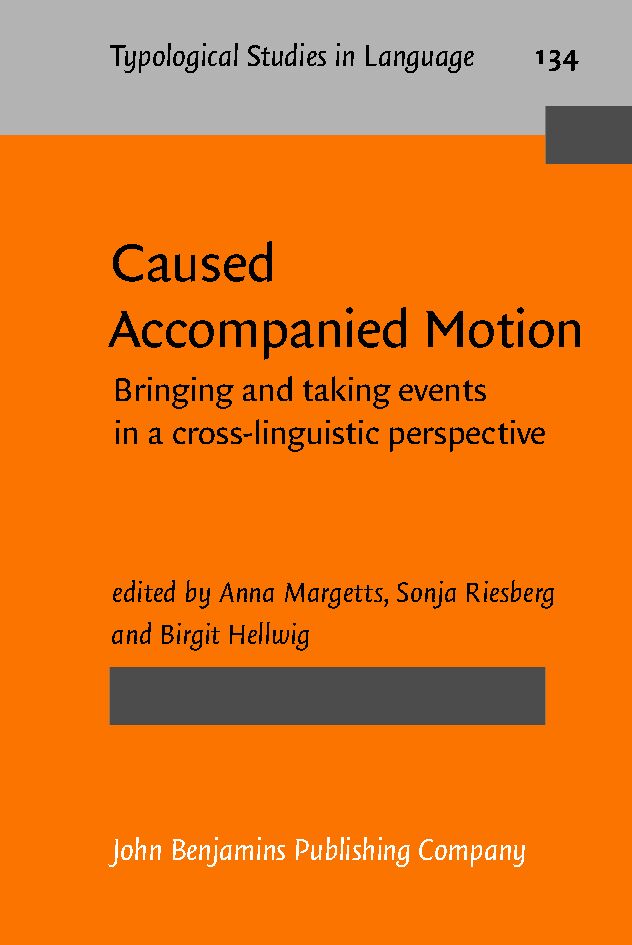
Caused accompanied motion : bringing and taking events in a cross-linguistic perspective
This volume investigates the linguistic expression of directed caused accompanied motion events, including verbal concepts like BRING and TAKE. Contributions explore how speakers conceptualise and describe these events across areally, genetically, and typologically diverse languages of the Americas, Austronesia and Papua. The chapters investigate such events on the basis of spoken language corpora of endangered, underdescribed languages and in this way the volume showcases the importance of documentary linguistics for linguistic typology. The semantic domain of directed caused accompanied motion shows considerable crosslinguistic variation in how meaning components are conflated within single lexemes or distributed across morphemes or clauses. The volume presents a typology of common patterns and constraints in the linguistic expression of these events. The study of crosslinguistic event encoding provided in this volume contributes to our understanding of the nature, extent and limits of linguistic and cognitive diversity.
eBook

Roots of Ergativity in Africa (and Beyond)
In the literature, it is often assumed that ergative constructions originate in passive constructions. The present contribution explores the likelihood of such a passive-to-ergative analysis for one language (Tima, Niger-Congo, Sudan), showing that this analysis cannot be substantiated and suggesting an origin in active constructions instead. This study is situated in its areal context (outlining similarities to split case marking systems across the region, especially in the Southern branch of Eastern Sudanic) and against the background of discussions in the Indo-Iranian family (from where the passive-to-ergative hypothesis presumably spread).
Journal Article
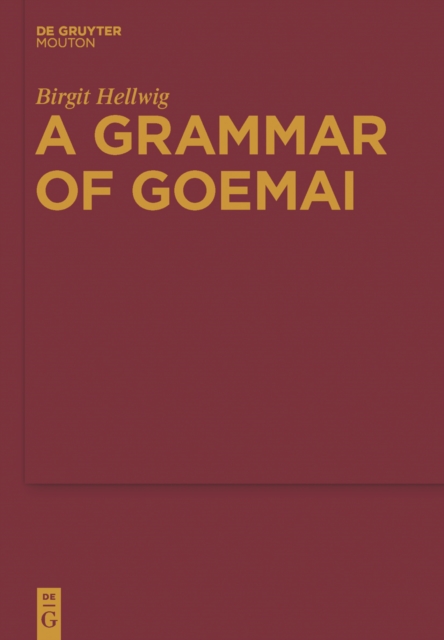
A Grammar of Goemai
This is the first description of Goemai, a West Chadic language of Nigeria. Goemai is spoken in a language contact area, and this contact has shaped Goemai grammar to the extent that it can be considered a fairly untypical Chadic language. The grammar presents the structure of the present-day language, relates it to its diachronic sources, and adds a semantic perspective to the description.
eBook

Qaqet
Qaqet (Glottocode qaqe1238; ISO 639-3: byx) is a Papuan (i.e. non-Austronesian) Baining language that is spoken by an estimated 15,000 people in Papua New Guinea’s East New Britain Province. Figure 1 shows a map of where Qaqet and the four other known Baining languages (Mali, Kairak (also spelt Qairaq – see map), Simbali and Ura) are spoken (see Stebbins, Evans & Terrill 2017 for an overview of Baining; for phonological descriptions, see Stanton 2007 on Ura, and Stebbins 2011 on Mali). The wider affiliations of the Baining languages are unknown. They share typological features with other East Papuan languages (i.e. the non-Austronesian languages of Island Melanesia), but there is no historical-comparative evidence to establish genealogical relationships.1 In terms of phonology, there are no structures shared across all of East Papuan, but Baining languages have similarities to the East Papuan language Kuot spoken on neighbouring New Ireland (i.e. the intervocalic lenition of voiceless plosives; pitch movements at the right edge of intonation units).2 Furthermore, language contact is known to have taken place across the entire region, and Baining languages share typological features with Oceanic languages. This includes phonemic contrasts between voiceless and voiced plosives and between /r/ and /l/; as well as a number of morphosyntactic structures (e.g. a large inventory of definite and indefinite articles, AVO/SV constituent order, prepositions).
Journal Article

The Scientific and Cultural Cost of Convenience Sampling in the Face of Rising Language Endangerment: Highlighting the Role of Language Acquisition
We live in an unprecedented era of language endangerment and loss. In the midst of this crisis, it is becoming more and more evident that the psychological and cognitive sciences know very little about how most of the world’s languages are acquired, represented, and processed. Therefore, the opportunity to understand our most important and defining species-specific trait is being rapidly lost. In this Perspective, we highlight the extent of this problem, focusing on a key group at the heart of language transmission and loss—child language learners. We show that, due to sampling biases, very little is known about how children learn much of the vast corners of the linguistic design space, and that our opportunity to do so this is fast running out. We end by arguing for the greater integration of the academy, government, and community in addressing this problem.
Journal Article
Goemai
Goemai is an Afroasiatic (Chadic, West Chadic A, Angas-Goemai group) language spoken in Central Nigeria. The name Goemai [ɡ
m
i] is used by the speakers themselves to refer to both their language and their ethnic group. To outsiders, they are better known under the name Ankwe – a name that is also commonly found in the older linguistic, anthropological and historical literature. The Goemai live as farmers, fishermen and hunters in villages throughout the lowland savannah region south of the Jos Plateau and north of the Benue River, an area that is known geographically as the Great Muri Plains. The economy is based on agriculture (yam, millet, guineacorn, groundnut, beniseed) and is supplemented with fishing and hunting. Politically, the area belongs to Plateau State, and more specifically to the Local Government Areas Shendam and Qua’an Pan. Smaller Goemai-speaking communities are found in surrounding Local Government Areas as well as in Jos, the capital of Plateau State.
Journal Article
Roots of Ergativity in Africa (and Beyond)
In the literature, it is often assumed that ergative constructions originate in passive constructions. The present contribution explores the likelihood of such a passive-to-ergative analysis for one language (Tima, Niger-Congo, Sudan), showing that this analysis cannot be substantiated and suggesting an origin in active constructions instead. This study is situated in its areal context (outlining similarities to split case marking systems across the region, especially in the Southern branch of Eastern Sudanic) and against the background of discussions in the Indo-Iranian family (from where the passive-to-ergative hypothesis presumably spread).
Journal Article