
Catalogue Search | MBRL


Are you sure you want to remove the book from the shelf?

{{itemTitle}}
402
result(s) for
"Hemingway, Ernest"
Sort by:


LETTER TO HAROLD LOEB
A letter written by Ernest Hemingway for Harold Loeb is presented. In the letter, the poet tells his friend about what has been going on his life.
Journal Article

Devour
Space Oddity (Youtube.com/ChrisHadfieId) International Space Station commander Chris Hadfield became a media sensation with his popular Twitter account.
Journal Article
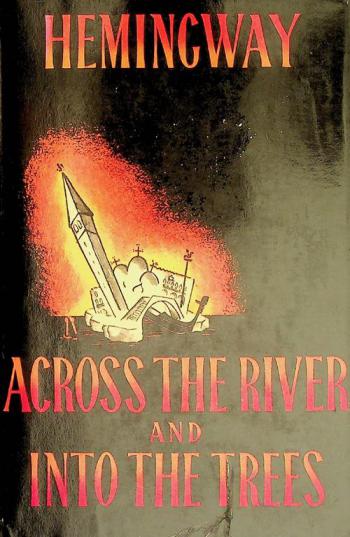
Across the river and into the trees
A post war story of an American colonel, whose fifty-years and heart condition weigh heavily upon him as he spends a week-end in Venice.

Along with Youth
Drawing on a wealth of previously unpublished material--including numerous letters and five early stories that appear in their entirety--this compelling biography traces the formative years of one of America's most celebrated and influential authors. The first of a projected three-volume life, it examines Hemingway's midwestern childhood, his journalistic apprenticeship, and his experiences as a Red Cross volunteer in Italy during World War I, closing with Hemingway on the brink of the literary career that would bring him worldwide fame.
eBook

The Cinematic Artist and the Literary Lion
Technological advances, coupled with greater affluence, enabled the motion picture industry to emerge in the United States. Drawing on photographic representations, scientific acumen, and the commercial genius of individuals like Thomas Alva Edison, American cinema began to flourish. As American cinema flourished in the early twentieth century, its pace, style, and tenor increasingly influenced other popular cultural venues, including literature. American cinema remained in its infancy, largely unformed and lacking artistry. As a young writer who had experienced the horrors of World War I, Ernest Hemingway honed his own literary skill, aspiring to a clean, minimalist, cinematic-like approach, but one that included complex psychological analyses befitting an age when psychoanalysis was increasingly in vogue. In 1930 D. W. Griffith sought to produce another epic, Abraham Lincoln, a talkie starring Walter Huston. Drawing on Porter's techniques, Griffith began to refine American cinema, assisted by cameraman G. W. Bitzer. The reviews by critics proved mixed, at best, and audiences also responded tepidly.
Book Chapter