
Catalogue Search | MBRL


Are you sure you want to remove the book from the shelf?

{{itemTitle}}
53
result(s) for
"Herring, Susan C"
Sort by:


Pragmatics of Computer-Mediated Communication
The present handbook provides an overview of the pragmatics of language and language use mediated by digital technologies. Computer-mediated communication (CMC) is defined to include text-based interactive communication via the Internet, websites and other multimodal formats, and mobile communication. In addition to 'core' pragmatic and discourse-pragmatic phenomena the chapters cover pragmatically-focused research on types of CMC and pragmatic approaches to characteristic CMC phenomena.
eBook

Where and How to Look for Help Matters: Analysis of Support Exchange in Online Health Communities for People Living with HIV
Research is scarce on how direct and indirect support seeking strategies affect support exchange in online health communities. Moreover, prior research has relied mostly on content analysis of forum posts at the post level. In order to generate a more fine-grained analysis of support exchange, we conducted content analysis at the utterance level, taking directness of support seeking, quality of provision, forum type, and seeker gender into account. Our analysis of four popular online support forums for people living with human immunodeficiency virus found that type of support sought and provided, support seeking strategy, and quality of emotional support provision differed in care provider/formal forums versus social/informal forums. Interestingly, indirect support seeking tended to elicit more supportive emotional responses than direct support seeking strategies in all forums; we account for this in terms of type of support sought. Practical implications for online support communities are discussed.
Journal Article

Conversational Fluency and Attitudes Towards Robot Pilots in Telepresence Robot-Mediated Interactions
In a controlled lab experiment, we compared how in-person and robot-mediated communicative settings affected attitudes towards communicators and discourse phenomena related to conversational negotiation. We used a mock interview within-participants experiment design where each participant (mock interviewee) experienced both types of communication with the same experimenter (mock interviewer). Despite communicating with the same person, participants found the in-person interviewer to be more likable, more capable, more intelligent, more polite, more in control, and less awkward than the same person using a telepresence robot. Behaviorally, we did not detect differences in participants’ productions of discourse phenomena (
like
s,
you know
s,
um
s,
uh
s), laughter, or gaze. We also tested the role of communicative expectations on attitudes towards communications. We primed participants to expect that they would be talking to a person via telepresence, a “disabled” robot-person combination using telepresence, or a person in person (between-participants). We did not find differences arising from people’s expectations of the communication.
Journal Article

Weblogs as a bridging genre
Purpose - Aims to describe systematically the characteristics of weblogs (blogs) - frequently modified web pages in which dated entries are listed in reverse chronological sequence and which are the latest genre of internet communication to attain widespread popularity.Design methodology approach - This paper presents the results of a quantitative content analysis of 203 randomly selected blogs, comparing the empirically observable features of the corpus with popular claims about the nature of blogs, and finding them to differ in a number of respects.Findings - Notably, blog authors, journalists and scholars alike exaggerate the extent to which blogs are interlinked, interactive, and oriented towards external events, and underestimate the importance of blogs as individualistic, intimate forms of self-expression.Originality value - Based on the profile generated by the empirical analysis, considers the likely antecedents of the blog genre, situates it with respect to the dominant forms of digital communication on the internet today, and suggests possible developments of the use of blogs over time in response to changes in user behavior, technology, and the broader ecology of internet genres.
Journal Article

Historical insights for ebook design
Purpose
The purpose of this paper is to provide ebook designers and researchers with design insights by promoting historical knowledge about books and reading as sources of ideas to implement in current and future ebooks.
Design/methodology/approach
The authors review historical features of books and practices of reading that have been implemented, weakened, or lost over time, referring to historical texts and resources, and relate them to ebook viewers (software) and readers (hardware) that are currently on the market. In particular, the review focuses on the physical form of the book and the practices of reading, annotation, and bookshelving.
Findings
While some older forms and reading practices have been implemented in ebook devices, others have been forgotten over time, due in part to physical constraints that are no longer relevant. The authors suggest that features that constrained print books and print reading in the past might actually improve the design of ebooks and e-reading in the present.
Research limitations/implications
This review is necessarily based on a limited set of existing historical sources.
Practical implications
Translating insights into novel tangible designs is always a challenging task. Ebook designers can gain insights from this paper that can be applied in a variety of design contexts.
Originality/value
No previous work on ebook design has foregrounded historical aspects of books and reading as viable sources of ideas to implement in ebooks.
Journal Article
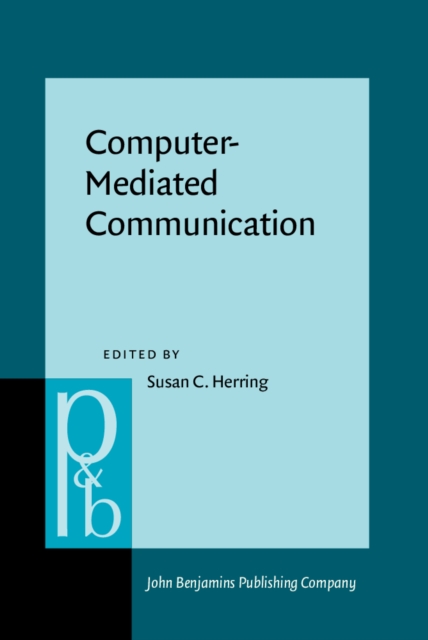
Computer-mediated communication : linguistic, social and cross-cultural perspectives
Text-based interaction among humans connected via computer networks, such as takes place via email and in synchronous modes such as \"chat\", MUDs and MOOs, has attracted considerable popular and scholarly attention. This collection of 14 articles on text-based computer-mediated communication (CMC), is the first to bring empirical evidence from a variety of disciplinary perspectives to bear on questions raised by the new medium.The first section, linguistic perspectives, addresses the question of how CMC compares with speaking and writing, and describes its unique structural characteristics. Section two, on social and ethical perspectives, explores conflicts between the interests of groups and those of individual users, including issues of online sex and sexism. In the third section, cross-cultural perspectives, the advantages and risks of using CMC to communicate across cultures are examined in three studies involving users in East Asia, Mexico, and students of ethnically diverse backgrounds in remedial writing classes in the United States. The final section deals with the effects of CMC on group interaction: in a women's studies mailing list, a hierarchically-organized workplace, and a public protest on the Internet against corporate interests.
eBook
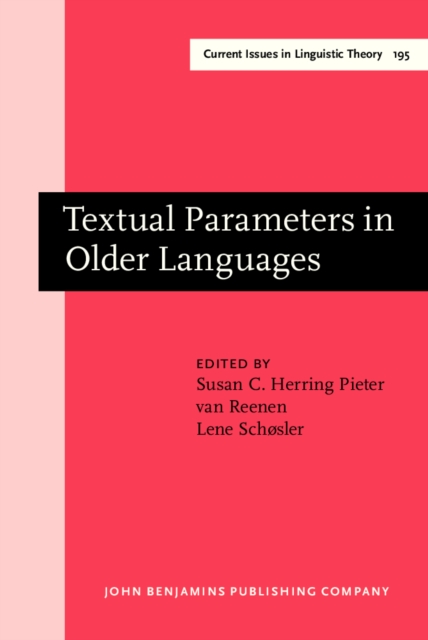
Textual Parameters in Older Languages
Textual Parameters in Older Languages takes a contemporary approach to the inherent limitations of using older texts as data for linguistic analysis, drawing on methods of text analysis, pragmatics and sociolinguistics to supplement traditional historical and philological methods. The focus of the book is on the importance of controlling for textual parameters-defined by the editors as dimensions of variation associated with texts and their production, including text type, degree of poeticality, orality, and dialect-in the analysis of older language data. Failure to do so can result in invalid generalizations; recognizing the influence of textual parameters, conversely, raises a myriad of issues for the practice and theory of historical linguistics.The 12 essays in this collection apply this approach in analyses of anaphora, non-finite verbal forms, particles, punctuation, word order and other phenomena in a wide range of languages including Ancient Tamil, Sanskrit, Latin, Heian Japanese, Medieval Greek, Old French, Old Russian, Middle English, and Modern Danish. An in-depth introduction by the editors lays out the goals of the textual parameters approach, and considers the methodological and theoretical consequences of the evidence presented in the book as a whole.
eBook
Blogging, Citizenship, and the Future of Media
This collection of original essays addresses a number of questions seeking to increase our understanding of the role of blogs in the contemporary media landscape. It takes a provocative look at how blogs are reshaping culture, media, and politics while offering multiple theoretical perspectives and methodological approaches to the study.
Americans are increasingly turning to blogs for news, information, and entertainment. But what is the content of blogs? Who writes them? What is the consequence of the population's growing dependence on blogs for political information? What are the effects of blogging? Do readers trust blogs as credible sources of information?
The volume includes quantitative and qualitative studies of the blogosphere, its contents, its authors, and its networked connections. The readers of blogs are another focus of the collection: how are blog readers different from the rest of the population? What consequences do blogs have for the lives of everyday people? Finally, the book explores the ramifications of the blog phenomenon on the future of traditional media: television, newspapers, and radio.
eBook
