
Catalogue Search | MBRL


Are you sure you want to remove the book from the shelf?

{{itemTitle}}
916
result(s) for
"Hess, Stephen"
Sort by:


Eliapixant is a selective P2X3 receptor antagonist for the treatment of disorders associated with hypersensitive nerve fibers
ATP-dependent P2X3 receptors play a crucial role in the sensitization of nerve fibers and pathological pain pathways. They are also involved in pathways triggering cough and may contribute to the pathophysiology of endometriosis and overactive bladder. However, despite the strong therapeutic rationale for targeting P2X3 receptors, preliminary antagonists have been hampered by off-target effects, including severe taste disturbances associated with blocking the P2X2/3 receptor heterotrimer. Here we present a P2X3 receptor antagonist, eliapixant (BAY 1817080), which is both highly potent and selective for P2X3 over other P2X subtypes in vitro, including P2X2/3. We show that eliapixant reduces inflammatory pain in relevant animal models. We also provide the first in vivo experimental evidence that P2X3 antagonism reduces neurogenic inflammation, a phenomenon hypothesised to contribute to several diseases, including endometriosis. To test whether eliapixant could help treat endometriosis, we confirmed P2X3 expression on nerve fibers innervating human endometriotic lesions. We then demonstrate that eliapixant reduces vaginal hyperalgesia in an animal model of endometriosis-associated dyspareunia, even beyond treatment cessation. Our findings indicate that P2X3 antagonism could alleviate pain, including non-menstrual pelvic pain, and modify the underlying disease pathophysiology in women with endometriosis. Eliapixant is currently under clinical development for the treatment of disorders associated with hypersensitive nerve fibers.
Journal Article

The Professor and the President
What happens when a conservative president makes a liberal professor from the Ivy League his top urban affairs adviser? The president is Richard Nixon, the professor is Harvard's Daniel Patrick Moynihan. Of all the odd couples in American public life, they are probably the oddest. Add another Ivy League professor to the White House staff when Nixon appoints Columbia's Arthur Burns, a conservative economist, as domestic policy adviser. The year is 1969, and what follows behind closed doors is a passionate debate of conflicting ideologies and personalities.
Who won? How? Why? Now nearly a half-century later, Stephen Hess, who was Nixon's biographer and Moynihan's deputy, recounts this fascinating story as if from his office in the West Wing.
Daniel Patrick Moynihan (1927-2003) described in the Almanac of American Politics as \"the nation's best thinker among politicians since Lincoln and its best politician among thinkers since Jefferson\", served in the administrations of four presidents, was ambassador to India, and U.S. representative to the United Nations, and was four times elected to the U.S. Senate from New York.
Praise for the works of Stephen Hess
Organzing the Presidency
Any president would benefit from reading Mr. Hess's analysis and any reader will enjoy the elegance with which it is written and the author's wide knowledge and good sense. -The Economist
The Presidential Campaign
Hess brings not only first-rate credentials, but a cool, dispassionate perspective, an incisive analytical approach, and a willingness to stick his neck out in making judgments. -American Political Science Review
From the Newswork Series
It is not much in vogue to speak of things like the public trust, but thankfully Stephen Hess is old fashioned. He reminds us in this valuable and provocative book that journalism is a public trust, providing the basic information on which citizens in a democracy vote, or tune out. - Ken Auletta, The New Yorker
eBook

Through Their Eyes: Foreign Correspondents in the United States
Americans often forget that, just as they watch the world through U.S. media, they are also being watched. Foreign correspondents based in the United States report news and provide context to events that are often unfamiliar or confusing to their readers back home. Unfortunately, there has been too little thoughtful examination of the foreign press in America and its role in the world media. Through Their Eyes fills this void in the unmistakable voice of Stephen Hess, who has been reporting on reporting for over a quarter century. Globalization is shrinking the planet, making it more important than ever to know what is going on in the world and how those events are being interpreted elsewhere. September 11 was a chilling reminder that how others perceive us does matter, like it or not. Hess seeks to answer three basic yet essential journalistic questions: Who are these U.S.-based foreign correspondents? How do they operate? And perhaps most important, what do they report, and how? Informed by scores of interviews and armed with original survey research, Hess reveals the mindset of foreign correspondents from a broad sample of countries. He examines how reporting from abroad has changed over the past twenty years and addresses the daunting challenges facing these journalists, ranging from home-office politics to national stereotypes. Unique among works on the subject, this book provides an engaging and humanizing \"Day in the Life…\" section, illustrating how foreign correspondents conduct their daily activities. This book continues the author's comprehensive Newswork series on the nexus of media, government, and politics. These five books, starting with The Washington Reporters (Brookings, 1981), have become valuable reference materials for all who seek to understand this intersection of journalism and government. Through Their Eyes furthers that rich tradition, making it essential and enjoyable reading.
eBook

Whatever Happened to the Washington Reporters, 1978-2012
Whatever Happened to the Washington Reporters, 1978-2012, is the first book to comprehensively examine career patterns in American journalism.
In 1978 Brookings Senior Fellow Stephen Hess surveyed 450 journalists who were covering national government for U.S. commercial news organizations. His study became the award-winning The Washington Reporters (Brookings, 1981), the first volume in his Newswork series. Now, a generation later, Hess and his team from Brookings and the George Washington University have tracked down 90 percent of the original group, interviewing 283, some as far afield as France, England, Italy, and Australia.
What happened to the reporters within their organizations? Did they change jobs? Move from reporter to editor or producer? Jump from one type of medium to another -from print to TV? Did they remain in Washington or go somewhere else? Which ones left journalism? Why? Where did they go?
A few of them have become quite famous, including television correspondents Ted Koppel, Sam Donaldson, Brit Hume, Carole Simpson, Judy Woodruff, and Marvin Kalb; some have become editors or publishers of theNew York Times,Wall Street Journal,Chicago Tribune,Miami Herald, orBaltimore Sun; some have had substantial careers outside of journalism. Most, however, did not become household names.
The book is designed as a series of self-contained essays, each concentrating on one characteristic, such as age, gender, or place of employment, including newspapers, television networks, wire services, and niche publications. The reporters speak for themselves. When all of these lively portraits are analyzed -one by one -the results are surprisingly different from what journalists and sociologists in 1978 had predicted.
Praise for other books in the Newswork series:
International News and Foreign Correspondents
\"It is not much in vogue to speak of things like the public trust, but thankfully Stephen Hess is old fashioned. He reminds us in this valuable and provocative book that journalism is a public trust, providing the basic information on which citizens in a democracy vote, or tune out.\" -Ken Auletta,The New Yorker
\"Regardless of one's view of American news media, one cannot help but be influenced by the information Stephen Hess puts forth inInternational News and Foreign Correspondents. After reading this book, it is not likely one will scan the newspaper or watch television news in the same way again.\" -International Affairs Review
\"Readers of all backgrounds will find this a provocative text.\" -The Harvard International Journal of Press/Politics
Live from Capitol Hill
\"Hess is a treasure -a Washington insider with a sharp sense of the important, the interesting, and the mythological. This book is essential reading for Hill practitioners, journalists, and scholars of Congress and the media.\" -Steven S. Smith, Washington University
The Washington Reporters\"A meticulously researched piece of anthropology that represents the first major look at the men and women who cover the government since Leo C. Rosten's classic 1937 book.\" -Newsweek
eBook

The Media and the War on Terrorism
These candid conversations capture the difficulties of reporting during crisis and war, particularly the tension between government and the press. The participants include distinguished journalists -American and foreign, print and broadcast -and prominent public officials, past and present. They illuminate the struggle to balance free speech and the right to know with the need to protect sensitive information in the national interest. As the Information Age collides with the War on Terrorism, that challenge becomes even more critical and daunting. \"We are very careful in what we talk about publicly. We do not want to paint a picture for the bad guys. So we don't talk very much at all about what we're going to do going forward.\" -Victoria Clarke, Department of Defense \"This was a war that was very different. It was conducted primarily by about 200 to 250 special forces soldiers on the ground. There were no reporters with those soldiers until after the fall of Kandahar, until the war was essentially over. There were no eyes and ears, and that's the way the Pentagon wants it.\" -John McWethy, ABC News \"I covered Capitol Hill for a very long time and was always astounded by the nonpolitical motivation of a lot of people that are up there who really do want to make the world better, want to make the U.S. better. So don't come away believing that because there are political implications that there are always political motivations.\" -Candy Crowley, CNN \"There is a feeling among the community, Muslim Americans, and also overseas that we might become the new enemy. But so far nobody knows whether it is just because of the war or if it's going to last.\" -Hafez Al-Mirazi, Al-Jazeera
Cosponsored with the Shorenstein Center on the Press, Politics and Public Policy at the Kennedy School, Harvard University.
eBook

What Do We Do Now?: A Workbook for the President-Elect
A workbook to guide future chief executives, decision by decision, through the minefield of transition. Based on experiences of a White House staffer and presidential adviser, shows what can be done to make presidential transitions go smoothly
eBook
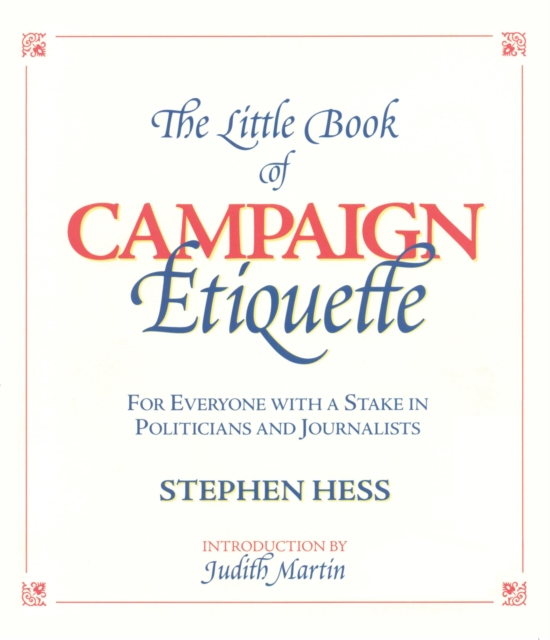
The Little Book of Campaign Etiquette
Revised and updated just in time for the 2000 campaign, this
shrewd and amusing series of observations provides a political
etiquette for campaign behavior on the part of both politicians and
journalists. Features illustrations by America's foremost political
cartoonists, including Herblock, Paul Conrad, Jeff McNally, Don
Wright, Garry Trudeau, Jim Borgman, Mike Peters, Tom Toles, Mike
Luckovich, Steve Benson, and Walt Handelsman. \"Stephen Hess has
stepped into the breach with answers to questions that ought to be
more frequently asked...This breezy book is likely to be of
interest to anyone who follows - or worries about - the state of
the nation's political discourse.\" - USA Today
eBook

The Importance of Being Profiled: Improving Drug Candidate Safety and Efficacy Using Ion Channel Profiling
Profiling of putative lead compounds against a representative panel of relevant enzymes, receptors, ion channels, and transporters is a pragmatic approach to establish a preliminary view of potential issues that might later hamper development. An early idea of which off-target activities must be minimized can save valuable time and money during the preclinical lead optimization phase if pivotal questions are asked beyond the usual profiling at hERG. The best data for critical evaluation of activity at ion channels is obtained using functional assays, since binding assays cannot detect all interactions and do not provide information on whether the interaction is that of an agonist, antagonist, or allosteric modulator. For ion channels present in human cardiac muscle, depending on the required throughput, manual-, or automated-patch-clamp methodologies can be easily used to evaluate compounds individually to accurately reveal any potential liabilities. The issue of expanding screening capacity against a cardiac panel has recently been addressed by developing a series of robust, high-throughput, cell-based counter-screening assays employing fluorescence-based readouts. Similar assay development approaches can be used to configure panels of efficacy assays that can be used to assess selectivity within a family of related ion channels, such as Nav1.X channels. This overview discusses the benefits of in vitro assays, specific decision points where profiling can be of immediate benefit, and highlights the development and validation of patch-clamp and fluorescence-based profiling assays for ion channels (for examples of fluorescence-based assays, see Bhave et al., 2010; and for high-throughput patch-clamp assays see Mathes, 2006; Schrøder et al., 2008).
Journal Article

Organizing the Presidency
When Franklin D. Roosevelt was inaugurated in March 1933, the White House staff numbered fewer than fifty people. In the ensuing years, as the United States became a world power and both the foreign and domestic duties of the president grew more complex, the White House staff has increased twentyfold. This books asks how best to manage a presidency that itself has become a bureaucracy. In the third edition of Organizing the Presidency, Stephen Hess, with the assistance of James P. Pfiffner, surveys presidential organizations from Roosevelt¡¯s to George W. Bush¡¯s, examining the changing responsibilities of the executive branch jobs and their relationships with one another, Capitol Hill, and the permanent government. He also describes the kinds of people who have filled these positions and the intentions of the presidents who appointed them.
eBook