
Catalogue Search | MBRL


Are you sure you want to remove the book from the shelf?

{{itemTitle}}
6
result(s) for
"Hill, Steven, 1958-"
Sort by:


Fixing Elections
Fixing Elections shows our whole 18th-century Winner Take All political system, including the way we elect our legislatures. Steven Hill argues our geographic-based, Winner Take All political system is at the root of many of our worst political problems, including poor minority and majority representation, low voter turnout, expensive mudslinging campaigns, congressional gridlock, regional balkanization, and the growing divide between city-dwellers and middle-America.
eBook
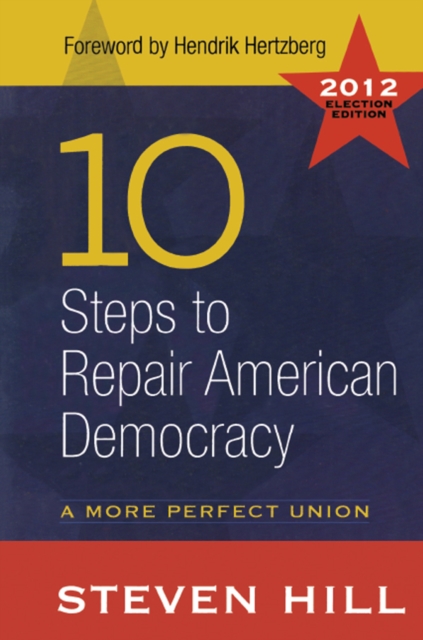
10 Steps to Repair American Democracy
In 10 Steps to Repair American Democracy Steven Hill addresses the problems plaguing the US political system, outlining his ten-step program to improve American democracy. He proposes specific reforms to give voters more choices at the ballot box, boost voter turnout, reduce Senate 'filibustering' and end excessive corporate dominance. In the face of mounting cynicism about the US political system, 10 Steps to Repair American Democracy is a refreshing blueprint for how to resurrect the Founders' democratic vision. It will change the way you think about US politics.
“We are fortunate to have Steven Hill’s latest book, Ten Steps to Repair American Democracy, to help us find our political compass. He identifies ten critical problems with our democracy and offers concrete solutions to each one. Ten Steps is a blueprint for a reinvigoration of our republic.”
—from the foreword by Hendrik Hertzberg, Senior Editor, The New Yorker
“We know that American democracy is being run over a cliff—choiceless elections, screwy voting machines, brain-dead political debate, unresponsive government, etc. What’s a citizen to do? Here, finally, is the plan.”
—Jim Hightower, columnist and author of Let’s Stop Beating Around the Bush
“Steven Hill’s new book is as practical as it is insightful, offering innovative ways to fix our broken political system. It’s an inspiring blueprint for reclaiming America. Read it, roll up your sleeves, and get to work.”
—Arianna Huffington, columnist and bestselling author of Pigs at the Trough
“In his timely new book, Steven Hill persuasively argues that much of what ails American politics is rooted in our antiquated methods and practices, from voting equipment to the way we elect the president … Anyone concerned about the state of our democratic system should read this book.”
—Trevor Potter, former chairman of the Federal Election Commission
“With this essential book, Steven Hill proposes a treatment plan for our ailing democracy that is as wide-ranging as it is necessary. This is the practical program for reform that we have been lacking. Read it. Embrace it. Make it the platform of your organizations and your parties.”
—John Nichols, Washington correspondent for The Nation
“10 Steps to Repair American Democracy is a terrific book, a much-needed owner’s manual for the citizen-owners of government in the United States.”
—Michael Lind, author of The Next American Nation
“Drawing on 20 years of advocacy and scholarship, Steven Hill outlines an information age overhaul for America’s agrarian-age electoral machinery. His ten innovative reforms, ranging from the nuts and bolts of how we count ballots to a whole new electoral system, add up to a compelling blueprint for a more perfect union in the 21st century.”
—Ted Halstead, president and CEO of the New America Foundation
“Ten Steps is a blueprint for a reinvigoration of our republic. Hill shows that there actually is a way we can keep faith with our Founding Fathers. The question isn’t: What, way back when, did Jefferson (and Madison and Hamilton) do? The question is: What would they do now? The answers begin here.”
— from the foreword by Hendrik Hertzberg, Senior Editor, The New Yorker
Foreword by Hendrik Hertzberg Introduction Double Trouble: The Political Collapse That Preceded the Economic Collapse One Secure the Vote Two Expand Voter Participation Three Increase Voter Choice with Instant Runoff Voting Four Scrap Winner-Take-All Elections Five Direct Election of the President Six Overhaul the US Senate Seven Reclaim the Airwaves Eight Minimize Money's Role Nine Reform the Supreme Court Ten Restore Faith in Government: \"Government Is Good for You\" Conclusion Renewing the American Republic Notes Acknowedgments Index About the Author
eBook


Becoming Grace
Becoming Grace surpasses the scope and purpose of most institutional histories, writes Brethren historian, Jeff Bach. He notes in the foreword that Burkholder, Norris, and their contributors offer a clear and balanced account of Grace College and Theological Seminary from its origins in Akron, Ohio, through its expansion at Winona Lake, Ind., and the difficulties of a later denominational division.The story is carefully set in the context of conflicts between professors and their advocates, the deeper Brethren framework behind those events, and the continued religious developments among the Grace Brethren. Add in broader cultural changes and developments within conservative Christianity in the U.S. in the early 20th century and readers will find the college and seminary illuminated against the backdrop of the larger landscape of Christian higher education in America.
eBook