
Catalogue Search | MBRL


Are you sure you want to remove the book from the shelf?

{{itemTitle}}
311
result(s) for
"Hillenbrand, Robert"
Sort by:
Eric Schroeder: maverick polymath
Eric Schroeder was an outstanding art historian who made a particularly significant contribution to the study of medieval Persian architecture and book painting in the 1930s and 1940s, a time when these subjects were finding their feet in academe. He therefore played a significant role in the early historiography of the discipline of Islamic art history - for he did not confine his interests to Iran. His charismatic personality made a deep impression on his contemporaries, which included some of the great and the good of the literary world. His reputation depends largely on his writings; he never made his mark on a more than local stage either as a teacher or as a museum curator. Thus it is indeed a pity that his two major books were published in such limited editions1 that they failed to have the impact that they deserved; and this was all the more unfortunate since his output was characterised by quality rather than quantity. He operated on the periphery of the academic world, for he did not have a university post, nor did he seek fame, and he virtually never taught undergraduates, let alone doctoral students.2 So he became something of a recluse, surrounded by an aura of mystery. Accordingly he has never received due recognition for his achievements as a historian of Persian art. The present article is a modest attempt to rectify this situation. Its point of departure is not to resuscitate a forgotten but now largely irrelevant figure, but on the contrary to celebrate Schroeder's work as prophetic in certain respects and, above all, as attaining a star quality that is timeless. Three of his supreme achievements should be required reading for any serious student of Islamic art, and the earlier a student reads them the better. They are his analyses of: the Fogg's early Timurid image of Tahmina entering Rustam's chamber; the north dome of the Isfahan Friday Mosque; and the Ilkhanid stucco mihrab in that mosque. Each of these is an absolute masterpiece of art-historical analysis and profound insight. Each is unsurpassed by later scholarship. And it is worth underscoring that the first concerns a book painting, the second an architectural monument and the third a decorative design. In other words, the analyses of these works do not overlap. Thus they illustrate Schroeder's status as one of the very rare Renaissance men in Islamic art history.
Journal Article


Islamic Architecture
Winner of the American Publishers Association's Award for an outstanding Professional and Scholarly title and the Alice Davis Hitchcock Medallion 1996 from the Society of Architectural Historians of Great Britain.In a dazzling display of erudition, Robert Hillenbrand surveys the major building-types of the Islamic World: religious architecture (the mosque, the minaret, the madrasa), the mausoleum 'between Heaven and Earth', and the caravansarai and the palace representing the secular side.All the building-types are discussed in art-historical terms, with the interplay of form and function taken as the underlying theme of the analysis. All are comprehensively illustrated with a full range of colour and black-and-white photographs, analytical drawings, thumbnail comparative assemblies and ground plans.This major reference work, covering from Spain to Afghanistan and c. 700 to c. 1700, is a source of fascination for all seeking to appreciate the rich heritage of the Islamic World. Recurrent themes and patterns take on a wider significance - a persistent reminder that the Islamic faith and the particular type of society which it engendered makes light of vast gulfs of time and space.Features:*24 colour plates*300 black-and-white photographs*1246 line drawings*Section of composite drawings and ground plansAvailable in Hardback (originally published in 1994) and a revised paperback edition published in 2000.This new paperback edition includes a previously unpublished index, designed to make the book more user-friendly.
eBook

Notes on the Aesthetics of Medieval Islamic Art—and of Medieval Persian Painting
The article sets the discussion of Islamic art within the very animated discussions of the last few decades by many prominent scholars that have sought to pinpoint its nature and that have highlighted the twin dangers of over-generalisation and too narrow a focus. Given that the parameters of the discussion have undergone radical change, and the need to revise traditional paradigms, the article confines itself to Islamic art in the medieval period and the central Islamic lands, especially through the prism of nature. Problems of definition and of the usefulness of medieval texts, and the roles of abstraction and contemplation, are reviewed in turn and the article ends with an attempt to define more closely the aesthetics of a single branch of Islamic art, namely medieval Persian book painting.
Journal Article

Oleg Grabar: the scholarly legacy
After surveying the various necrologies and events celebrating the life and achievements of Oleg Grabar, the article reflects in a general sense on why his death has unleashed such a flood of memories, using Grabar’s own assessment of his work as a tool. The paper then underlines his extraordinary range and attempts to identify his special skills: his intellectual curiosity that drove him to pose questions rather than dictate answers; his openness to new theoretical and technological ideas and techniques; and his habit of thinking outside the box, a skill he made very much his own and that he did not learn from his teachers. His lack of professional jealousy and of the deformities that attend over-specialization were alike noteworthy. The paper then discusses his books in detail, especially The Formation of Islamic Art and The Mediation of Ornament, his acknowledged masterpieces which had wide circulation within the field and outside it. Finally, the paper anthologizes the comments of his students and colleagues on this remarkable and lovable man.
Journal Article
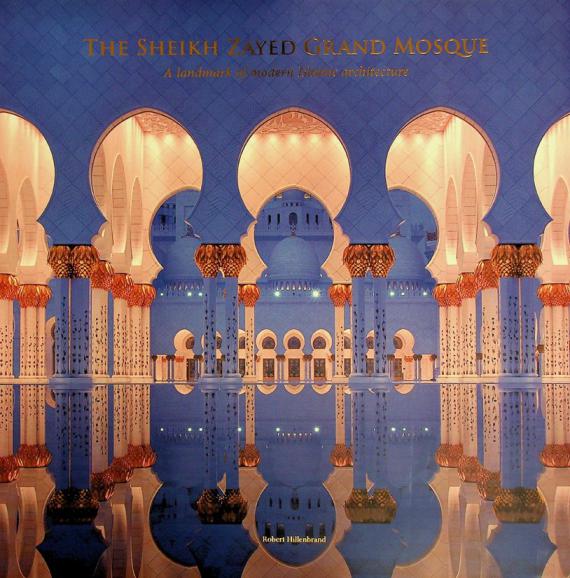
The Sheikh Zayed Grand Mosque : a landmark of modern Islamic architecture
In this scholarly and visually expansive volume, Robert Hillenbrand, one of the world's leading authorities on Islamic art, provides a definitive analysis of the Sheikh Zayed Grand Mosque in Abu Dhabi. Hillenbrand situates this modern wonder within the long continuum of Islamic architectural history, arguing that it is not merely a monumental place of worship but a sophisticated synthesis of diverse historical styles—from Fatimid and Mamluk to Ottoman and Mughal. The book explores how the mosque serves as a \"unifying\" structure, reflecting the late Sheikh Zayed bin Sultan Al Nahyan’s vision of peace, tolerance, and global architectural heritage.
BOOK

Islamic Architecture
A comprehensive and authoritative survey of Islamic Architecture from the world's leading expert.
eBook