
Catalogue Search | MBRL


Are you sure you want to remove the book from the shelf?

{{itemTitle}}
58
result(s) for
"Hirabayashi, Gordon K"
Sort by:

A Principled Stand
In 1943, University of Washington student Gordon Hirabayashi defied the curfew and mass removal of Japanese Americans on the West Coast, and was subsequently convicted and imprisoned as a result. InA Principled Stand, Gordon's brother James and nephew Lane have brought together his prison diaries and voluminous wartime correspondence to tell the story ofHirabayashi v. United States, the Supreme Court case that in 1943 upheld and on appeal in 1987 vacated his conviction. For the first time, the events of the case are told in Gordon's own words. The result is a compelling and intimate story that reveals what motivated him, how he endured, and how his ideals changed and deepened as he fought discrimination and defended his beliefs.
A Principled Standadds valuable context to the body of work by legal scholars and historians on the seminal Hirabayashi case. This engaging memoir combines Gordon's accounts with family photographs and archival documents as it takes readers through the series of imprisonments and court battles Gordon endured. Details such as Gordon's profound religious faith, his roots in student movements of the day, his encounters with inmates in jail, and his daily experiences during imprisonment give texture to his storied life.
eBook
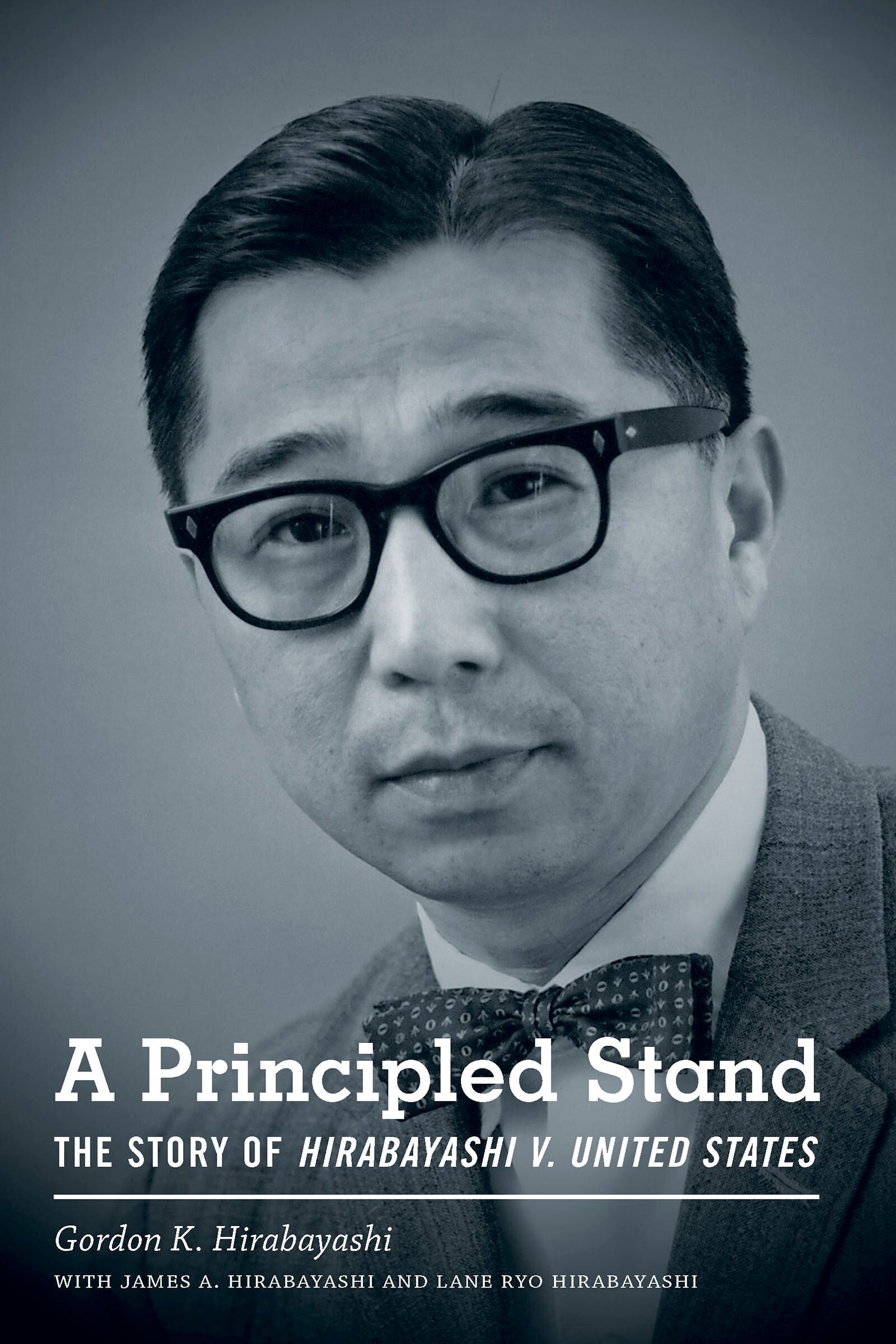
A Principled Stand
In 1943, University of Washington student Gordon Hirabayashi defied the curfew and mass removal of Japanese Americans on the West Coast, and was subsequently convicted and imprisoned as a result. In A Principled Stand, Gordon's brother James and nephew Lane have brought together his prison diaries and voluminous wartime correspondence to tell the story of Hirabayashi v. United States, the Supreme Court case that in 1943 upheld and on appeal in 1987 vacated his conviction. For the first time, the events of the case are told in Gordon's own words. The result is a compelling and intimate story that reveals what motivated him, how he endured, and how his ideals changed and deepened as he fought discrimination and defended his beliefs.A Principled Stand adds valuable context to the body of work by legal scholars and historians on the seminal Hirabayashi case. This engaging memoir combines Gordon's accounts with family photographs and archival documents as it takes readers through the series of imprisonments and court battles Gordon endured. Details such as Gordon's profound religious faith, his roots in student movements of the day, his encounters with inmates in jail, and his daily experiences during imprisonment give texture to his storied life.Scott and Laurie Oki Series in Asian American StudiesA Capell Family Book
eBook

The Japanese Canadians and World War II
The history of Japanese immigration to Canada is similar to that of the United States, with the peak years being the decade of 1900 to 1910. For both countries the year 1907 represented the heaviest single year of immigration.¹ In those days there was little awareness among the immigrants of any national boundary; to them the land across the Pacific was simply “America.” In 1977 the Japanese Canadians celebrated the centennial of the arrival of the first known Japanese settler.² At the time of World War II, 23,149 persons of Japanese ancestry lived in Canada; in the continental United States
Book Chapter

Jail Visitations
KING COUNTY JAIL HAS TWO DAYS A WEEK THAT ARE CALLED visitors’ days. The visiting facility is perfectly horrible here, where you can either talk or look, and you have to yell into an inhuman contraption to be heard.
The sheriff said of me, “This boy has more friends than anybody I ever saw.” All of those friends were Caucasian, since all my Japanese friends and relatives had been swept into WCCA centers and WRA camps.
For the first time in over two months, I had the opportunity to see many of my friends face-to-face. It’s wonderful to be able
Book Chapter
King County Jail
TANK—THEY USE THAT WORD—3C IS THE FEDERAL TANK, AND it has a capacity of forty persons. It has two levels of five cells, with four bunks on each side. There are twenty men over here on this aisle, back-to-back. They all face out. At 6 or 6:30 a.m., they open up and keep the hallways open. Then you go into the day tank, with a table and a metal bench screwed down to the cement right in the center so that forty people can sit down there. It has bars on all sides and hallways on the outside
Book Chapter
U.S. Supreme Court
MARCH 27, 1943—THE COURT OF APPEALS PASSED MY CASE TO the Supreme Court to decide the constitutionality of Public Law 503 and the Western Defense commander DeWitt’s curfew and evacuation orders.
We retained Harold Evans, a Quaker lawyer from Philadelphia with Supreme Court experience, who said, “There is a good bit of sympathy in Quaker circles for Hirabayashi, a high type of man.” He reasonably asked for postponement to acquaint himself with the intricacies of the case and to prepare his strategy. Postponement was denied, and the hearing took place as scheduled.
I still maintain my faith in the
Book Chapter
King County Jail Mates
AS FOR MY FELLOW PRISONERS, IN ROUND FIGURES I WOULD say that maybe 50 percent were there as a result of some kind of wartime regulation violation of one type or another: some resisted the draft or some other type of war-related thing. In other words, they were not your typical “criminal.” The others were petty thieves, this and that, in for some sort of criminal violation.
Holy smokes! Six fellows came in yesterday, and we’re full up to the brim. Thirty-nine guests, and forty is the capacity. However, several are expected to leave soon, with some bound for the
Book Chapter
Pretrial
TWO SIGNIFICANT THINGS HAPPENED THIS WEEK (JULY 4, 1942) that were of interest from the legal side. First, my lawyer, Frank Walters, came in with a plea of abatement. This plea stated that I was a native-born citizen of good standing and, as such, should receive the benefits thereof. Therefore, I should not be incarcerated any longer but should be released immediately. The hearing for this plea will come on July 13. It is very doubtful that the judge will do other than refuse to accept it. I presume that will lead to the trial. Inasmuch as citizenship is completely
Book Chapter
Out on Bail
AFTER THE TRIAL, WITH THE STALEMATE OVER MY BAIL TERMS, I remained in jail four months into the appeal period. By that time, Judge Black was willing to release me. We’d become sort of like old friends, in terms of his knowledge of me, and he said, “We ought to get him out.” We worked out a compromise that I would go to Spokane, which was outside of the restricted area for Japanese Americans. Judge Black said, “I want you to promise that you will not return to the restricted area for the duration of the appeal.” That sounded acceptable
Book Chapter
You’re Going to College
PURSUING AN EDUCATION WAS AN AUTOMATIC FOR ME AS LONG as I could make the grade. Although we were a poor farm family, my parents led me to anticipate university following high school, much as we were expected to move on to high school after elementary school. Mom said, “You’re going to college but you are going to a good school. The guys going to the University of Washington—that’s just a farm school. You’re going to a school like Yale or Harvard!” She had big dreams, and she just hated the farm, so I hated it, too. I was
Book Chapter