
Catalogue Search | MBRL


Are you sure you want to remove the book from the shelf?

{{itemTitle}}
254
result(s) for
"Hirsch, Donald"
Sort by:
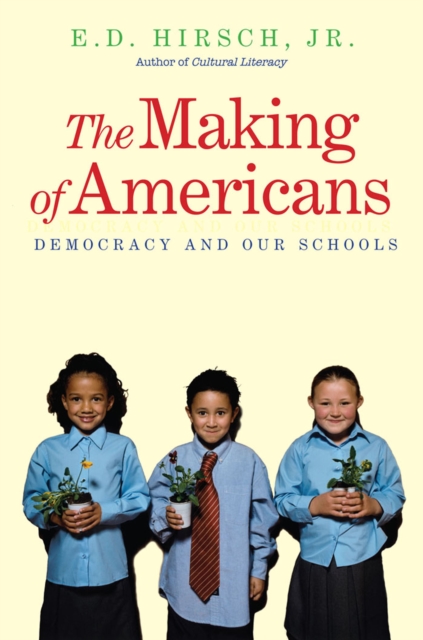
The making of Americans
From the bestselling author ofCultural Literacy, a passionate and cogent argument for reforming the way we teach our children Why, after decades of commissions, reforms, and efforts at innovation, do our schools continue to disappoint us? In this comprehensive and thought-provoking book, educational theorist E. D. Hirsch, Jr. offers a masterful analysis of how American ideas about education have veered off course, what we must do to right them, and most importantlywhy. He argues that the core problem with American education is that educational theorists, especially in the early grades, have for the past sixty years rejected academic content in favor of \"child-centered\" and \"how-to\" learning theories that are at odds with how children really learn. The result is failing schools and widening inequality, as only children from content-rich (usually better-off) homes can take advantage of the schools' educational methods. Hirsch unabashedly confronts the education establishment, arguing that a content-based curriculum is essential to addressing social and economic inequality. A nationwide, specific, grade-by-grade curriculum established in the early school grades can help fulfill one of America's oldest and most compelling dreams: to give all children, regardless of language, religion, or origins, the opportunity to participate as equals and become competent citizens. Hirsch not only reminds us of these inspiring ideals, he offers an ambitious and specific plan for achieving them.
eBook

The big tax hikes that make UBI ‘affordable’ could be used to cut poverty in more targeted ways: a reply to ‘Universal Basic Income is affordable and feasible: evidence from UK economic microsimulation modelling’ by Howard Robert Reed et al
Blueprints for a universal basic income (UBI) have come a long way in recent years, particularly in explaining how UBI could be paid for. In ‘Universal Basic Income is affordable and feasible: evidence from UK economic microsimulation modelling’, the authors (Reed et al, 2023) set out in admirable detail how additional taxes could be raised, in some scenarios supplemented by increased public borrowing. All the schemes presented are highly redistributive, focusing on improving benefits for those at the bottom of the income distribution. In itself, this does not answer the question of whether the schemes described would be politically acceptable. Johnson, Johnson and Nettle’s (2022) study appears to show that presenting the advantages of UBI to sceptical citizens can increase their levels of support for it – but did not test this where the objection was on the grounds of cost. This evidence is not exactly a game-changer, or an indication of how the combination of a basic income and higher taxes will fare in electoral politics. The article shows that its most modest, ‘fiscally neutral’ UBI could more than halve child poverty and concludes that such a scheme can therefore be ‘affordable, feasible and highly progressive’. But fiscally neutral here does not mean replacing our social security system with one that costs the same; but rather being up-front about building extra taxation into the design in order to pay for additional expenditures. Whether it is feasible depends on whether people are willing to vote for those additional taxes to achieve such results. And if they are, is UBI the only way of achieving them?
Journal Article

P09 Poverty at the end of life in the UK
BackgroundIt has been estimated that someone with a terminal illness in the UK can experience a negative financial impact of up to £16,000 per year (APPG for Terminal Illness, 2019). However, while poverty at the end of life is recognised as a legitimate concern, its magnitude has remained unclear. This research aimed to produce a statistical profile to increase understanding of the risk and prevalence of poverty in the last year of life for people across the UK.MethodsThe analysis was based on data for individuals aged 20 and older from of the UK Household Longitudinal Study, Understanding Society. Mixed-effects binary logistic regression was used to estimate the probability of an individual being in poverty in a given year, based on their age, whether they were in the last 12 months of life, and the interaction between these variables. The estimates were used to produce a risk ratio that could be applied to population-level data on poverty rates and mortality rates. This was repeated for selected subgroups of the population based on geographical location, sex, ethnicity and diagnosis.ResultsThe regression analysis revealed a statistically significant, positive association between being at the end of life and being in poverty (OR=1.6. p<0.001). There was a significant interaction with age (p=0.08), with a stronger association between poverty and mortality for younger respondents.When combined with population-level data, the estimates suggested that in 2019, more than 90,000 people died in poverty in the UK. Among working age people, the risk of experiencing poverty was 34% higher for those in the last 12 months of life than for others in the same age group, while for pensioners it was 23% higher. Elevated risks of poverty at the end of life were also observed among women, people from minority ethnic groups, and those with non-cancer diagnoses prior to death.DiscussionThe findings show that poverty at the end of life is an extensive and wide-reaching issue that affects many people at a time when they are vulnerable and least able to deal with financial or material hardship. In policy terms, the findings draw attention to the importance of ensuring that people are able to access all of the support from the social security system to which they are entitled at the end of life, especially if faced with an unpredictable prognosis and a potentially long period of financial hardship.
Journal Article
An untested premise: would voters really support redistribution through UBI which left many of them worse off? A reply to ‘Changing circumstances and new basic premises: turning the affordability and feasibility relationship on its head’ by Howard Robert Reed et al
Yes, a ‘Plimsoll Line’ or minimum income guarantee at a decent level should be an ambition of any social security system. There are both universal and targeted routes to this goal. Universal ones have the advantage of better take-up. But the much bigger issue is what system is able to achieve minimum entitlements adequate to escape poverty, spending more money on redistribution with the public’s consent. The proposed ‘starter scheme’ retains a high degree of means-testing, contributing to a design that sharply reduces poverty with the help of extra tax revenue (Reed et al, 2023b). Universal Credit could also achieve this with higher entitlements; calling it a ‘patching’ scheme does not change this (Hirsch, 2023). The more full-blown versions of UBI would involve many better-off voters accepting high taxes that reduce their net income, in some cases by a lot. The key assertion of the authors here is that people would vote for this if delivered as a ‘universal’ scheme, rather than to an ‘out-group’. This supposition remains untested at the ballot box. Preliminary evidence that the pandemic improved public support for social protection does not demonstrate the permanent and dramatic transformation in voter opinion that the authors imply. Of course I support any scheme setting a Plimsoll Line that brings the lowest incomes closer to the Minimum Income Standard that I’ve spent the past 16 years helping develop – without imagining that this income level will be guaranteed in full by any method in the foreseeable future. The key question is whether a universal benefit can be set higher than a targeted guarantee, if the former requires much higher taxes but may stimulate greater willingness to pay them. The day after the election when people vote for this, I’ll be the first to join the celebrations.
Journal Article

Why knowledge matters : rescuing our children from failed educational theories
In this provocative book, influential scholar E.D. Hirsch, Jr., addresses critical issues in contemporary education reform - over-testing, teacher blaming, preschool fadeout, and the persistence of achievement gaps over time. In each case, he shows how cherished truisms about education and child development have led to unintended and negative consequences. Drawing on recent findings in neuroscience and new data from France, he provides new evidence for the argument that a coherent, knowledge-based elementary curriculum is essential to providing the foundations for children's life success and ensuring equal opportunity for students of all backgrounds.
Book