
Catalogue Search | MBRL


Are you sure you want to remove the book from the shelf?

{{itemTitle}}
856
result(s) for
"Hirsch, L. R."
Sort by:
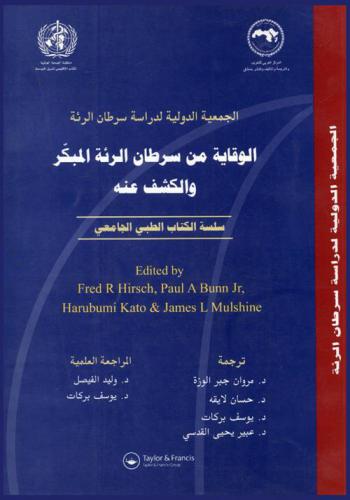
الوقاية من سرطان الرئة المبكر وكشفه
يتحدث هذا الكتاب عن : سرطان الرئة هو السبب الرئيسي للموت المسبب بالسرطان في كافة أنحاء العالم، وذلك لأن إنذاره ما يزال سيئا رغم جهود البحث المكثفة. ومع تأخر التشخيص خصوصا، يكون سرطان الرئة قد انتشر فعلا إلى العقد اللمفاوية الناحية أو أبعد، وتصعب وقتها معالجته الناجحة كثيرا. ولهذا يؤمن العديد من الباحثين بأن أفضل فرصة لتحسين نتائج سرطان الرئة هي العودة إلى تركيز الجهود على كشف سرطان الرئة المبكر أو الوقاية منه. واتساقا مع رسالة الجمعية الدولية لسرطان الرئة (LASLC)، يجمع هذا الكتاب باحثين دوليين بارزين لمناقشة العمل في مجال من القضايا المتضمنة في الوقاية من سرطان الرئة وكشفه المبكر. ليس المرمى هو إنتاج أداة تعليمية لاختصاصيي الأورام المحترفين فحسب، بل أيضا لتشجيع أعظم مشاركة من المجتمع العلمي في إيتاء خدمات الوقاية من سرطان الرئة. هذا بالإضافة إلى تشجيع الفاعليات الخاصة بأبحاث الوقاية.
Book

Nanoshell-Mediated Near-Infrared Thermal Therapy of Tumors under Magnetic Resonance Guidance
Metal nanoshells are a class of nanoparticles with tunable optical resonances. In this article, an application of this technology to thermal ablative therapy for cancer is described. By tuning the nanoshells to strongly absorb light in the near infrared, where optical transmission through tissue is optimal, a distribution of nanoshells at depth in tissue can be used to deliver a therapeutic dose of heat by using moderately low exposures of extracorporeally applied near-infrared (NIR) light. Human breast carcinoma cells incubated with nanoshells in vitro were found to have undergone photothermally induced morbidity on exposure to NIR light (820 nm, 35 W/cm2), as determined by using a fluorescent viability stain. Cells without nanoshells displayed no loss in viability after the same periods and conditions of NIR illumination. Likewise, in vivo studies under magnetic resonance guidance revealed that exposure to low doses of NIR light (820 nm, 4 W/cm2) in solid tumors treated with metal nanoshells reached average maximum temperatures capable of inducing irreversible tissue damage (ΔT = 37.4 ± 6.6° C) within 4-6 min. Controls treated without nanoshells demonstrated significantly lower average temperatures on exposure to NIR light (ΔT < 10° C). These findings demonstrated good correlation with histological findings. Tissues heated above the thermal damage threshold displayed coagulation, cell shrinkage, and loss of nuclear staining, which are indicators of irreversible thermal damage. Control tissues appeared undamaged.
Journal Article

Entry overload, emergency department overcrowding, and ambulance bypass
Objectives: To describe an experience of emergency department (ED) overcrowding and ambulance bypass. Methods: A prospective observational study at Royal Perth Hospital, a major teaching hospital. Episodes of ambulance bypass and their characteristics were recorded. Results: From 1 July 1999 to 30 June 2001, there were 141 episodes of ambulance bypass (mean duration 187 min, range 35–995). Monday was the most common day with 39 (28%) episodes. Entry block alone was the most common reason bypass was activated (n=38, 30.4%). The mean number of patients in ED at these times was 40 (occupancy 174%), including nine in the corridor, seven awaiting admission, and 14 waiting to be seen. Episodes attributable to entry block were typically preceded by a presentation rate of ⩾10 patients per hour for ⩾2 hours (OR 6.2, 95% CI 4.3 to 8.5). Mid-afternoon to early evening was the most common time for activation. Ambulance bypass is increasing in frequency and duration. Conclusions: Entry overload resulting in entry block results from overwhelming numbers of patients presenting to the ED in a short space of time. Entry block impairs access to emergency care. Unless something is done in the near future, the general public may no longer be able to rely on EDs for quality and timely emergency care. A “whole of system” approach is necessary to tackle the problem.
Journal Article

Metal Nanoshells
Metal nanoshells are a new class of nanoparticles with highly tunable optical properties. Metal nanoshells consist of a dielectric core nanoparticle such as silica surrounded by an ultrathin metal shell, often composed of gold for biomedical applications. Depending on the size and composition of each layer of the nanoshell, particles can be designed to either absorb or scatter light over much of the visible and infrared regions of the electromagnetic spectrum, including the near infrared region where penetration of light through tissue is maximal. These particles are also effective substrates for surface-enhanced Raman scattering (SERS) and are easily conjugated to antibodies and other biomolecules. One can envision a myriad of potential applications of such tunable particles. Several potential biomedical applications are under development, including immunoassays, modulated drug delivery, photothermal cancer therapy, and imaging contrast agents.
Journal Article

Respiratory syncytial virus immune globulin treatment of lower respiratory tract infection in pediatric patients undergoing bone marrow transplantation – a compassionate use experience
Respiratory syncytial virus (RSV) pneumonia in BMT recipients carries a mortality rate of approximately 50-70% despite ribavirin (Virazole) treatment. In both immunocompetent and immunocompromised animal models, RSV neutralizing antibodies rapidly reduce pulmonary virus load after a single dose. RSV-IGIV (RespiGam) is an IgG immune globulin with high concentrations of RSV neutralizing antibody (>19 200 MU/ml). From June 1991 to February 1996, a compassionate-use protocol using RSV-IGIV for treatment of RSV infections was conducted. Eleven children at multiple centers, mean age 3.3 years (4 months to 9 years), were undergoing BMT and met the protocol criteria. They received a single 1500 mg/kg dose of RSV-IGIV infused over 12 h at a median of 5 days (1-37 days) after RSV symptom onset. Ten of these patients received prior or concurrent aerosolized ribavirin. Serum RSV neutralizing titers were measured in five patients and showed a 3- to 30-fold increase 24 h after RSV-IGIV infusion. Adverse events were mild. One of 11 (9.1%) patients died from their RSV illness (91% RSV survival). In comparison to previously published reports, RSV-IGIV treatment of RSV pneumonia in BMT patients may increase survival above that in such patients treated with ribavirin alone. Bone Marrow Transplantation (2000) 25, 161-165.
Journal Article

Scintillation light detection in the 6-m drift-length ProtoDUNE Dual Phase liquid argon TPC
DUNE is a dual-site experiment for long-baseline neutrino oscillation studies, neutrino astrophysics and nucleon decay searches. ProtoDUNE Dual Phase (DP) is a 6 × 6 × 6 m3 liquid argon time-projection-chamber (LArTPC) that recorded cosmic-muon data at the CERN Neutrino Platform in 2019–2020 as a prototype of the DUNE Far Detector. Charged particles propagating through the LArTPC produce ionization and scintillation light. The scintillation light signal in these detectors can provide the trigger for non-beam events. In addition, it adds precise timing capabilities and improves the calorimetry measurements. In ProtoDUNE-DP, scintillation and electroluminescence light produced by cosmic muons in the LArTPC is collected by photomultiplier tubes placed up to 7 m away from the ionizing track. In this paper, the ProtoDUNE-DP photon detection system performance is evaluated with a particular focus on the different wavelength shifters, such as PEN and TPB, and the use of Xe-doped LAr, considering its future use in giant LArTPCs. The scintillation light production and propagation processes are analyzed and a comparison of simulation to data is performed, improving understanding of the liquid argon properties.
Journal Article

Reconstruction of interactions in the ProtoDUNE-SP detector with Pandora
The Pandora Software Development Kit and algorithm libraries provide pattern-recognition logic essential to the reconstruction of particle interactions in liquid argon time projection chamber detectors. Pandora is the primary event reconstruction software used at ProtoDUNE-SP, a prototype for the Deep Underground Neutrino Experiment far detector. ProtoDUNE-SP, located at CERN, is exposed to a charged-particle test beam. This paper gives an overview of the Pandora reconstruction algorithms and how they have been tailored for use at ProtoDUNE-SP. In complex events with numerous cosmic-ray and beam background particles, the simulated reconstruction and identification efficiency for triggered test-beam particles is above 80% for the majority of particle type and beam momentum combinations. Specifically, simulated 1 GeV/
c
charged pions and protons are correctly reconstructed and identified with efficiencies of 86.1
±
0.6
% and 84.1
±
0.6
%, respectively. The efficiencies measured for test-beam data are shown to be within 5% of those predicted by the simulation.
Journal Article
Neutrino interaction vertex reconstruction in DUNE with Pandora deep learning
The Pandora Software Development Kit and algorithm libraries perform reconstruction of neutrino interactions in liquid argon time projection chamber detectors. Pandora is the primary event reconstruction software used at the Deep Underground Neutrino Experiment, which will operate four large-scale liquid argon time projection chambers at the far detector site in South Dakota, producing high-resolution images of charged particles emerging from neutrino interactions. While these high-resolution images provide excellent opportunities for physics, the complex topologies require sophisticated pattern recognition capabilities to interpret signals from the detectors as physically meaningful objects that form the inputs to physics analyses. A critical component is the identification of the neutrino interaction vertex. Subsequent reconstruction algorithms use this location to identify the individual primary particles and ensure they each result in a separate reconstructed particle. A new vertex-finding procedure described in this article integrates a U-ResNet neural network performing hit-level classification into the multi-algorithm approach used by Pandora to identify the neutrino interaction vertex. The machine learning solution is seamlessly integrated into a chain of pattern-recognition algorithms. The technique substantially outperforms the previous BDT-based solution, with a more than 20% increase in the efficiency of sub-1 cm vertex reconstruction across all neutrino flavours.
Journal Article
Neutrino interaction vertex reconstruction in DUNE with Pandora deep learning
The Pandora Software Development Kit and algorithm libraries perform reconstruction of neutrino interactions in liquid argon time projection chamber detectors. Pandora is the primary event reconstruction software used at the Deep Underground Neutrino Experiment, which will operate four large-scale liquid argon time projection chambers at the far detector site in South Dakota, producing high-resolution images of charged particles emerging from neutrino interactions. While these high-resolution images provide excellent opportunities for physics, the complex topologies require sophisticated pattern recognition capabilities to interpret signals from the detectors as physically meaningful objects that form the inputs to physics analyses. A critical component is the identification of the neutrino interaction vertex. Subsequent reconstruction algorithms use this location to identify the individual primary particles and ensure they each result in a separate reconstructed particle. A new vertex-finding procedure described in this article integrates a U-ResNet neural network performing hit-level classification into the multi-algorithm approach used by Pandora to identify the neutrino interaction vertex. The machine learning solution is seamlessly integrated into a chain of pattern-recognition algorithms. The technique substantially outperforms the previous BDT-based solution, with a more than 20% increase in the efficiency of sub-1 cm vertex reconstruction across all neutrino flavours.
Journal Article
Neutrino interaction vertex reconstruction in DUNE with Pandora deep learning
The Pandora Software Development Kit and algorithm libraries perform reconstruction of neutrino interactions in liquid argon time projection chamber detectors. Pandora is the primary event reconstruction software used at the Deep Underground Neutrino Experiment, which will operate four large-scale liquid argon time projection chambers at the far detector site in South Dakota, producing high-resolution images of charged particles emerging from neutrino interactions. While these high-resolution images provide excellent opportunities for physics, the complex topologies require sophisticated pattern recognition capabilities to interpret signals from the detectors as physically meaningful objects that form the inputs to physics analyses. A critical component is the identification of the neutrino interaction vertex. Subsequent reconstruction algorithms use this location to identify the individual primary particles and ensure they each result in a separate reconstructed particle. A new vertex-finding procedure described in this article integrates a U-ResNet neural network performing hit-level classification into the multi-algorithm approach used by Pandora to identify the neutrino interaction vertex. The machine learning solution is seamlessly integrated into a chain of pattern-recognition algorithms. The technique substantially outperforms the previous BDT-based solution, with a more than 20% increase in the efficiency of sub-1 cm vertex reconstruction across all neutrino flavours.
Journal Article