
Catalogue Search | MBRL


Are you sure you want to remove the book from the shelf?

{{itemTitle}}
66
result(s) for
"Hoechsmann, Michael"
Sort by:


Media literacies
Media Literacies: A Critical Introduction traces the history of media literacy and grapples with the fresh challenges posed by the convergent media of the 21st century. The book provides a much-needed guide to what it means to be literate in today's media-saturated environment. Updates traditional models of media literacy by examining how digital media is utilized in today's convergent culture Explores the history and emergence of media education, the digitally mediated lives of today's youth, digital literacy, and critical citizenship Complete with sidebar commentary written by leading media researchers and educators spotlighting new research in the field and an annotated bibliography of key texts and resources.
eBook
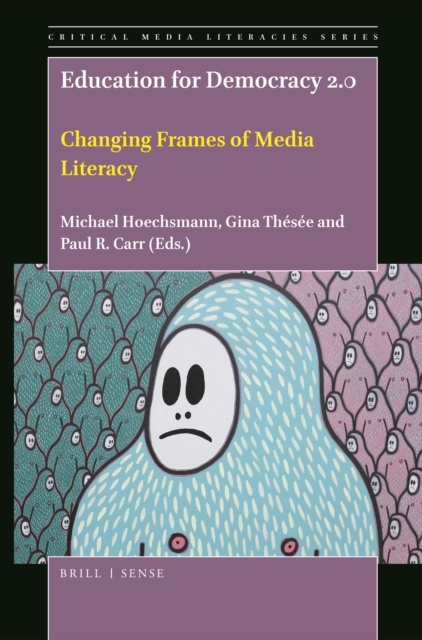
Education for Democracy 2.0
Winner of the 2022 AESA Critics' Choice Book Award Winner of the 2022 Society of Professors of Education Outstanding Book Award This diverse and global collection of scholars, educators, and activists presents a panorama of perspectives on media education and democracy in a digital age. Drawing upon projects in both the formal and non-formal education spheres, the authors contribute towards conceptualizing, developing, cultivating, building and elaborating a more respectful, robust and critically-engaged democracy. Given the challenges our world faces, it may seem that small projects, programs and initiatives offer just a salve to broader social and political dynamics but these are the types of contestatory spaces, openings and initiatives that enable participatory democracy. This book provides a space for experimentation and dialogue, and a platform for projects and initiatives that challenge or supplement the learning offered by traditional forms of education. The Foreword is written by Divina Frau-Meigs (Sorbonne Nouvelle, Paris) and the Postscript by Roberto Apirici and David García Marín (UNED, Madrid). Contributors are: Roberto Aparici, Adelina Calvo Salvador, Paul R. Carr, Colin Chasi, Sandra L. Cuervo Sanchez, Laura D'Olimpio, Milena Droumeva, Elia Fernández-Diaz, Ellen Field, Michael Forsman, Divina Frau-Meigs, Aquilina Fueyo Gutiérrez, David García-Marín, Tania Goitandia Moore, José Gutiérrez-Pérez, Ignacio Haya Salmón, Bruno Salvador Hernández Levi, Michael Hoechsmann, Jennifer Jenson, Maria Korpijaakko, Sirkku Kotilainen, Emil Marmol, María Dolores Olvera-Lobo, Tania Ouariachi, Mari Pienimäki, Anna Renfors, Ylva Rodney-Gumede, Carlos Rodríguez-Hoyos, Mar Rodríguez-Romero, Tafadzwa Rugoho, Juha Suoranta, Gina Thésée, Robyn M. Tierney, Robert C. Williams and María Luisa Zorrilla Abascal.
eBook

The handbook of media education research
Over the past forty years, media education research has emerged as a historical, epistemological and practical field of study.Shifts in the field--along with radical transformations in media technologies, aesthetic forms, ownership models, and audience participation practices--have driven the application of new concepts and theories across a.
eBook


Audience Incorporated (Inc.): Youth Cultural Production and the New Media
Changes in access to technology have facilitated new conditions for young people to shoot, cut, and mix multimodal texts, and the emergence of the Internet as a \"home theatre\" for a global audience has enabled youth to communicate across borders and across the street. Alongside the outpouring of youth expression, a newly empowered youth audience has emerged as the newest actor in the mediasphere, helping to determine and create content and seemingly balance out increasing corporate control, the other major development in our mediascapes. In this article, I argue that differing conceptions of audience\"”incorporated into the act of media creation\"”produce different outcomes, that there are strong residual communicational and cultural elements in contemporary \"participatory\" media production, and that as young people are drawn into new forms of media practice, they draw substantially on a pre-existing repertoire of cultural meanings.
Journal Article

The Fine Line between Person and Persona in the Spanish Reality Television Show La isla de las tentaciones: Audience Engagement on Instagram
The hybridization of television genres has led to numerous non-fiction television shows that base much of their success on audience engagement through social networks. This study analyses a specific case, that of La isla de las tentaciones (Temptation Island), to identify interpretive frames in reality shows and their interrelationships with audience involvement on Instagram. Based on a corpus of 8409 comments posted on Instagram by the followers of the program’s actor profiles, the article analyzes the lines between reality and fiction in this non-fiction television show about relationships and infidelity, and, in particular, how online “haters” play a performative role. The show’s participants who were unfaithful are insulted and receive numerous negative value judgments. The “coding and counting” method, drawn from Computer Mediated Discourse Analysis, is used for the coding. Results show that viewers barely allude to this show as fiction, do not differentiate between the actors and their characters, and empathize strongly with the stories they view. The study shows the need for media education, both for those who make the media and those who view it. The goal is not to detract from entertainment value, but to improve critical skills and to recover the educational function of media.
Journal Article

Education for Democracy 2. 0
A panorama of perspectives on media education and democracy in a digital age that draws upon projects in both the formal and non-formal education spheres, this collection contributes to conceptualizing and cultivating a more respectful, robust and critically-engaged democracy.
eBook