
Catalogue Search | MBRL


Are you sure you want to remove the book from the shelf?

{{itemTitle}}
5
result(s) for
"Hoffer, Williamjames, author"
Sort by:


The Clamor of Lawyers
The Clamor of Lawyers explores a series of extended public pronouncements that British North American colonial lawyers crafted between 1761 and 1776. Most, though not all, were composed outside of the courtroom and detached from on-going litigation. While they have been studied as political theory, these writings and speeches are rarely viewed as the work of active lawyers, despite the fact that key protagonists in the story of American independence were members of the bar with extensive practices. The American Revolution was, in fact, a lawyers' revolution.
Peter Charles Hoffer and Williamjames Hull Hoffer broaden our understanding of the role that lawyers played in framing and resolving the British imperial crisis. The revolutionary lawyers, including John Adams's idol James Otis, Jr., Pennsylvania's John Dickinson, and Virginians Thomas Jefferson and Patrick Henry, along with Adams and others, deployed the skills of their profession to further the public welfare in challenging times. They were the framers of the American Revolution and the governments that followed. Loyalist lawyers and lawyers for the crown also participated in this public discourse, but because they lost out in the end, their arguments are often slighted or ignored in popular accounts. This division within the colonial legal profession is central to understanding the American Republic that resulted from the Revolution.
eBook
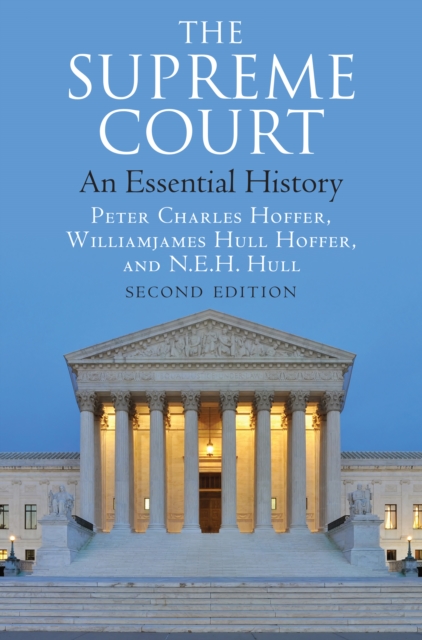
The Supreme Court : an essential history
The most respected one volume history of the US Supreme Court, expanded to include the Roberts Court through 2017.
eBook

The Supreme Court
For more than two centuries, the U.S. Supreme Court has provided a battleground for nearly every controversial issue in our nation's history. Now a veteran team of talented historians-including the editors of the acclaimed Landmark Law Cases and American Society series-have updated the most readable, astute single-volume history of this venerated institution with a new chapter on the Roberts Court.The Supreme Courtchronicles an institution that dramatically evolved from six men meeting in borrowed quarters to the most closely watched tribunal in the world. Underscoring the close connection between law and politics, the authors highlight essential issues, cases, and decisions within the context of the times in which the decisions were handed down. Deftly combining doctrine and judicial biography with case law, they demonstrate how the justices have shaped the law and how the law that the Court makes has shaped our nation, with an emphasis on how the Court responded-or failed to respond-to the plight of the underdog.Each chapter covers the Court's years under a specific Chief Justice, focusing on cases that are the most reflective of the way the Court saw the law and the world and that had the most impact on the lives of ordinary Americans. Throughout the authors reveal how-in times of war, class strife, or moral revolution-the Court sometimes voiced the conscience of the nation and sometimes seemed to lose its moral compass. Their extensive quotes from the Court's opinions and dissents illuminate its inner workings, as well as the personalities and beliefs of the justices and the often-contentious relationships among them.Fair-minded and sharply insightful,The Supreme Courtportrays an institution defined by eloquent and pedestrian decisions and by justices ranging from brilliant and wise to slow-witted and expedient. An epic and essential story, it illuminates the Court's role in our lives and its place in our history in a manner as engaging for general readers as it is rigorous for scholars.
eBook

To Enlarge the Machinery of Government
How did the federal government change from the weak apparatus of the antebellum period to the large, administrative state of the Progressive Era? To Enlarge the Machinery of Government explores the daily proceedings of the U.S. House and Senate from 1858 to 1891 to find answers to this question.Through close readings of debates centered around sponsorship, supervision, and standardization recorded in the Congressional Globe and Congressional Record during this period, Williamjames Hull Hoffer traces a critical shift in ideas that ultimately ushered in Progressive legislation: the willingness of American citizens to allow, and in fact ask for, federal intervention in their daily lives. He describes this era of congressional thought as a \"second state,\" distinct from both the minimalist approaches that came before and the Progressive state building that developed later. The \"second state\" era, Hoffer contends, offers valuable insight into how conceptions of American uniqueness contributed to the shape of the federal government.
eBook