
Catalogue Search | MBRL


Are you sure you want to remove the book from the shelf?

{{itemTitle}}
6
result(s) for
"Hopkins, Lisa, 1962- editor"
Sort by:

Bess of Hardwick : new perspectives
\"Bess of Hardwick was one of the most extraordinary figures of Elizabethan England. She was born the daughter of a country squire but by the end of her long life (which a recent redating of her birth suggests was even longer than previously thought) she was the richest woman in England outside the royal family, had risen to the rank of countess and seen two of her daughters do the same, and had built one of the major 'prodigy houses' of the period, Hardwick Hall. While married to her fourth husband, the Earl of Shrewsbury, she had been jailer to Mary, Queen of Scots, and her granddaughter by her second marriage, Lady Arbella Stuart, was of royal blood and might have succeeded to the throne of England. This wide-ranging collection brings out the full range of her activities and impact\"-- Provided by publisher.
Book

Essex
This collection of new essays about the earl of Essex, one of the most important figures of the Elizabethan court, resituates his life and career within the richly diverse contours of his cultural and political milieu. It identifies the ways in which his biography has been variously interpreted both during his own lifetime and since his death in 1601. Collectively, the essays examine a wealth of diverse visual and textual manifestations of Essex: poems, portraits, films; texts produced by Essex himself, including private letters, prose tracts, poems and entertainments; and the transmission and circulation of these as a means of disseminating his political views. As well as prising open long-held assumptions about the earl’s life, the authors provide a diachronic approach to the earl’s career, identifying crucial events such as the Irish campaign and the uprising, and re-evaluating their significance and critical reception. Collectively, the essays illuminate the reach and significance of the many roles played by the earl and the impact of his brief, dazzling life on his contemporaries and on those who came after, making this the first volume to offer a comprehensive critical overview of the Earl's life and influence.
eBook

The genres of Renaissance tragedy
This collection of newly commissioned essays explores the extraordinary versatility of Renaissance tragedy and shows how it enables exploration of issues ranging from gender to race to religious conflict, as well as providing us with some of the earliest dramatic representations of the lives of ordinary Englishmen and women. The book mixes perspectives from emerging scholars with those of established ones and offers the first systematic examination of the full range and versatility of Renaissance tragedy as a literary genre. It works by case study, so that each chapter offers not only a definition of a particular kind of Renaissance tragedy but also new research into a particularly noteworthy or influential example of that genre.
Book

The genres of Renaissance tragedy
This collection of essays explores tragedy, the most versatile of Renaissance literary genres, revealing its astonishing thematic, stylistic and emotional range. Each chapter consists of a case study, offering not only a definition of a particular kind of Renaissance tragedy but also new research into an important example of that genre. There is only one chapter on Shakespeare; instead contributors attend to subgenres of tragedy – biblical tragedy and closet drama, for example – in which Shakespeare did not engage and others in which the nature of his influence is interrogated, producing original critical readings of individual plays which show how interventions in these subgenres can be mapped onto debates surrounding numerous important issues, including national identity, the nature of divine authority, early modern youth culture, gender and ethics, as well as questions relating to sovereignty and political intervention. The chapters also highlight the rich range of styles adopted by the early modern tragic dramatists and show how opportunely the genre as a whole is positioned for speaking truth to power. Collectively, these essays reassess the various sub-genres of Renaissance tragedy in ways which respond to the radical changes that have affected the critical landscape over the last few decades.
eBook

Essex : the cultural impact of an Elizabethan courtier
\"This collection of new essays about the Earl of Essex, one of the most important figures of the Elizabethan court, resituates his life and career within the richly diverse contours of his cultural and political milieu. It identifies the ways in which his biography has been variously interpreted both during his own lifetime and since his death in 1601.\"--Page 4 of cover.
Book
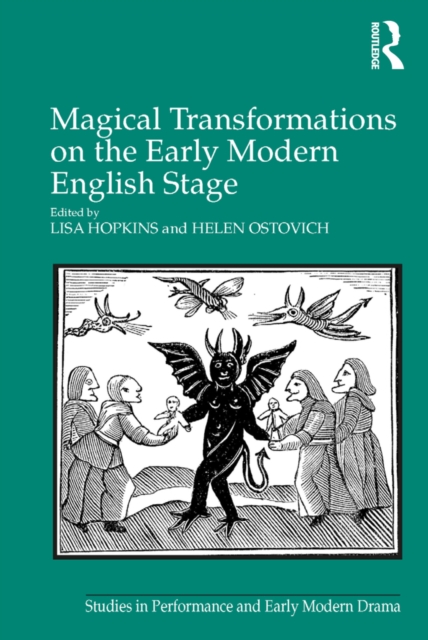
Magical Transformations on the Early Modern English Stage
Considering a variety of questions centering on magic and, or in, performance, this volume furthers the debate about the cultural work performed by representations of magic on the early modern English stage. Collectively the essays show that the idea of transformation applies not only to the objects and subjects of magic, but that the plays themselves can be seen as working to effect transformation in the ways that they challenge contemporary assumptions and stereotypes.
eBook