
Catalogue Search | MBRL


Are you sure you want to remove the book from the shelf?

{{itemTitle}}
55
result(s) for
"Horberry, Tim"
Sort by:

Driver acceptance of new technology : theory, measurement and optimisation
\"Acceptance of new technology and systems by drivers is an important area of concern to governments, automotive manufacturers and equipment suppliers, especially technology that has significant potential to enhance safety. To be acceptable, new technology must be useful and satisfying to use. If not, drivers will not want to have it, in which case it will never achieve the intended safety benefit. Even if they have the technology, drivers may not use it if it is deemed unacceptable, or may not use it in the manner intended by the designer. At worst, they may seek to disable it\"-Provided by publisher.
Book

A Rider-Centered Critical Decision Method Study to Better Understand the Challenges to Further Uptake of Cycling
Despite the many benefits of cycling, there is still a widespread perception that riding bicycles on public roads is unsafe. There has been a substantial increase in cycling research over the past decade, but little work has explored the challenges to greater uptake of cycling from a rider-centered perspective. To explore this, our research undertook a large international survey for experienced cyclists in which rider perspectives were explored using an in-depth process called the Critical Decision Method. The results revealed a wide range of self-reported cycling experiences, and most respondents classified themselves as either strong and fearless or enthused and confident. Few actual differences with respect to threatening incidents and rider countermeasures were present, illustrating how overall similarly experienced cyclists respond to threatening incidents. An overarching summary of all survey responses is presented with respect to each gender, then a more specific case study of two riders, one female and one male, is presented showing how many emotions and fear responses were similar for the different riders, but their coping strategies and reactions were somewhat different. It is concluded that further work to explore the issue from a rider-centered perspective is needed, and that the wide variety of cyclist types implies that there is no single recommendation for encouraging greater uptake of riding.
Journal Article
Development and Reliability Review of an Assessment Tool to Measure Competency in the Seven Elements of the Risk Management Process: Part Three—Evaluation of the Group Results from the RISK Tool
This study used ratings to form teams of participants with different risk management competence levels to determine if a collectively optimised team performed a risk management exercise better than a marginally or a sub-optimised team. This paper also determined whether team performance was better than individual performance on a risk management exercise. An experimental group was split into three teams of six participants based on their individual risk scenario exercise outcomes. The collectively optimised team had at least one member rated as having some high-level or expert competency in one of the seven risk management process elements. So, jointly, the group had this competency level in all elements. Similarly, the marginally optimised team’s members were rated as having just above average or high-level competency in the seven elements. Likewise, the sub-optimised team’s members were rated as having just above average competency, just below average, or no competency in the seven elements. Each team undertook the risk scenario exercise, and two observers rated their performances, as recorded on a video camera. The results were that the collectively optimised team performed better in each of the seven risk management elements than the other teams (the marginally optimised or the sub-optimised team). However, a significant difference was only evident between the collectively optimised and sub-optimised teams across all elements. Also, the teams performed better in each of the seven elements than individuals. These results imply that a team collectively optimised in the seven elements of the risk management process can better perform a risk management process than a sub-optimised team. These competency outcomes could be used to assemble risk management teams that are collectively optimised, leading to better results from the risk management process.
Journal Article

Driver Acceptance of New Technology
This edited volume brings together the accumulating body of work on driver and operator acceptance of new technology. It covers the theory behind acceptance, how it can be measured and how it can be improved. Case studies are presented that provide data on driver acceptance for new and emerging vehicle technology.
eBook
Development and Reliability Review of an Assessment Tool to Measure Competency in the Seven Elements of the Risk Management Process: Part Two—Evaluation of the Individual Results from the RISKometric Tool
This study aims to test further the RISKometric previously developed by the authors. This paper is the second of three studies: it compares individuals’ RISKometric results in the first study with their performance in a risk scenario exercise in this second study; so, providing a reliability review for the RISKometric. A risk scenario exercise was developed that required participants to individually undertake a risk management process on a realistic, potentially hazardous event involving working at heights during simultaneous operations. Two observers assessed their responses, rating the participants’ competence in each of the seven risk management process elements. Twenty-six participants individually undertook the risk scenario exercise, known as round one. Analyses found that participants’ individual competence ratings given to them (by observers) when undertaking the risk scenario exercise were strongly and positively associated with the competence ratings given to them by their peers and downline colleagues in the RISKometric in an earlier study; for each of the seven elements in this second study. This finding supports the RISKometric as a useful tool for rating the competency of individuals in the seven elements of the risk management process. Work was also undertaken in preparation for a planned future third study whereby eight participants of the original 26 were selected to individually undertake the risk scenario exercise again to determine any difference in ratings, e.g., if there was a learning effect. The analysis found no significant difference over the two rounds.
Journal Article
Development and Reliability Review of an Assessment Tool to Measure Competency in the Seven Elements of the Risk Management Process: Part One—The RISKometric
Ineffective and inefficient workforce involvement can negatively impact risk management practice for work health and safety (WHS) issues. Often the risk management process is undertaken by a single person, or by teams without a facilitator and without regard to the participants’ levels of competency in the risk management process. This study aimed to develop a tool to assess the competence of individuals in different elements of the risk management process and then review its reliability. This tool, termed the RISKometric, incorporated a 360° performance review method whereby peers upline and downline colleagues and the individual themselves gave competence ratings. The RISKometric was tested using 26 participants. Results showed that a significant positive relationship existed between the feedback given by peers and downline colleagues. Initial results gained from using the tool suggest it is able to discriminate the competence of participants, in each of the elements of risk management, through the opinions of self and others. In future research, we test assumptions through a further two studies. Firstly, that individuals’ RISKometric results are comparable with their performance in a risk scenario exercise; so, providing validity for the tool. Secondly, that a collectively-optimised team (formed using the Riskometric) can perform a risk assessment exercise better than marginally- or sub-optimised teams.
Journal Article
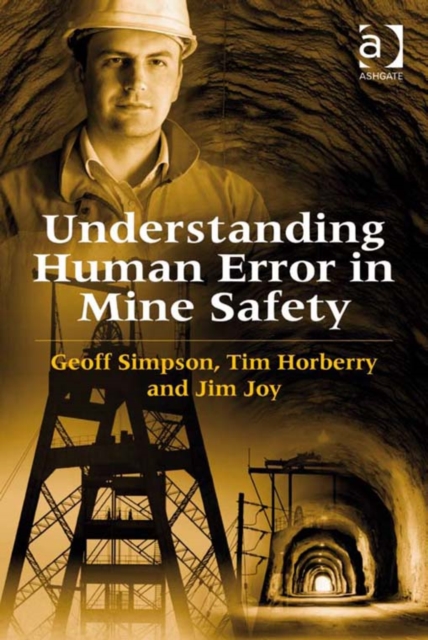
Understanding Human Error in Mine Safety
The consideration of human factors issues is vital to the mining industry. As in other safety-critical domains, human performance problems constitute a significant threat to system safety, making the study of human factors an important field for improving safety in mining operations. The primary purpose of this book is to provide the reader with a much-needed overview of human factors within the mining industry, in particular to understand the role of human error in mine safety, explaining contemporary risk management and safety systems approaches. The approach taken is multidisciplinary and holistic, based on a model of the systems of work in the mining industry domain. The ingredients in this model include individual operators, groups/teams, technology/equipment, work organisation and the physical environment. Throughout the book, topics such as human error and safety management are covered through the use of real examples and case studies, allowing the reader to see the practical significance of the material presented while making the text rigorous, useful and enjoyable. Understanding Human Error in Mine Safety is written for professionals in the field, researchers and students of mining engineering, safety or human factors.
eBook

Human Factors for the Design, Operation, and Maintenance of Mining Equipment
Written by leading experts from Australia and North America, this book covers the impact of new mining technology on human work performance and safety. Ergonomics experts Tim John Horberry, Robin Burgess-Limerick, and Lisa J. Steiner draw on their personal experience to provide recent research, case studies, and examples, making the book useful, accurate, informative, and easy to read. The authors combine their in-the-trenches experience and academic expertise to present a treatment that balances breadth with depth. The book supplies a much-needed overview of the human element in the journey to optimal equipment design of mining equipment.
eBook
Development and Validation of Plain English Interpretations of the Seven Elements of the Risk Management Process
A fundamental problem with risk management standards and other associated guiding documents is that the definitions and descriptors of the seven elements of the risk management process within these documents are commonly at odds with each other and are difficult to understand. An implication is that personnel within and across organisations interpret the process in different ways. This has led to some companies developing their own interpretations of the elements in their risk/work health and safety (WHS) management systems and thereby exacerbating the problem. A standard set of definitions, terminology and language are vital for addressing WHS issues efficiently and effectively to result in better outcomes. This study aimed to develop a set of plain English interpretations (PEI) for each of the seven elements of the risk management process. These seven elements sit between the scant and technical definitions contained in standards (primary and secondary) and the voluminous guidance in the handbooks and codes of practice. The Delphi-technique was used with 20 risk-experts to evaluate, over two iterations a set of draft PEIs—developed by the researchers. These were finally reviewed for readability and understandability by 24 operators/workers. The implications for these new PEIs is that they could be considered for future standards and guidance documents by the ISO Working Group Risk Management Standard and similar committees and used by organisations for their risk/WHS management systems.
Journal Article

A Path towards Sustainable Vehicle Automation: Willingness to Engage in Level 3 Automated Driving
This paper describes a driving simulator study exploring driver willingness to engage in automated driving. The study aimed to explore factors that may influence willingness to engage (WTE) in automated driving and willingness to resume control (WTRC) in Level 3 automated vehicles during everyday driving. Automated driving is an emerging technology that promises a range of benefits. The first step towards sustainable automated driving is the successful introduction of Level 3 automated vehicles. This study investigates key factors that influence the driver’s willingness to engage in automated driving in a Level 3 automated vehicle. A purpose-built driving simulator was used. Forty participants were exposed to driving situations of differing complexity in both manual and automated driving modes, and their willingness to engage or disengage automated driving and perception of safety were recorded. Results demonstrated a strong negative effect of perceived situation complexity on willingness to engage in automated driving. Other significant factors that determine drivers’ willingness to engage in automated driving were trust in automation and driving enjoyment. The identification of perceived situation complexity as a significant factor in drivers’ willingness to engage the automated driving vehicle control mode was the major finding of this research. This finding suggests that it is possible to improve the rate of uptake and sustainability of automated driving with external interventions (technological, regulatory and publicity).
Journal Article