
Catalogue Search | MBRL


Are you sure you want to remove the book from the shelf?

{{itemTitle}}
207
result(s) for
"Horowitz, Donald L"
Sort by:

Constitutional change and democracy in Indonesia
\"This is the story of how democracy became entrenched in the world's largest Muslim-majority country\"-- Provided by publisher.
Book
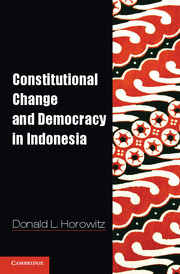
Constitutional Change and Democracy in Indonesia
How did democracy became entrenched in the world's largest Muslim-majority country? After the fall of its authoritarian regime in 1998, Indonesia pursued an unusual course of democratization. It was insider-dominated and gradualist and it involved free elections before a lengthy process of constitutional reform. At the end of the process, Indonesia's amended constitution was essentially a new and thoroughly democratic document. By proceeding as they did, the Indonesians averted the conflict that would have arisen between adherents of the old constitution and proponents of radical, immediate reform. Donald L. Horowitz documents the decisions that gave rise to this distinctive constitutional process. He then traces the effects of the new institutions on Indonesian politics and discusses their shortcomings and their achievements in steering Indonesia away from the dangers of polarization and violence. He also examines the Indonesian story in the context of comparative experience with constitutional design and intergroup conflict.
eBook

Ethnic Power Sharing: Three Big Problems
In societies severely divided by ethnicity, race, religion, language, or any other form of ascriptive affiliation, ethnic divisions make democracy difficult, because they tend to produce ethnic parties and ethnic voting. Two commonly proposed methods of amelioration are called consociational and centripetal . Three problems derive from these proposals: The first concerns the adoptability of either of the two principal prescriptions. Under what conditions can either be adopted? The second relates to a possibility inherent in centripetal regimes: the potential degradation of the electoral arrangements that sustain the interethnic coalition. The third derives from a common consequence of the adoption of a consociational regime: Where robust guarantees, including minority vetoes, are adopted, immobilism is a strong possibility, and it may be very difficult to overcome the stasis that immobilism can produce. By examining these three problems, we can uncover some of the frailties inherent in both of the common prescriptions.
Journal Article
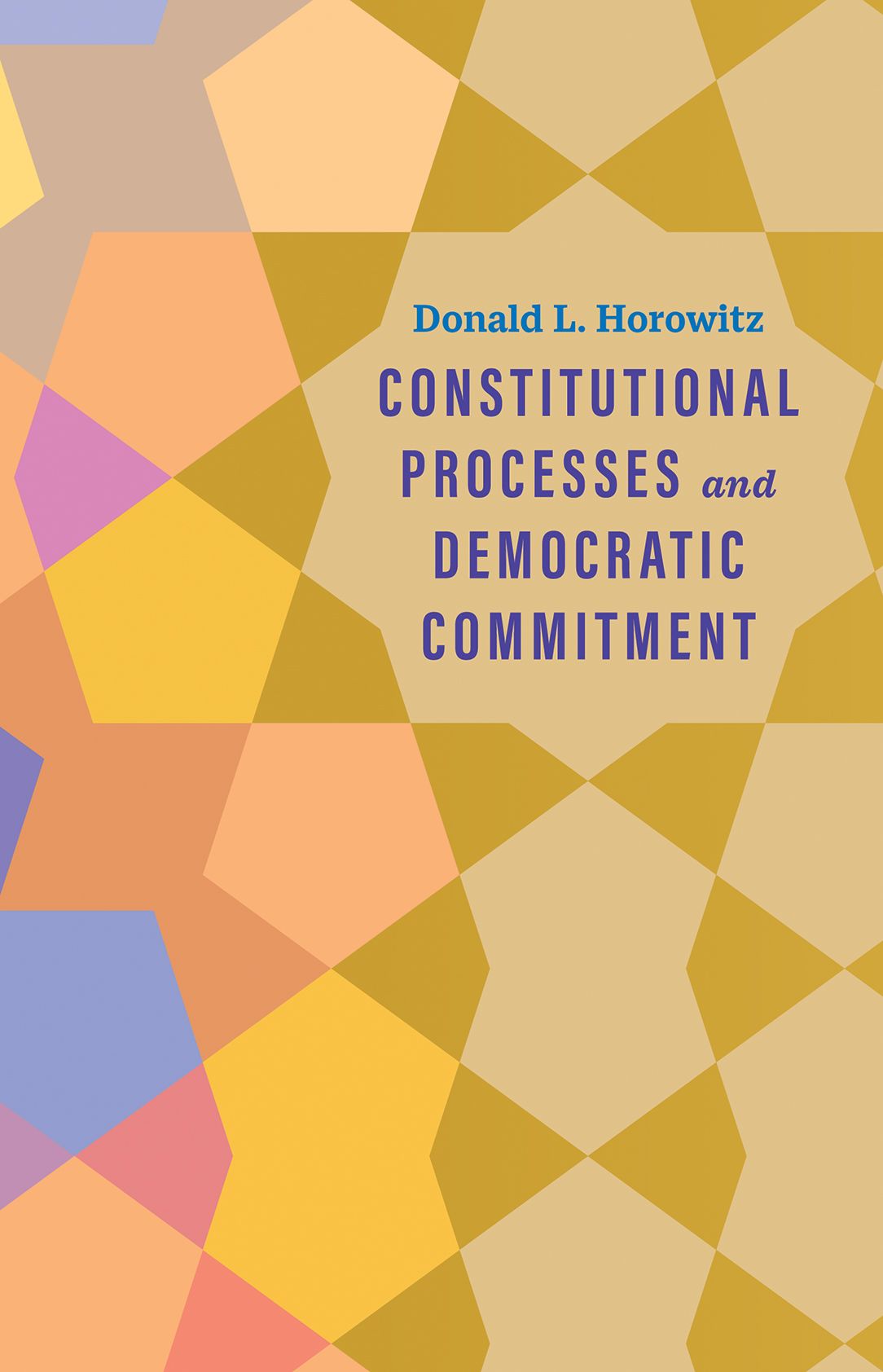
Constitutional processes and democratic commitment
From one of our leading scholars of comparative constitutionalism, advice for everyone involved in the surprisingly common practice of constitution-writing Enhancing prospects for democracy is an important objective in the process of creating a new constitution. Donald L. Horowitz argues that constitutional processes ought to be geared to securing commitment to democracy by those who participate in them. Using evidence from numerous constitutional processes, he makes a strong case for a process intended to increase the likelihood of a democratic outcome. He also assesses tradeoffs among various process attributes and identifies some that might impede democratic outcomes. This book provides a fresh perspective on constitutional processes that will interest students and scholars. It also offers sound advice for everyone involved in the surprisingly common practice of constitution-writing.
eBook

Constitutional Processes and Democratic Commitment
From one of our leading scholars of comparative
constitutionalism, advice for everyone involved in the surprisingly
common practice of constitution-writing Enhancing
prospects for democracy is an important objective in the process of
creating a new constitution. Donald L. Horowitz argues that
constitutional processes ought to be geared to securing commitment
to democracy by those who participate in them. Using evidence from
numerous constitutional processes, he makes a strong case for a
process intended to increase the likelihood of a democratic
outcome. He also assesses tradeoffs among various process
attributes and identifies some that might impede democratic
outcomes. This book provides a fresh perspective on constitutional
processes that will interest students and scholars. It also offers
sound advice for everyone involved in the surprisingly common
practice of constitution†'writing.
eBook
Reconsidering the Transition Paradigm
Four leading experts on democracy—Larry Diamond, Francis Fukuyama, Donald L. Horowitz, and Marc F. Plattner—discuss the relevance of the \"transition paradigm\" in light of the \"Arab Spring\" and other developments in the world today.
Journal Article

Walker Connor
I met Walker Connor in 1972 at the Glazer and Moynihan conference on ethnicity held at the American Academy of Arts and Sciences (Glazer and Moynihan 1975). We thought we would be intimidated by the company at the conference: Talcott Parsons, Daniel Bell, Andy Greeley, Orlando Patterson, Bill Petersen, and Lucian Pye – a good sample of the elders of social theory. By then Walker had published three articles in World Politics in five years – perhaps a record – including one containing his splendid deconstruction of the theories of Karl Deutsch. But I think we acquitted ourselves well enough – especially Walker did. He was the star of the show, with numerous observations on boiling or incipient conflicts across the globe that many of the elders did not know about (or did not know existed). Unfortunately, he did not submit an essay for the volume that came out of the conference (Glazer and Moynihan 1975).
Journal Article
Electoral Systems: A Primer for Decision Makers
Electoral systems do not simply reflect voter preferences, social cleavages, or the political party configuration of a given society. All electoral systems shape and reshape these features. The choice of one electoral system or another involves a decision about what goals decision-makers wish to foster. The present article enumerates six possible goals of electoral systems and then explains how various systems foster or derogate from these goals. In all cases of electoral-system choice, there are tradeoffs. A system may fulfill one objective but make it difficult to attain another. Clarity of objective and attention to the details of system choice are, therefore, necessary.
Journal Article
Constitutional Courts: A Primer for Decision Makers
Judicial review is a growing institution. Originating in the United States two centuries ago, the power to declare governmental action, whether legislative or executive, unconstitutional has spread around the world in the last half century. A carefully designed and properly limited constitutional court could be of inestimable benefit to the creation of the rule of law. Equally, a badly designed constitutional court, with unspecified or poorly specified powers, can become an object of political struggle, an impediment to democracy, and a negative influence on the development of the legal system.
Journal Article

Explaining the Northern Ireland Agreement: The Sources of an Unlikely Constitutional Consensus
Advocates of one or another set of institutions for new democracies have typically neglected the question of adoptability. The omission is especially evident in institutional prescriptions for the reduction of ethnic conflict in severely divided societies. These have been advanced with little regard for obstacles likely to be encountered in the process of adoption. Yet adoption is problematic. Processes of negotiation and exchange open the possibility of mixed outcomes reflecting the asymmetric preferences of majorities and minorities. The Northern Ireland Agreement of 1998, however, is a glaring exception, for it produced institutions that are intended to be clearly and consistently consociational. An examination of the process by which the agreement was produced suggests that the coherent outcome in Northern Ireland was the result of some very special conditions conducive to a consensus on institutions that spanned party lines. These conditions are unlikely to be widely replicable, and the fact of consensus does not imply that the agreed institutions are apt for the divided society whose problems they are intended to ameliorate.
Journal Article