
Catalogue Search | MBRL


Are you sure you want to remove the book from the shelf?

{{itemTitle}}
64
result(s) for
"Hoyle, Carolyn"
Sort by:


FORENSIC SCIENCE AND EXPERT TESTIMONY IN WRONGFUL CONVICTIONS
The Criminal Cases Review Commission reviews possible wrongful convictions in England, Wales and Northern Ireland, referring back to the Court of Appeal cases where there is a ‘real possibility’ that the conviction is unsafe. This article presents findings from a four-year empirical study of decision-making within the Commission. It explores how Commission staff exercise their discretionary powers in identifying and investigating possible wrongful convictions from approximately 1,400 applications a year, referring just a few back to the Court. It focuses on a sample of cases that turned on forensic evidence and expert testimony, showing that while there is some variation in individual caseworkers’ approaches to investigation, decision-making is shaped by the law and internal policies such that reasonably consistent decision frames emerge.
Journal Article

Contradictions in Judicial Support for Capital Punishment in India and Bangladesh: Utilitarian Rationales
India and Bangladesh share a common history, and each has developed somewhat similarly since partition. However, while both countries now have relatively low murder rates, India has seen a decline in the rate of executions, while Bangladesh continues to impose death sentences and carry out executions at a higher rate. There have been challenges to the death penalty in India, restricting its use to exceptional cases. The same has not occurred in Bangladesh. Yet in both countries, systemic flaws in the criminal process are evident. This article draws on two original empirical research projects that explored judges’ opinions on the retention and administration of capital punishment in India and Bangladesh. The data expose justice systems marred by corruption, incompetence, abuses of due process, and arbitrary and inconsistent treatment of defendants from arrest through to conviction and sentencing. It shows that those with the power to sentence to death have little faith in the integrity of the criminal process. Yet, a startling paradox emerges from these studies; despite personal knowledge of its flaws, judges have trust in the death penalty to deter crime and to realise other sentencing aims and feel retention benefits society. This is explained by reference to utilitarian values. Not only did our judges express strongly utilitarian justifications for sentencing people to death, in terms of their erroneous belief in its deterrent effect, but some also articulated utilitarian justifications for misconduct in pre-trial processes, suggesting that it was necessary to break the rules to secure convictions when the system was dysfunctional and ineffective.
Journal Article

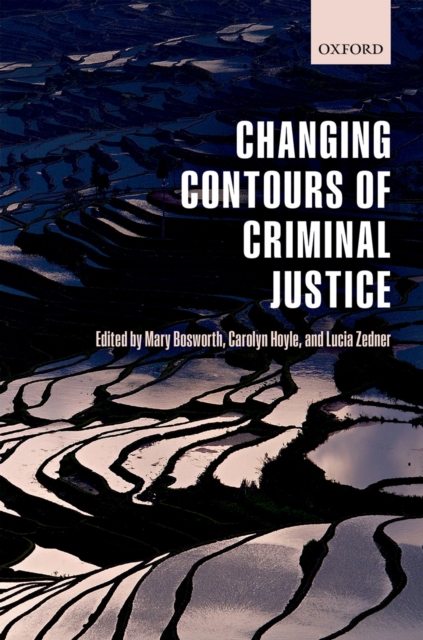
Changing contours of criminal justice
This collection will provide an engaging and critical account of the current state of criminal justice and the origins and implications of contemporary practice, celebrating the 50th Anniversary of the Oxford Centre for Criminology and featuring contributions from leading internationally-renowned criminologists.
eBook

Abolishing the Death Penalty Worldwide: The Impact of a “New Dynamic”
The number of countries to abolish capital punishment has increased remarkably since the end of 1988. A “new dynamic” has emerged that recognizes capital punishment as a denial of the universal human rights to life and to freedom from tortuous, cruel, and inhuman punishment, and international human rights treaties and institutions that embody the abolition of capital punishment as a universal goal have developed. We pay attention to the political forces important in generating the new dynamic: the emergence of countries from totalitarian and colonial repression, the development of democratic constitutions, and the emergence of European political institutions wedded to the spread of human rights. Where abolition has not been formally achieved in law, we discuss the extent to which capital punishment has been bridled and by what means. Finally, we examine the prospects for further reduction and final abolition in those countries that hang on to the death penalty. More and more of these countries are accepting that capital punishment must be used sparingly, judiciously, and with every safeguard necessary to protect the accused from abuse and wrongful conviction. From there, it is not a long step to the final elimination of the death penalty worldwide.
Journal Article

New Visions of Crime Victims
This innovative collection presents original theoretical analyses and previously unpublished empirical research on criminal victimisation. Following an overview of the development and deficiencies of victimology,subsequent chapters present more detailed challenges to stereotypical conceptions of victimisation through their focus on: male victims of domestic violence; victims of male-on-male rape; corporate victims; and the “victim-offenders” who are the recipients of IRA punishment beatings. The second half of the book considers criminal justice responses to victimisation, focusing in particular on the potential of, and limits to, restorative justice, the social (and gendered) construction of the victim within contested trials and the exclusionary nature of current 'victim-centred' initiatives. This important book will further the debate on how we conceptualise victims as well as their appropriate role within the criminal justice system. New Visions of Crime Victims will be of interest to academics, students, criminal justice practitioners and policy-makers. It has particular implications for scholarship in the fields of victimology, restorative justice and feminist approaches to criminology and criminal justice. The integration of work by established criminologists, such as Carolyn Hoyle, Paul Rock, Andrew Sanders and Richard Young with that of young, previously unpublished scholars, makes for an interesting and stimulating book. As well as being a valuable addition to the literature, it can be used to support undergraduate and postgraduate courses in criminal justice and criminology.
eBook
POLICE RESPONSE TO DOMESTIC VIOLENCE: From Victim Choice to Victim Empowerment?
This article explores the neglected question of why victims of domestic violence call the police, and how useful the police response is to them. We found that many women do not seek criminal sanctions because sanctions are unlikely to help to end the violence. This calls into question the value, to victims, of mandatory arrest policies which require prosecution decisions to be based on evidential concerns alone. These policies are based (naively, we argue) on assumptions about the interests of victims. Policies which give effect to victim preferences are also naive in ignoring the circumstances which shape victim preferences. We therefore argue for an approach which would empower victims to make choices which are less coerced (by their circumstances) than is usual at present. Elements of this approach can be found in the practices of some domestic violence units.
Journal Article
Police Response to Domestic Violence
This article explores the neglected question of why victims of domestic violence call the police, and how useful the police response is to them. We found that many women do not seek criminal sanctions because sanctions are unlikely to help to end the violence. This calls into question the value, to victims, of mandatory arrest policies which require prosecution decisions to be based on evidential concerns alone. These policies are based (naively, we argue) on assumptions about the interests of victims. Policies which give effect to victim preferences are also naive in ignoring the circumstances which shape victim preferences. We therefore argue for an approach which would empower victims to make choices which are less coerced (by their circumstances) than is usual at present. Elements of this approach can be found in the practices of some domestic violence units.
Journal Article