
Catalogue Search | MBRL


Are you sure you want to remove the book from the shelf?

{{itemTitle}}
376
result(s) for
"Hufbauer, Gary Clyde"
Sort by:


Success ensures long-term importance to the US
Trade was dominated by natural resources on the one hand (such as oil, copper and other commodities) and finished products made by vertically integrated firms on the other (including clothing, furniture and steel). The supply chain revolution has enabled the magic of comparative advantage to operate on a far grander scale since each component-of a good or a service-can now be produced or assembled in the best location. [...]according to the pioneering analysis by Angus Maddison of economic growth over the very long term, the post-Second World War period has been the best in human history.
Journal Article

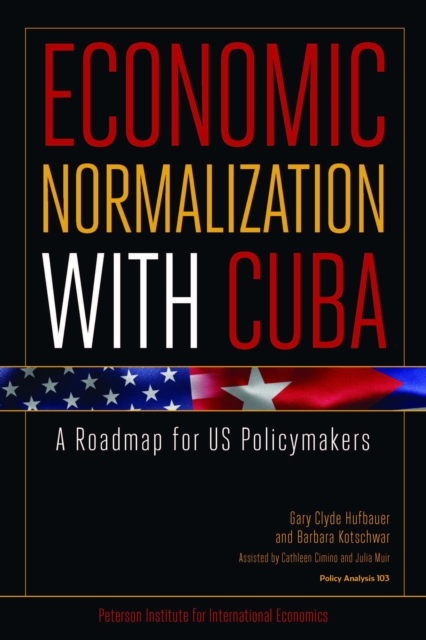
Economic normalization with Cuba : a roadmap for US policymakers
Will the Obama administration's decision to normalize relations with Cuba usher in a new era of economic cooperation, trade, and investment between the two countries? This prescient book, published only eight months before President Obama's historic announcement at the end of 2014, provides answers to that question and offers a roadmap for a sequenced lifting of the Cold War era economic sanctions against Cuba. The authors, Gary Clyde Hufbauer and Barbara Kotschwar, lay out the difficulties of achieving a dynamic economic relationship. They caution that a unilateral dismantling of US sanctions without insuring that proper institutions are in place in Cuba could squander this golden opportunity for US companies and hurt Cubans. They argue that US policies should encourage Cuba to liberalize its economy and adopt democratic institutions, so that it does not transition from a Communist dictatorship to a corrupt and authoritarian oligarchy. This farsighted book, produced in anticipation of an opening with Cuba that seemed impossible to some skeptics, is a must-read for anyone interested in the evolution of a historically contentious relationship that promises to evolve productively if the right policies are pursued.
eBook

Globalization at risk : challenges to finance and trade
History has declared globalization the winner of the 20th century. Globalization connected the world and created wealth unimaginable in the wake of the Second World War. But the financial crisis of 2008-09 has now placed at risk the liberal economic policies behind globalization. Engulfing the entire world, the crisis gave new fuel to the skeptics of the benefits of economic integration. Policy responses seem to favor anti-globalizers. New regulations could balkanize the global financial system, while widespread protectionist impulses might undo the Doha Round. Issues from climate change to national security may be used as convenient excuses to keep imports out, keep jobs at home, and to clamp down on global capital. Will globalization triumph or perish in the 21st century? What reforms make sense in the post-crisis world? The authors argue that globalization has been a force of great good, one that needs to be actively advanced and honed. Drawing on the latest economic analyses, they seek to reveal the drivers and effects of global finance and trade, lay out the key risks to globalization, and offer a practical policy roadmap for managing the challenges while increasing the gains.
eBook

U.S. taxation of foreign income
Since 1992, new issues have arisen in international taxation--for example, taxation of electronic commerce, novel means of shielding passive income, the World Trade Organization (WTO) debate over the foreign sales corporation and subsequent passage of the American Jobs Creation Act of 2004, the problem of corporate inversions, and alleged \"earnings stripping\" by foreign-based multinational enterprises (MNEs) operating in the United States. In the meantime, US-based MNEs operating abroad have used a variety of methods to cut the effective US tax on repatriated foreign source income to around 2 percent. This revised study analyzes the impact of taxes on industry location and profit shifting using new panel econometric studies. It also discusses and evaluates new paradigms that have been suggested for the international tax system.
eBook

NAFTA revisited : achievements and challenges
NAFTA entered into force in 1994 after a bitter Congressional debate. But NAFTA in operation has proved no less controversial than NAFTA before ratification, for both supporters and opponents of trade liberalization have cited experience with the agreement to justify their positions. To provide a factual basis for this ongoing debate, the authors evaluate NAFTA's performance over the first seven years, comparing actual experience with both the objectives of the agreement's supporters and the charges of its critics. They then examine future challenges and opportunities in the trade and investment relationships among the three partner countries and the broader implications for new trade initiatives throughout the hemisphere.
eBook

Multilateralism and regionalism from an American perspective: Parallels and contrasts with the Langhammer vision
The paper discusses various milestones in the process of multilateral trade negotiations, pinpoints current challenges facing the world trading order, and proposes possible ways out of the persistent impasse. Hufbauer argues that the success of the multilateral approach is at least partly because the GATT departed from the strictly unconditional definition of the most-favored nation (MFN) rule in the late 1970s already. Regional agreements such as NAFTA complemented, rather than hindered, multilateral trade liberalization in the past. The political economy of further multilateral liberalization has become increasingly complicated since countries such as Brazil, China, and India have emerged as relevant players. Against this backdrop, Hufbauer expects regionalism to become the strongest vehicle for delivering liberalization in the future. This could still leave a bright future for the WTO as a 'house of plurilaterals', i.e., agreements on specific issues such as services liberalization with conditional MFN treatment of varying membership.
Journal Article

Foreign Direct Investment Meets Tariffs and Geopolitics
executive summary: This essay examines how foreign direct investment changed from propelling world economic growth between 1980 and 2010 to being altered in character and held back in expansion since the 2008–10 global financial crisis. main argument FDI became a truly significant part of the world economy after World War II. Driving the expansion of multinational corporations (MNCs) was the economic logic of applying proprietary technology, created at substantial cost, to production in foreign countries. The decades between 1980 and 2010 became the golden era of globalization as large U.S., European, and Japanese firms established profitable operations abroad. Their investments made an outsized contribution to world economic growth. Later, MNCs with home offices in emerging economies such as China, Brazil, and South Korea put down their own footprint. Since 2010, however, new FDI worldwide (inbound and outbound) has significantly slowed, although Asia remains a relatively dynamic region. The slowdown cannot be explained by a change in economic logic but rather by an escalation of policy barriers designed to impede globalization. Moreover, rising tensions between the U.S. and China have enabled national security concerns to supplant market forces in shaping investment decisions. policy implications • MNC expansion depends on reliable access to world markets, but further trade liberalization is now disfavored by advanced economies. • Unlike in the golden era, the global expansion of MNCs will not make an outsized contribution to world economic growth in the near future. • In some industries, tariffs and subsidies might carry U.S. firms closer to the technological frontier, but the economic distortion implied by Donald Trump's broad policy agenda is immense. • As a result of national security restrictions, many countries will need to reverse-engineer technology in high-tech sectors such as electric vehicles, artificial intelligence, and novel materials rather than lure the proprietary know-how of foreign MNCs. • Emerging countries will benefit if they avoid taking sides in geopolitical rivalry and instead offer an open door to FDI from all sources.
Journal Article
