
Catalogue Search | MBRL


Are you sure you want to remove the book from the shelf?

{{itemTitle}}
67
result(s) for
"Hvattum, Mari"
Sort by:

Style and solitude : the history of an architectural problem
\"This book examines conflicting conceptions of style and traces their impact on architecture in the modern period\"-- Provided by publisher.
BOOK

Style: Notes on the Transformation of a Concept
Style has been a key concept in architectural discourse since the 18th century, yet its meaning is far from unequivocal. This essay traces the shifting meanings attributed to style in German architectural thinking from the mid-18th to the early 19th century. Reading and discussing texts by J.J. Winckelmann, J.W. Goethe, C.C. Hirschfeld, A.W. Schlegel, H. Hübsch, and F. Eisenlohr, I study the multifarious uses to which style was put in this period and look at the effects these uses had on architecture.
Journal Article

The printed and the built : architecture, print culture, and public debate in the nineteenth century
'The Printed and the Built' explores the intricate relationship between architecture and the printed media in the fast-changing nineteenth century. Publication history is a rapidly-expanding scholarly field, one which has profoundly influenced architectural history in recent years. Yet, while groundbreaking work has been done on architecture and printing in the Renaissance, the Enlightenment, and the twentieth century, the nineteenth century has to date received little attention. This omission represents a significant gap in the understanding of architecture's cultural history - and one which 'The Printed and the Built' is the first to address. Illustrated with colourful and eclectic visual material, from panoramas to printed ephemera, adverts, penny magazines, early photography, and even crime reportage, this book consists of six in-depth thematic essays by leading figures in the field, accompanied by 18 short 'micro-histories' each examining a particular printed form. Altogether, they illustrate how new genres communicated architecture to a mass audience, setting the stage for the modern architectural era.
Book
Mere Style?
According to Muthesius, modern architecture had to break free from the chains of style, replacing a stifled Stilarchitektur with a ‘living building art’ (1902: 67). If modernist architects drove style out of architectural practice, historians followed suit, chasing it out of the history books. Caroline van Eck — a pioneer of style studies with books such as The Question of Style in Philosophy and the Arts (1995) — studies the dynamics of stylistic transformation in Napoleonic France in the essay ‘The Style Empire and its Pedigree: Piranesi, Pompeii, and Alexandria’. In his entry on style in the International Encyclopaedia of Social Science from 1968, Ernst Gombrich warned against the ‘physiognomic fallacy’ — that is, the assumption that one can judge the cultural level of a period or a people by looking at the style of their art and architecture.
Journal Article
Heteronomic Historicism
If classical architecture from Vitruvius to Winckelmann had been characterized by firmness, fixity, and ‘quiet grandeur’, the 19th-century monument stood anything but still. Architecture in the 19th century moved at a rapid pace, disseminated in the form of archaeological fragments, exhibition displays, texts, and images. One of the most striking examples of this newfound mobility is the proliferation of architectural images distributed by the new illustrated press. Presenting the old and the new, the high and the low, the local and the global alongside each other, the new media challenged the hegemony of classicism and opened up a new, heteronomic field of architectural expression and deliberation. Using the mid 19th-century public press as a point of departure, this essay addresses historicist attempts to legitimize architecture in an age when even monuments seemed to move.
Journal Article
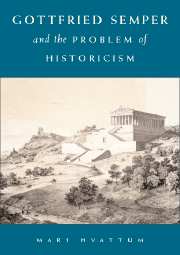
Gottfried Semper and the Problem of Historicism
Using key texts by the German architect and theorist Gottfried Semper, Mari Hvattum offers a reinterpretation of historicism, which is here viewed both as a philosophical outlook and as an architectural problem. Hvattum focuses on Semper's two major concerns: an understanding of the ontological significance of art and architecture, and the rendering of art and architecture as the objects of scientific investigation and prediction. Hvattum investigates the background and implications of these conflicting concerns. By examining the historicist fusion of Romanticism and Positivism, the book seeks to understand the nature as well as the limits of the modern dream of a 'method of inventing'. More than an intellectual biography, Gottfried Semper and the Problem of Historicism explores historicism and its implications for modern architectural discourse and practice.
eBook

The printed and the built : architecture, print culture and public debate in the nineteenth century
The Printed and the Built explores the intricate relationship between architecture and printed media in the fast-changing nineteenth century.Publication history is a rapidly expanding scholarly field which has profoundly influenced architectural history in recent years.
eBook
Crisis and Correspondence: Style in the Nineteenth Century
In his manifesto Das Kunstwerk der Zukunft (1850), Richard Wagner characterised the nineteenth century as a time of crisis. Echoing Saint-Simon, he defined this crisis as a discrepancy between the spirit of the age and the actual, historical conditions. Evoking some of the most potent concepts of modern thinking—Zeitgeist, genius, and the Gesamtkunstwerk—Wagner outlined an aesthetic theory by which the artwork (including architecture) simultaneously reflects and shapes its context, serving both as a mirror of its age and an agent of change.
Wagner’s seemingly paradoxical notion of art provides an apt introduction to historicist thinking. Obsessed with the idea of correspondence (or the lack of it) between art and its times, nineteenth-century thinkers such as Heinrich Hübsch, Carl Bötticher and Gottfried Semper all responded to the perceived crisis. While Hübsch and Bötticher sought to alleviate the crisis by redefining this correspondence for a modern world, Semper presented a far more radical alternative. Not only did he see the current crisis as inevitable; he welcomed it as a necessary dissolution of an old order, out of which a new architecture could emerge. He thus anticipated modernists, such as Sigfried Giedion, for whom historicism was a necessary melt-down; an apocalypse, preparing for the advent of modernism. In this essay, I propose that crisis and style are intrinsically linked in modern thinking. To look closely at this coupling may throw new light not only on historicism but also on the noticeable unease with which the notion of style is treated in contemporary architectural history.
Journal Article
Tracing Modernity
First published in 2004.Walter Benjamin famously defined modernity as \"the world dominated by its phantasmagorias\".The chapters in this book focus on one such phantasmagoria, namely that of 'modernity' itself.From the late seventeenth century until today, the 'modern' has served as a key category by which to understand an ever-changing present.
eBook

Panoramas of Style
Focusing on three nineteenth-century railroad lines in Norway,Mari Hvattuminvestigates the architectural and cultural significance of early railways. InPanoramas of Style: Railway Architecture in Nineteenth-century Norway,she argues that the seemingly frivolous historicism of mid-nineteenth-century railway architecture should be understood as an attempt to craft appropriate cultural associations for the new Norwegian nation state. Railway architects created an architecture that fused the local and the global, the modern and the traditional, into a new whole. They designed buildings with a mimetic and emblematic relationship to their surroundings, construing the railway journey as—to paraphrase the cultural historian Wolfgang Schivelbusch—a “panorama of style.”
Journal Article