
Catalogue Search | MBRL


Are you sure you want to remove the book from the shelf?

{{itemTitle}}
150
result(s) for
"Hyland, Ken"
Sort by:


Reworking research
The blog is an increasingly familiar newcomer to the panoply of academic genres, offering researchers the opportunity to disseminate their work to new and wider audiences of experts and interested lay people. This digital medium, however, also brings challenges to writers in the form of a relatively unpredictable readership and the potential for immediate, public and potentially hostile criticism. To understand how academics in the social sciences respond to this novel rhetorical situation, we explore how they discoursally recontextualize in blogs the scientific information they have recently published in journal articles. Based on two corpora of 30 blog posts and 30 journal articles with the same authors and topics, we examine the ways researchers carefully reconstruct a different writer persona and relationship with their readers using stance and engagement model. In addition to supporting the view that the academic blog is a hybrid genre situated between academic and journalistic writing, we show how writers’ rhetorical choices help define different rhetorical contexts.
Journal Article

Metadiscourse : exploring interaction in writing
Part of a series of books exploring areas of discourse in-depth, this title provides an accessible introduction to metadiscourse, discussing its role and importance in written communication. It explores examples from a range of texts from business, journalism, academia and student writing.
Book
Stance and engagement: a model of interaction in academic discourse
A great deal of research has now established that written texts embody interactions between writers and readers. A range of linguistic features have been identified as contributing to the writer's projection of a stance to the material referenced by the text, and, to a lesser extent, the strategies employed to presuppose the active role of an addressee. As yet, however, there is no overall typology of the resources writers employ to express their positions and connect with readers. Based on an analysis of 240 published research articles from eight disciplines and insider informant interviews, I attempt to address this gap and consolidate much of my earlier work to offer a framework for analysing the linguistic resources of intersubjective positioning. Attending to both stance and engagement, the model provides a comprehensive and integrated way of examining the means by which interaction is achieved in academic argument and how the discoursal preferences of disciplinary communities construct both writers and readers.
Journal Article


Bundles in Academic Discourse
Automated, frequency-driven approaches to identifying commonly used word combinations have become an important aspect of academic discourse analysis and English for academic purposes (EAP) teaching during the last 10 years. Referred to as clusters, chunks, or bundles, these sequences are certainly formulaic, but in the sense that they are simply extended collocations that appear more frequently than expected by chance, helping to shape meanings in specific contexts and contributing to our sense of coherence in a text. More recently, work has extended to “concgrams,” or noncontiguous word groupings where there is lexical and positional variation. Together, these lexical patterns are pervasive in academic language use and a key component of fluent linguistic production, marking out novice and expert use in a range of genres. This article discusses the emerging research which demonstrates the importance of formulaic language in both academic speech and writing and the extent to which it varies in frequency, form, and function by mode, discipline, and genre.
Journal Article

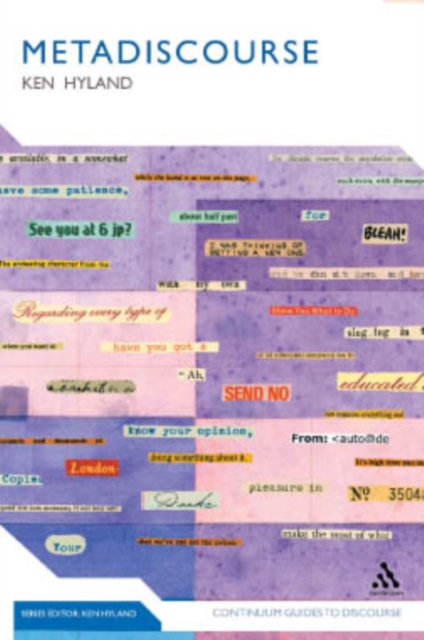
Metadiscourse : exploring interaction in writing
This book addresses an important aspect of how language is used in written communication: the ways that writers reflect on their texts to refer to themselves, their readers or the text itself.This is known as METADISCOURSE.Metadiscourse is a key resource in language, as it allows the writer to engage with readers in familiar and expected ways.
eBook

الخطاب الأكاديمي
يهدف هذا الكتاب لأن يكون مدخلا إلى الخطاب الأكاديمي في اللغة الإنجليزية، وهو موجه إلى الطلاب والقراء العاديين وكذلك المتخصصين في مجالات أخرى من اللغويات التطبيقية وتدريس اللغة ويسعى مؤلف هذا الكتاب إلى تقديم لمحة سريعة عن المجالات الأساسية للخطاب الأكاديمي، والتحدث باختصار عن طبيعة المعرفة والاتصال وعن ممارسات أولئك الأشخاص الذين يعملون ويدرسون في الجامعات، معتمدا على عدد من المجموعات التي تم جمعها من الخطاب الأكاديمي المكتوب والمنطوق.
Book

Writing in the university: education, knowledge and reputation
This paper challenges the widespread view that writing is somehow peripheral to the more serious aspects of university life – doing research and teaching students. It argues that universities are about writing and that specialist forms of academic literacy are at the heart of everything we do: central to constructing knowledge, educating students and negotiating a professional academic career. Seeing literacy as embedded in the beliefs and practices of individual disciplines, instead of a generic skill that students have failed to develop at school, helps explain the difficulties both students and academics have in controlling the conventions of disciplinary discourses. Ultimately, and in an important sense, we are what we write, and we need to understand the distinctive ways our disciplines have of addressing colleagues and presenting arguments, as it is through language that academics and students conceptualise their subjects and argue their claims persuasively.
Journal Article