
Catalogue Search | MBRL


Are you sure you want to remove the book from the shelf?

{{itemTitle}}
91
result(s) for
"Iddon, Martin"
Sort by:

New music at Darmstadt : Nono, Stockhausen, Cage, and Boulez
New Music at Darmstadt explores the rise and fall of the so-called 'Darmstadt School', through a wealth of primary sources and analytical commentary. Martin Iddon's book examines the creation of the Darmstadt New Music Courses and the slow development and subsequent collapse of the idea of the Darmstadt School, showing how participants in the West German new music scene, including Herbert Eimert and a range of journalistic commentators, created an image of a coherent entity, despite the very diverse range of compositional practices on display at the courses. The book also explored the collapse of the seeming collegiality of the Darmstadt composers, which crystallised around the arrival there in 1958 of the most famous, and notorious, of all post-war composers, John Cage, an event that, Carl Dahlhaus opined, 'swept across European avant-garde like a natural disaster'.
BOOK

New Music at Darmstadt
New Music at Darmstadt explores the rise and fall of the so-called 'Darmstadt School', through a wealth of primary sources and analytical commentary. Martin Iddon's book examines the creation of the Darmstadt New Music Courses and the slow development and subsequent collapse of the idea of the Darmstadt School, showing how participants in the West German new music scene, including Herbert Eimert and a range of journalistic commentators, created an image of a coherent entity, despite the very diverse range of compositional practices on display at the courses. The book also explores the collapse of the seeming collegiality of the Darmstadt composers, which crystallised around the arrival there in 1958 of the most famous, and notorious, of all post-war composers, John Cage, an event Carl Dahlhaus opined 'swept across the European avant-garde like a natural disaster'.
eBook

The Cambridge companion to serialism
\"What is serialism? Defended by enthusiastic champions and decried by horrified detractors, serialism was central to twentieth-century art music, but riven, too, by inherent contradictions. The term can be a synonym for dodecaphony, Arnold Schoenberg's 'method of composing with twelve tones which are related only to one another'. It can be more expansive, describing ways of composing systematically with parameters beyond pitch -duration, dynamic, and more - and can even stand as a sort of antonym to dodecaphony: 'Schoenberg is Dead', as Pierre Boulez once insisted. Stretched to its limits, it can describe approaches where sound can be divided into discrete parameters and later recombined to generate the new, the unexpected, beginning to blur into a further antonym, post-serialism. This Companion introduces and embraces serialism in all its dimensions and contradictions, from Schoenberg and Stravinsky to Stockhausen and Babbitt, and explores its variants and legacies in Europe, the Americas and Asia\"-- Provided by publisher.
BOOK

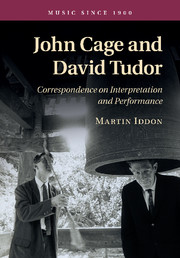
John Cage and David Tudor
John Cage is best known for his indeterminate music, which leaves a significant level of creative decision-making in the hands of the performer. But how much licence did Cage allow? Martin Iddon's book is the first volume to collect the complete extant correspondence between the composer and pianist David Tudor, one of Cage's most provocative and significant musical collaborators. The book presents their partnership from working together in New York in the early 1950s, through periods on tour in Europe, until the late stages of their work from the 1960s onwards, carried out almost exclusively within the frame of the Merce Cunningham Dance Company. Tackling the question of how much creative flexibility Tudor was granted, Iddon includes detailed examples of the ways in which Tudor realised Cage's work, especially focusing on Music of Changes to Variations II, to show how composer and pianist influenced one another's methods and styles.
eBook

TEACHING COMPOSITION IN A FLIPPED CLASSROOM
In 2019 the present authors, along with our colleague Mic Spencer, began work on a project funded by the Leeds Institute for Teaching Excellence, designed to look at the ways in which we taught composition at the University of Leeds and how we might change them. Mic has focused on postgraduate teaching, and we have considered the earliest parts of the undergraduate curriculum, particularly the first two years of study, when the largest numbers of students with the least experience of the study of composition at tertiary level might be in a classroom (50 or so, in our case).
Journal Article
OUTSOURCING PROGRESS: ON CONCEPTUAL MUSIC
This article addresses the phenomenon of New Conceptualism, otherwise known as conceptual music, or Konzeptmusik, and locates it within the German new music scene of the last decade. It is suggested that conceptual music may perhaps be a contradiction in terms, representing a nostalgic desire for the semantic strength of conceptual art. In particular the article focuses on Johannes Kreidler's 2009 work, Fremdarbeit, and scrutinises the composer's claim to have ‘outsourced’ the composition of the work to India and China. The significance of this – whether actual or fictional – as an example of globalisation is examined and set within its political and economic context.
Journal Article
INTRODUCTION: THEORY AND PRACTICE OF SOMATIC MUSIC
This introductory article defines somatic music/ology as music that emphasises and reflects on its embodied nature and an associated theoretical discourse that addresses this aspect. It further traces the genealogy of this concept to the convergence of different intellectual and artistic currents from the mid twentieth century, including the phenomenology of Edmund Husserl and Maurice Merleau-Ponty, ecological psychology associated with James J. Gibson, performance- and body-oriented musicology represented by Roland Barthes and Carolyn Abbate and later developments such as 4E cognition as well as the experimental music theatre emerging from the 1960s. Finally, it introduces the various contributions to the issue.
Journal Article


Bartók after Catastrophe: Reading Bartók through Adorno in the post-war era
\"Adorno's Bartók\" is a figure drawn most concretely in notes Adorno made on the composer in the 1920s, a composer who makes the \"folkloristic,\" between irony and inferiority, dialectically progressive. Adorno's views, however, changed enormously through the combination of catastrophe and exile, along with his engagement with the \"young guns\" of post-war music, while Bartók already becomes reduced to a footnote in his Philosophie der neuen Musik. This paper suggests a place for Bartok in the context of Adorno's post-war aesthetics, proposing that, while Adorno sees, finally, in Bartók's refusal to abandon tonality a reactionary, comforting nostalgia, instead a redoubling of the dialectic reveals this as, instead, fractured, alienated melancholy.
Journal Article