
Catalogue Search | MBRL


Are you sure you want to remove the book from the shelf?

{{itemTitle}}
70
result(s) for
"Inboden, William"
Sort by:


Religion and American Foreign Policy, 1945–1960
The Cold War was in many ways a religious war. Presidents Truman and Eisenhower and other American leaders believed that human rights and freedom were endowed by God, that God had called the United States to defend liberty, and that Soviet communism was evil because of its atheism and enmity to religion. Along with security and economic concerns, these religious convictions helped determine both how the United States defined the enemy and how it fought the conflict. Meanwhile, American Protestant churches failed to seize the moment. Internal differences over theology and politics, and resistance to cooperation with Catholics and Jews, hindered Protestant leaders domestically and internationally. Frustrated by these internecine disputes, Truman and Eisenhower attempted to construct a new civil religion to mobilize domestic support for Cold War measures, determine the strategic boundaries of containment, unite all religious faiths against communism, and to undermine the authority of communist governments abroad.
eBook

The last card : inside George W. Bush's decision to surge in Iraq
\"An oral history of President George W. Bush's decision to surge troops to Iraq, accompanied by scholarly analysis by leading scholars of international security and presidential history\"-- Provided by publisher.
BOOK

The Prophetic Conflict
This article traces the development of Reinhold Niebuhr's growing alarm over the rise of Nazi Germany and Imperial Japan leading up to World War II, and his corresponding warnings to the United States and allied powers of the need to confront fascist aggression. The theme of the \"prophetic\" shaped Niebuhr's perception of the threat of fascism, both through his concern over the religious liberty of Christian and Jewish voices to bring prophetic judgments against totalitarian governments and through his predictions of the threat that fascist regimes posed to the international order. In the course of the 1930s Niebuhr also refined his doctrine of Christian realism, which both influenced yet differed from the evolution of realism as a theory of international relations. Niebuhr's development over this decade also marked his transition from the margins to the center of American intellectual and political life.
Journal Article
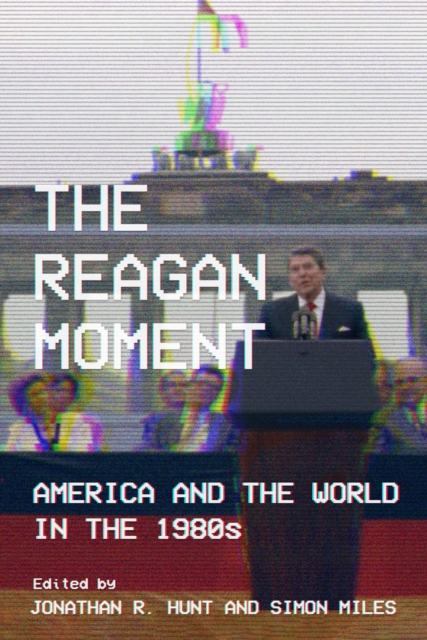
Reagan Moment
In The Reagan Moment, the ideas, events, strategies, trends, and movements that shaped the 1980s are revealed to have had lasting effects on international relations: The United States went from a creditor to a debtor nation; democracy crested in East Asia and returned to Latin America; the People's Republic of China moved to privatize, decentralize, and open its economy; Osama bin Laden founded Al Qaeda; and relations between Washington and Moscow thawed en route to the Soviet Union's dissolution. The Reagan Moment places US foreign relations into global context by examining the economic, international, and ideational relationships that bound Washington to the wider world. Editors Jonathan R. Hunt and Simon Miles bring together a cohort of scholars with fresh insights from untapped and declassified global sources to recast Reagan's pivotal years in power. Contributors: Seth Anziska, James Cameron, Elizabeth Charles, Susan Colbourn, Michael De Groot, Stephanie Freeman, Christopher Fuller, Flavia Gasbarri, Mathias Haeussler, William Inboden, Mark Atwood Lawrence, Elisabeth Mariko Leake, Melvyn P. Leffler, Evan D. McCormick, Jennifer Miller, David Painter, Robert Rakove, William Michael Schmidli, Sarah Snyder, Lauren Frances Turek, James Wilson
eBook

Religious freedom and national security
In 2002 North Korea admitted to its advanced nuclear weapons program, and Iran's uranium enrichment efforts came to light as well, which only added to concerns about Iran's longstanding sponsorship of terrorism. [...]tormenting the sacred often also amounts to profaning the international order - and suggests that the purportedly spiritual concerns of religious liberty activists and the secular concerns of security professionals might not be such separate realms.
Journal Article
War in Ukraine : conflict, strategy, and the return of a fractured world
The war in Ukraine has altered the course of global history. These authors explore how.When Vladimir Putin's forces sought to conquer Ukraine in February 2022, they did more than threaten the survival of a vulnerable democracy. The invasion unleashed a crisis that has changed the course of world affairs. This conflict has reshaped alliances, deepened global cleavages, and caused economic disruptions that continue to reverberate around the globe. It has initiated the first great-power nuclear crisis in decades and raised fundamental questions about the sources of national power and military might in the modern age. The outcome of the conflict will profoundly influence the international balance of power, the relationship between democracies and autocracies, and the rules that govern global affairs. In War in Ukraine, Hal Brands brings together an all-star cast of analysts to assess the conflict's origins, course, and implications and to offer their appraisals of one of the most geopolitically consequential crises of the early twenty-first century. Essays cover topics including the twists and turns of the war itself, the successes and failures of US strategy, the impact of sanctions, the future of Russia and its partnership with China, and more.Contributors: Anne Applebaum, Joshua Baker, Alexander Bick, Hal Brands, Daniel Drezner, Peter Feaver, Lawrence Freedman, Francis Gavin, Brian Hart, William Inboden, Andrea Kendall-Taylor, Michael Kimmage, Michael Kofman, Stephen Kotkin, Mark Leonard, Bonny Lin, Thomas Mahnken, Dara Massicot, Michael McFaul, Robert Person, Kori Schake, and Ashley Tellis.
eBook

Of swords, shields, and scaffolding: American religion and foreign relations
From a different vantage point albeit in a similar vein, historians of American religion have also likewise paid relatively litde attention to foreign relations. [...]classic and otherwise magisterial overviews such as Sydney Ahlstroms A Religious History of the American People and Mark Noll's A History of Christianity in the United States and Canada, make but occasional nods to foreign policy.1 Admittedly one of the most unfair criticisms that can be made of a synthetic overview, which almost by their nature run overlong, is that the book \"unconscionably neglected\" this or that additional topic. The book is most compelling when it reintroduces readers to otherwise familiar figures in die annals of American foreign policy through the previously unfamiliar lens of their faith. [...]John Quincy Adams, author of the Monroe Doctrine and the subject of endless invocations in foreign policy editorials for his \"America goes not abroad in search of monsters to destroy\" speech beloved of modern realists, is revealed to also be \"a deeply religious man\" and orthodox Protestant who served as president of the American Bible Society concurrently with his tenure as Secretary of State (103-6). [...]debates over war and peace, pacifism and revolution, abolitionism and humanitarian intervention, communism and fascism, human rights and poverty relief, all emanated from moral convictions that American Christians held strongly and sought to apply to foreign policy. [...]concerns continue today. [...]the resurgence over the last two decades of evangelical and Catholic efforts to shape American foreign policy overridingly focus on moral issues.
Journal Article

Foreword
We appear to be at the outset of a very fruitful period of scholarship on the Ronald Reagan administration and international politics in the 1980s. This volume exemplifies this new era and establishes many of the parameters of future lines of inquiry into this most consequential of presidencies and most consequential of decades. It began as a three-day conference convened in January 2017 at the University of Texas at Austin by the Clements Center for National Security, with generous additional support provided by other University of Texas at Austin entities, including the Robert S. Strauss Center for International Security and
Book Chapter