
Catalogue Search | MBRL


Are you sure you want to remove the book from the shelf?

{{itemTitle}}
120
result(s) for
"Ingraham, Patricia W"
Sort by:


In pursuit of performance : management systems in state and local government
Based on five years of extensive research by the Government Performance Project, this volume offers a comprehensive analysis of how government managers and elected officials use management and management systems to improve performance. Drawing on data from across the nation, it examines the performance of state, county, and city governments between 1997 and 2002 within the framework of basic management systems: financial information, human resources, capital and infrastructure, and results evaluation. Key issues addressed:
• How governments strategically select elements of management to emphasize the role of leadership
• How those governments that aim to improve performance differ from those that do not
• What \"effective management\" looks like
Through this careful, in-depth investigation, the contributors conclude that the most effective governments are not those with the most resources, but those that use the resources available to them most carefully and strategically. In Pursuit of Performance is an invaluable tool for government leaders and the scholars who study them.
eBook

The Suspect Handmaiden: The Evolution of Politics and Administration in the American State
Scholars of an earlier era predicted a more secure role for the administrative state in American political culture. This vision overlooked a historical irony that governs the relationship between politics and administration. For American society, the administrative state is a suspect handmaiden. Citizens have looked to public administration to enable extraordinary growth while simultaneously distrusting it. In recent decades, these contradictory trends have grown. The growth of the state, increased polarization, and political attacks on government have produced a set of values, perspectives, and capabilities that often do not mesh with one another or with many governmental activities. As a result, we find outdated mechanisms of accountability, politicization, and a broader illegitimacy that threatens the capacity of the state to act effectively.
Journal Article
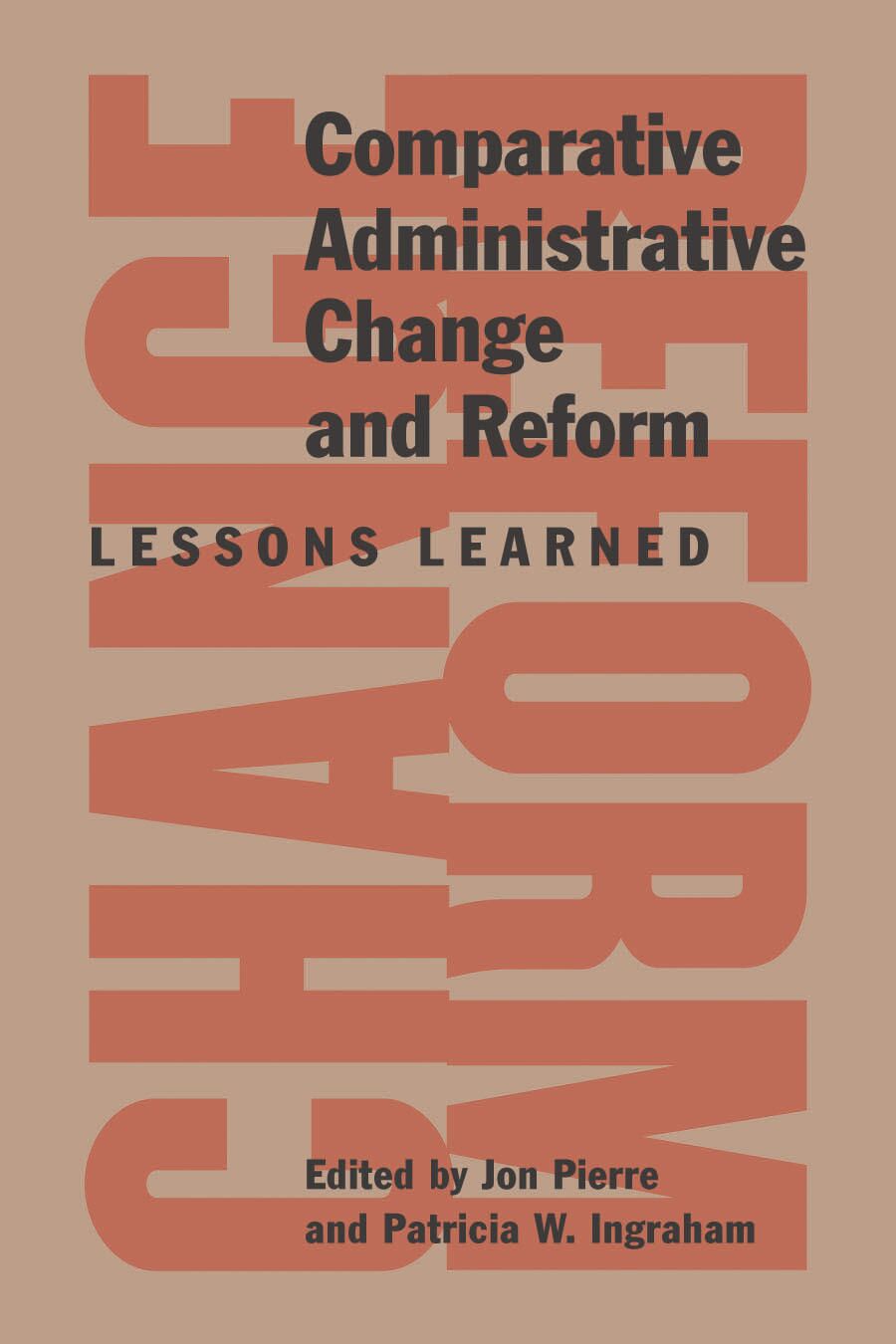
Comparative Administration Change
Providing important insights into the origins of policy ideas, the qualities and capabilities of leaders, the nature and challenges of large organizational changes, and the complexity of efforts to evaluate the outcomes of reform, the contributors consider aspects of public administration reform in countries such as Canada, Thailand, Mexico, and China as well as the ways in which changes have been shaped by global forces, national values, traditions, and culture. An invaluable work for understanding the new challenges faced by the governments around the world, Comparative Administration Change and Reform offers a clear analysis of both the successes and failures of reform and should be read by anyone interested in politics, administration, and public sector reform.
eBook

Look for the Silver Lining: When Performance-Based Accountability Systems Work
In advancing improved accountability and performance, governments have relied upon one or more of the following approaches: political accountability or improved responsiveness to political direction, legal accountability or contract accountability, and performance-based accountability. This article examines the major approach to the last, managing for results (MFR), in the context of the American states. All state governments seek to improve decision making by employing MFR models but with clear differences in the degree of quality. States regarded as having strong MFR systems devote energy to integrative facilitators: practical actions that ensure that the links between components of the MFR system connect, provide quality performance information, and facilitate information exchange and utilization. The facilitators identified are the comprehensiveness of the MFR system, vertical integration of goals, strong strategic guidance for agency efforts, balance between bottom-up and top-down approaches, and leadership and political commitment.
Journal Article

Measuring Government Management Capacity: A Comparative Analysis of City Human Resources Management Systems
This article fills a gap in both the public management and human resources literatures by applying a conceptual model supported by a criteria-based evaluative framework to assess and compare the nature and capacity of city government human resources management systems. Various management reforms have swept through many American governments recently, but practitioners and researchers have not reflected carefully on how these reforms contribute to management effectiveness. One management system that has received relatively little systematic attention is human resources management. The existing research about assessing human resources is sparse, focuses on the private sector, and fails to converge upon a set of criteria for evaluating human resources management systems comprehensively. In earlier work, we proposed a theory that dissects the black box of government management to identify key management systems and define their contribution to management capacity and to overall government performance. In this article, we refine this model by developing a set of criteria that serve as indicators of the effectiveness of human resources management systems. We apply our framework and criteria to a sample of cities in an empirical analysis that measures human resources management capacity and controls for two key environmental contingencies: unionization and government structure. We find that higher capacity governments are able to achieve better human resources outcomes, and that more unionized governments and those that lack a senior professional administrative officer generally have lower human resources management capacity.
Journal Article
Of Pigs in Pokes and Policy Diffusion: Another Look at Pay-for-Performance
What is the rationale for the adoption, diffusion, and implementation of pay-for-performance programs in the public sector? Patricia Ingraham questions the basis for the common view that private sector experience with pay-for-performance has been successful. She explores the additional problems posed by public management and compensation systems. An examination of implementation of pay-for-performance in the United States and in other OECD nations demonstrates gaps between expectations and realities in public settings. Despite obvious problems, the effort continues to appeal to both elected officials and many public managers. More careful attention to design, resource commitment, and evaluation in public organizations is recommended.
Journal Article
Play It Again, Sam; It's Still Not Right: Searching for the Right Notes in Administrative Reform
This article examines administrative reform in the comparative context of the United Kingdom, Australia, New Zealand and the United States. A reform continuum is presented, which moves from the nonstrategic incremental reforms of the United States to the comprehensive and fundamental reforms adopted in New Zealand. The role of politics and political leadership is linked to the various models of reform. More comprehensive and strategic efforts require great initial political leadership and will, but incremental efforts require more continuous political involvement. In the countries examined, using fundamental reform to create a simplified base from which to launch other initiatives appears to be a key component of success.
Journal Article
Comparative administrative change and reform : lessons learned
Providing important insights into the origins of policy ideas, the qualities and capabilities of leaders, the nature and challenges of large organizational changes, and the complexity of efforts to evaluate the outcomes of reform, the contributors consider aspects of public administration reform in countries such as Canada, Thailand, Mexico, and China as well as the ways in which changes have been shaped by global forces, national values, traditions, and culture. An invaluable work for understanding the new challenges faced by the governments around the world, Comparative Administration Change and Reform offers a clear analysis of both the successes and failures of reform and should be read by anyone interested in politics, administration, and public sector reform.
eBook