
Catalogue Search | MBRL


Are you sure you want to remove the book from the shelf?

{{itemTitle}}
146
result(s) for
"Innes, Matthew"
Sort by:

Dimpled elastic sheets: a new class of non-porous negative Poisson’s ratio materials
In this study, we report a novel periodic material with negative Poisson’s ratio (also called auxetic materials) fabricated by denting spherical dimples in an elastic flat sheet. While previously reported auxetic materials are either porous or comprise at least two phases, the material proposed here is non-porous and made of a homogeneous elastic sheet. Importantly, the auxetic behavior is induced by a novel mechanism which exploits the out-of-plane deformation of the spherical dimples. Through a combination of experiments and numerical analyses, we demonstrate the robustness of the proposed concept, paving the way for developing a new class of auxetic materials that significantly expand their design space and possible applications.
Journal Article

Infestation of Grain Fields and Degree-Day Phenology of the Cereal Leaf Beetle (Coleoptera: Chrysomelidae) in Utah: Long-Term Patterns
Scouting at key times in the seasonal development of insect pest populations, as guided by degree-day accumulation, is important for minimizing unwarranted insecticide application. Fields of small grains in northern Utah were censused weekly from 2001 to 2011, to assess infestation by the cereal leaf beetle, Oulema melanopus (L.) (Coleoptera: Chrysomelidae), and develop degree-day guidelines for measuring cereal leaf beetle abundance at peak egg and larval densities in any given year. Even in years of high overall numbers of cereal leaf beetle, relatively few fields were heavily infested (with 20 or more cereal leaf beetle eggs + larvae per 0.09 m2) at either egg or larval peak density during the growing season. In individual fields, the number of immature cereal leaf beetle (eggs + larvae) at peak larval density was positively related to the number of immature cereal leaf beetles present earlier at peak egg density. Although there was large variation among years in when cereal leaf beetle egg and larval numbers peaked during the season as measured by degree-day accumulation from 1 January, much of this variation was accounted for by the warmth of the early spring before significant egg laying occurred. Hence, degree-day estimates that account for early spring warmth can guide growers in scouting grain fields at peak egg densities to identify fields at high risk of subsequent economic damage from cereal leaf beetle larval feeding. The relatively low incidence of fields heavily infested by cereal leaf beetle in northern Utah emphasizes the benefit that growers can gain by scouting early before applying insecticide treatments.
Journal Article

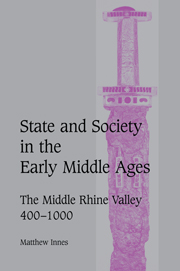
State and Society in the Early Middle Ages
This book, first published in 2000, is a pioneering study of politics and society in the early Middle Ages. Whereas it is widely believed that the source materials for early medieval Europe are too sparse to allow sustained study of the workings of social and political relationships on the ground, this book focuses on a uniquely well-documented area to investigate the basis of power. Topics covered include the foundation of monasteries, their relationship with the laity, and their role as social centres; the significance of urbanism; the control of land, the development of property rights and the organization of states; community, kinship and lordship; justice and dispute settlement; the uses of the written word; violence and the feud; and the development of political structures from the Roman empire to the high Middle Ages.
eBook
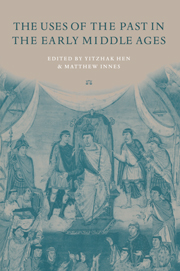
The Uses of the Past in the Early Middle Ages
This volume investigates the ways in which people in western Europe between the fall of Rome and the twelfth century used the past: to legitimate the present, to understand current events, and as a source of identity. Each essay examines the mechanisms by which ideas about the past were subtly (and sometimes not so subtly) reshaped for present purposes. As well as written histories, also discussed are saints' lives, law codes, buildings, Biblical commentary, monastic foundations, canon law and oral traditions. The book thus has important implications for how historians use these sources as evidence: they emerge as representations of the past made for very special reasons, often by interested parties. This was the first volume to be devoted fully to these themes, and as such it makes a significant contribution to our understanding of the role of the past within early medieval societies.
eBook
Pierre De Belloy (c 1550-1611) : Politics, Polemic, and Political Thought During the French Wars of Religion
Lawyer and royalist, political prisoner and polemicist, Pierre de Belloy (c. 1550-1611) had the misfortune to live through interesting times. During the 1580s, he became the leading Catholic apologist of the Protestant heir-presumptive to the throne of France, Henri of Navarre. Belloy suffered imprisonment in the Conciergerie and the Bastille for his controversial political writings, the most famous of which was the Apologie catholique of 1585. After his escape in 1591, he became a royal representative, as avocat-général, to the Parlement of Toulouse. This thesis uses a combination of archival, manuscript, and printed primary sources to better understand this minor but not insignificant figure in the history of political thought. It reconstructs his formation in the society of royal office-holders in Toulouse as well as his later speeches as avocat-général to the Parlement. In so doing, it connects Belloy’s political thought, particularly his Gallican concern for royal jurisdiction, to his social background. This thesis also shows the importance of Belloy’s voice during the 1580s for his writings on the Salic Law and on the inexcommunicability of the King of France. Although Belloy is known to historians as a theorist of absolute kingship, his writing on obedience and resistance is more notable for its manipulation of Étienne de la Boétie’s La servitude volontaire than for any theory of sovereignty within it. With its dual concern for the intellectual content and social context of Belloy’s political writing, this thesis is a significant study of the place of ideas in the society of early modern France.
Dissertation

Land, Freedom and the Making of the Medieval West
In the course of the fifth and sixth centuries, barbarian warbands acquired property rights in the former provinces of the Roman west, in a process that established the broad structural characteristics of early medieval society in western Europe: that is the central contention of this essay. Focusing on the western Mediterranean heartlands of the Imperial government and senatorial aristocracy, it argues that these property transfers were fundamental to the emergence of ethnic identity as the crucial political marker in the post-Roman west. Latent conflict over the respective rights and obligations of barbarian 'guests' and their provincial 'hosts' structured the first attempts at post-Roman state-formation in the west, for the nature of the 'hospitality' offered to barbarian warbands accommodated within the Empire became a matter of contention as second and third generation 'guests' continued to enjoy the fruits of the property of their 'hosts'. Interpreting these new social relationships in the light of established legal forms, barbarian kings identified agreed mechanisms for the legitimate transfer of Roman property to their followers: this process allowed Roman landowners to seek remedies for illegitimate or violent seizure, but at the price of acknowledging a significant redistribution of land to a new class of barbarian soldiers whose liberty was rooted in their military service. The result was the emergence, by the seventh century, of regionalised and militarised elites who appropriated the language of ethnicity to legitimate their position.
Journal Article

RITUALS, RIGHTS AND RELATIONSHIPS: SOME GIFTS AND THEIR INTERPRETATION IN THE FULDA CARTULARY, C. 827/Rituales, derechos y relaciones: algunas donaciones y su interpretación en el cartulario de Fulda, c 827
This article analyses a cluster of legal documents concerning newly cleared woodland between the river Fulda and its minor tributary the Haune, copied into the earliest Fulda cartulary which was completed in 828. It elucidates the complex interactions between local landholders of varying status, the monks of Fulda and their claims to spiritual patronage and tenurial right, and the public world of legal ritual and county meetings which were central to the exercise of power in the Carolingian world. It argues that the legal rituals recorded in charters were simultaneously attempts to define and regulate the relationships between different social actors (individuals, groups and institutions) as well as to transfer rights over property. Historians need to pay particular care to the mechanisms of transmission, as the archival record wa s carefully constructed to meet immediate needs, and it may obscure the extent to which relationships and the rights embedded in them were matters of interpretation. As well as raising epistemological and methodological questions about the nature of the charter evidence, this discussion also sheds light on the nature of land claims and clearances, and the relationship between internal colonisation and the crystallisation of ecclesiastical and political structures under Carolingian rule, topics which parallel the concerns of much recent work on early medieval Iberia. Finally, it is argued that if charter sare read not of passive records of abstract rights but as active attempts to interpret social relations, they can shed some light on the identities and interests of landowners of relatively modest means, and place them at historiographial centre stage. [PUBLICATION ABSTRACT]
Journal Article
The uses of the past in the early Middle Ages
This volume investigates the ways in which people in western Europe between the fall of Rome and the twelfth century used the past: to legitimate the present, to understand current events, and as a source of identity. Each essay examines the mechanisms by which ideas about the past were subtly (and sometimes not so subtly) reshaped for present purposes. As well as written histories, also discussed are saints' lives, law codes, buildings, Biblical commentary, monastic foundations, canon law and oral traditions. The book thus has important implications for how historians use these sources as evidence: they emerge as representations of the past made for very special reasons, often by interested parties. This was the first volume to be devoted fully to these themes, and as such it makes a significant contribution to our understanding of the role of the past within early medieval societies.
eBook
Rituales, derechos y relaciones: algunas donaciones y su interpretación en el cartulario de Fulda, c 827
Este artículo analiza un grupo de documentos legales copiados en el primer cartulario de Fulda, que se completó en 828, referentes a las áreas de bosque recientemente roturadas entre los ríos Fulda y su tributario el Haune. Ese corpus permite poner de manifiesto las complejas interacciones entre propietarios locales de diversos estatus, los monjes de Fulda y sus reclamaciones de patronazgo espiritual y derechos sobre tenencias de tierras, y el mundo público de rituales legales y encuentros presididos por el conde que eran centrales en el ejercicio del poder en el mundo carolingio. El argumento es que los rituales legales recogidos en los documentos eran al mismo tiempo intentos de definir y regular las relaciones entre actores sociales diferentes (individuos, grupos e instituciones) y de transferir derechos sobre la propiedad. Los historiadores necesitan prestar particular atención a los mecanismos de transmisión y a cómo el registro archivístico fue cuidadosamente construido para unas necesidades inmediatas, lo que puede oscurecer el hecho de que las relaciones y derechos en ellos relatados eran el resultado de una interpretación. Además de estas cuestiones epistemológicas y metodológicas sobre la naturaleza de la evidencia escrita, esta discusión debe a su vez arrojar luz sobre la naturaleza de las reclamaciones de tierras y de las roturaciones de bosques, así como sobre las relaciones entre colonización interna y la cristalización de estructuras políticas y eclesiásticas bajo el dominio carolingio, aspectos que poseen paralelos con recientes trabajos sobre la Península Ibérica altomedieval. Finalmente, se plantea si los documentos escritos deben ser leídos no como registros pasivos de derechos abstractos sino como instrumentos activos en la interpretación de las relaciones sociales, que pueden hablarnos de las identidades e intereses de propietarios relativamente modestos y situarlos en el centro del interés historiográfico.
Journal Article