
Catalogue Search | MBRL


Are you sure you want to remove the book from the shelf?

{{itemTitle}}
16
result(s) for
"Iovino, Rossella"
Sort by:

Analisi comparativa del doppio accusativo latino
This paper proposes a comparative analysis of some ditransitive verbs in Latin and English which assign accusative case to both internal arguments (theme and recipient). In English, these verbs also display the possibility to realize the recipient as the object of the preposition to. In the passive, the two constructions behave differently. Whilst in the double accusative construction the subject is the recipient (Mary was given a book), in the prepositional construction the subject is the theme (a book was given to Mary). In Latin, in which the double object construction is generally known to be the only possibility, the tendency to have the recipient as the subject of the double object construction in the passive is confirmed, with the exception of verba rogandi. This exception will be shown to be only apparent and will be reduced to the possibility for verba rogandi to realize the recipient as indirect object in dative case.
Journal Article

Rethinking the teaching of Latin in the inclusive school
This paper aims at renewing the teaching of Latin applying the advances of the contemporary comparative linguistic research to the production and experimentation of materials for the teaching of (classical) languages. In addition, it addresses a particular aspect to which the Italian school is currently more and more sensitive, namely the inclusion of students with dyslexia (Italian law 170/2010). The method encourages students to formulate expectations on the contents of the Latin texts they read, by brainstorming activities, spotting keywords, and proposing collaborative hypotheses to the peer group. Furthermore, it proposes an inductive approach to the morphological analysis of the texts. Finally, it is very important to recognize the positive role of the cross-linguistic comparative approach to the texts, mostly (but not only) based on the reflection on the thematic structure of the verbs which is universal and only varies in its syntactic realization; on the recognition of phrases; on the graphic representation (first guided, then independent) of the syntactic structure of phrases and sentences.
Journal Article
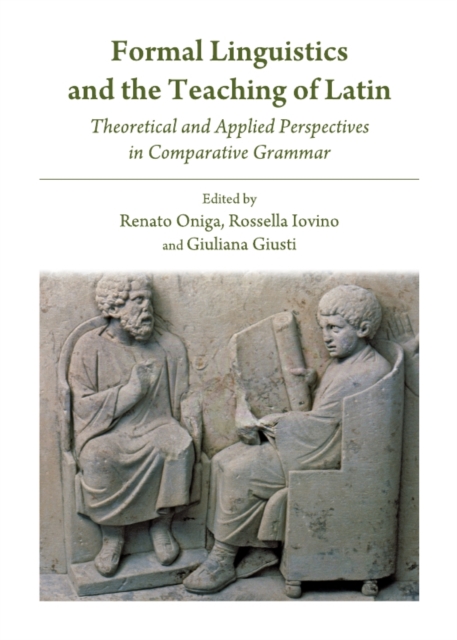
Formal linguistics and the teaching of Latin : theoretical and applied perspectives in comparative grammar
This volume offers a coherent collection of 26 papers presented at an international conference held in November 2010, exploring the latest achievements of formal and comparative linguistics applied to the teaching of Latin. The three sections (syntax and morphology, semantics and pragmatics, history and theory of teaching) compare Latin with different ancient and modern languages, aiming to represent grammar rules as the product of mental processes. The book is addressed to linguists, teacher.
eBook
Some observations on ille and ipse in the Mulomedicina Chironis
This paper deals with the use of
and
in the veterinary treatise
(fourth century AD). We will first give the quantitative analysis of the data, then we will focus on the cases in which
and
co-occur with a noun or as pronouns. Regarding
, we will propose that, even in the absence of morphological distinctions, it presents the syntactic features of three different categories, namely (a) an anaphoric demonstrative, which will turn into the definite article; (b) a strong pronoun; (c) a weak pronoun from which clitic pronouns will develop in Romance. As for
, we will show that it can both co-occur with a noun already known in the context expressing anaphoricity, and be a subject and a direct/indirect object pronoun. Furthermore, it can be introduced by a preposition. When it is a pronoun,
expresses anaphoricity as well, although in many contexts (especially when it is used as a subject pronoun), it is possible to identify an emphatic value for
, which can presumably be due to the realisation of the subject in a pro-drop language.
Journal Article
Analisi comparativa del doppio accusativo latino
Cette étude propose une analyse comparée de quelques verbes ditransitifs en latin et en anglais dont les deux arguments internes (le thème et le destinataire) sont à l'accusatif. En anglais, la construction à « double accusatif » coexiste avec la possibilité d'exprimer le destinataire comme un objet indirect introduit par la préposition to. Au passif, les deux constructions se comportent de manière différente : tandis que dans le cas du double accusatif, le sujet est le destinataire (Mary was given a book), dans le cas de la construction prépositionnelle, le sujet est le thème (a book was given to Mary). En latin, où la construction à double accusatif n'est pas concurrencée par la construction à objet indirect, le destinataire est généralement le sujet du double accusatif au passif, à l'exception des uerba rogandi. On montrera que cette exception n'est qu'apparente et que le latin peut, lui aussi, exprimer le destinataire comme un objet indirect au datif. This paper proposes a comparative analysis of some ditransitive verbs in Latin and English which assign accusative case to both internal arguments (theme and recipient). In English, these verbs also display the possibility to realize the recipient as the object of the preposition to. In the passive, the two constructions behave differently. Whilst in the double accusative construction the subject is the recipient (Mary was given a book), in the prepositional construction the subject is the theme (a book was given to Mary). In Latin, in which the double object construction is generally known to be the only possibility, the tendency to have the recipient as the subject of the double object construction in the passive is confirmed, with the exception of verba rogandi. This exception will be shown to be only apparent and will be reduced to the possibility for verba rogandi to realize the recipient as indirect object in dative case.
Journal Article


Gerd symptoms after laparoscopic Roux-en-Y gastric bypass: an emerging scenario
Laparoscopic Roux-en-Y gastric bypass (RYGB) is the second most performed bariatric procedure and it is considered the procedure of choice to treat patients with severe obesity and gastroesophageal reflux disease (GERD). However, some authors described the new onset or the recurrence of GERD symptoms after RYGB, and data at follow-up were scanty. In our center, we evaluated trend in weight, GERD symptoms and obesity-related comorbidities in 45 patients undergone RYGB at least 60 months before (mean follow-up 99.9 ± 22.9 months). At RYGB 51.1% patients referred preoperative GERD symptoms; among them, 47.8% showed an intraoperative hiatal hernia (HH). At medium-term follow-up mean BMI was significantly lower compared to baseline (p < 0.001). Among patients with preoperative GERD, 69.6% had GERD resolution and 30.4% reported postoperative GERD symptoms. Furthermore, 18.2% without preoperative GERD referred postoperative GERD new onset. We confirmed that RYGB as primary intervention provides satisfactory weight loss and a high percentage of GERD symptoms resolution. However, about 24.4% of patients complained of GERD symptoms at medium-term follow-up. The pathophysiology of GERD after RYGB, de novo or persistence, is not completely understood and several hypotheses could be drawn; however, further studies focusing the pathophysiology of these symptoms are needed.
Journal Article

Intravitreal Dexamethasone Implant as a Sustained Release Drug Delivery Device for the Treatment of Ocular Diseases: A Comprehensive Review of the Literature
Drug delivery into the vitreous chamber remains a great challenge in the pharmaceutical industry due to the complex anatomy and physiology of the eye. Intravitreal injection is the mainstream route of drug administration to the posterior segment of the eye. The purpose of this review is to assess the current literature about the widening use of the intravitreal 0.7 mg dexamethasone (Dex) implant, and to provide a comprehensive collection of all the ocular disorders that benefit from Dex administration. Although anti-vascular endothelial growth-factors (VEGFs) have been largely indicated as a first-choice level, the Dex implant represents an important treatment option, especially in selected cases, such as vitrectomized eyes or patients in whom anti-VEGF failed or are contraindicated. In this article, the safety profile as well as the list of the possible complications related to intravitreal Dex injection are also discussed.
Journal Article
