
Catalogue Search | MBRL


Are you sure you want to remove the book from the shelf?

{{itemTitle}}
2
result(s) for
"Isaacson, Walter. Einstein : his life and universe"
Sort by:
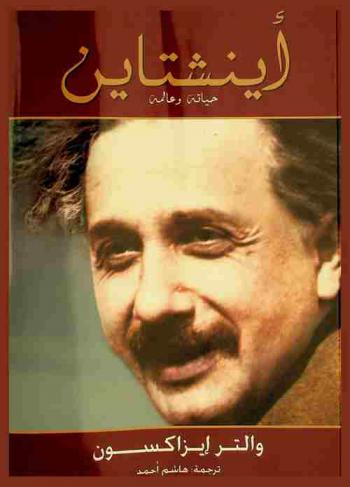
أينشتاين : حياته وعالمه
نجح والتر إيزاكسون في تقديم أينشتاين من جميع جوانبه، مستخدما أسلوبا سلسا ينم عن اهتمام كبير بالتفاصيل والدقة العلمية، ليصطحبنا معه في رحلة نحلق فيها عبر حياة وعقل وعلم ذلك الرجل الذي غير طريقة نظرتنا إلى الكون\"، وقال سيلفيستر جيمس جيتس أستاذ الفيزياء بجامعة ميريلاند: \"يؤدي هذا الكتاب مهمة عظيمة بتناوله الجوانب العلمية بصورة دقيقة، وبكشفه خبايا حياة أينشتاين الرجل\".
Book
NOTEBOOK, Math rebel, where are you?
[Albert Einstein] intuitively understood that math was nature's playbook. So, at age 16, being a bit more advanced than my daughter, he was imagining and picturing Maxwell's equations, which describe electromagnetic waves. How would these equations be manifest, he wondered, to someone who was riding alongside a light beam? If you caught up, the waves should seem stationary relative to you, but Maxwell's equations didn't allow for that. It worried Einstein mightily for the next 10 years. Others had come close to that insight, including Henri Poincar and Hendrik Lorentz. But Einstein had a rebelliousness, a willingness not to conform, that they lacked. He alone was willing to discard the notion of absolute time, which had been a sacred tenet of classical physics ever since Sir Issac Newton in his \"Principia\" had declared in 1687 that it tick-tocked along \"without relation to anything external.\"
Newspaper Article