
Catalogue Search | MBRL


Are you sure you want to remove the book from the shelf?

{{itemTitle}}
288
result(s) for
"J. DAVID ARCHIBALD"
Sort by:

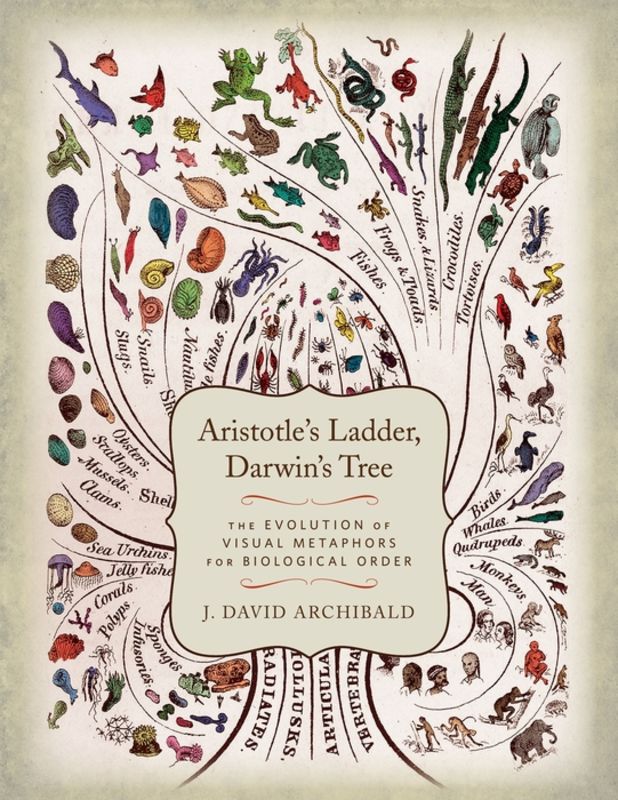
Aristotle's ladder, Darwin's tree
Leading paleontologist J. David Archibald explores the rich history of visual metaphors for biological order from ancient times to the present and their influence on humans' perception of their place in nature, offering uncommon insight into how we went from standing on the top rung of the biological ladder to embodying just one tiny twig on the tree of life. He begins with the ancient but still misguided use of ladders to show biological order, moving then to the use of trees to represent seasonal life cycles and genealogies by the Romans. The early Christian Church then appropriated trees to represent biblical genealogies. The late eighteenth century saw the tree reclaimed to visualize relationships in the natural world, sometimes with a creationist view, but in other instances suggesting evolution. Charles Darwin's On the Origin of Species (1859) exorcised the exclusively creationist view of the \"tree of life,\" and his ideas sparked an explosion of trees, mostly by younger acolytes in Europe. Although Darwin's influence waned in the early twentieth century, by midcentury his ideas held sway once again in time for another and even greater explosion of tree building, generated by the development of new theories on how to assemble trees, the birth of powerful computing, and the emergence of molecular technology. Throughout Archibald's far-reaching study, and with the use of many figures, the evolution of \"tree of life\" iconography becomes entwined with our changing perception of the world and ourselves.
eBook


Quantitative Analysis of the Timing of the Origin and Diversification of Extant Placental Orders
Fossil evidence is consistent with origination and diversification of extant placental orders in the early Tertiary (Explosive Model), and with the possibility of some orders having stem taxa extending into the Cretaceous (Long Fuse Model). Fossil evidence that 15 of 18 extant placental orders appeared and began diversification in the first 16 m.y. of the Cenozoic is, however, at odds with molecular studies arguing some orders diversified up to 40 m.y. earlier in the Early Cretaceous (Short Fuse Model). The quality of the fossil record was assessed by tabulating localities of all mammals in the last 105 m.y. Global locality data (except Africa) for 105 m.y. of eutherian evolution indicate discernible biogeographic patterns by the last 15 m.y. of the Cretaceous. Eutherian genera increase from 11 in latest Cretaceous to 139 in earliest Tertiary, although both are represented by about 50 localities. Yet even in the Late Cretaceous of North America and Asia where eutherians are abundant, none of the 18 extant orders are definitely known. A series of Monte Carlo simulations test whether the rapid appearance of most mammalian orders is statistically significant, and if so, whether it is a radiation event or an artifact of a limited fossil record. Monte Carlo tests affirm that the clustering of appearances in the early Cenozoic is statistically significant. Quantitative analysis of the locality data suggests that the number of genera described is a function of the number of localities sampled. In contrast, the number of orders is not a simple function of localities and thus does not appear to be limited by localities. A second set of Monte Carlo simulations confirms that the increase in orders cannot be explained by the limited number of localities sampled. Even for best-fit simulations, the observed pattern of ordinal appearances is steeper than expected under a variety of null models. These quantitative analyses of the fossil record demonstrate that the rapid ordinal appearances cannot be ascribed to limited Late Cretaceous sample sizes; thus, early Tertiary ordinal diversification is real. Although the fossil record is incomplete, it appears adequate to reject the hypothesis that orders of placentals began to diversify before the K/T boundary.
Journal Article


Fossil Evidence for a Late Cretaceous Origin of \Hoofed\ Mammals
Seventeen of eighteen orders of living placental mammals are not known before 65 million years ago. The monophyly of each order is well established, but interrelations have been less certain. A superordinal grouping of up to seven extant orders plus a variety of extinct orders, all included within Ungulata (\"hoofed\" mammals), can be linked to Late Cretaceous mammals from the 85-million-year-old Bissekty Formation, Uzbekistan (and, less certainly, North America and Europe), thus pushing the origin of this major clade back by 20 million years. Ungulatomorphs are not closely related to primates, rodents, or rabbits.
Journal Article

Charles Darwin
In 1859 Charles Darwin published 'On the Origin of Species'. With this bedrock of biology books, Darwin carved a new origin-story for all life: evolution rather than creation. But this single book is not the whole story. In this biography, J. David Archibald describes and analyzes Darwin's prodigious body of work and complex relationships with colleagues, as well as his equally productive home life - he lived with his wife and seven surviving children in the bustling environs of Down House, south of London. There, among his family and friends, Darwin continued to experiment and write many more books on orchids, sex, emotions, and earthworms until his death in 1882, when he was honoured with burial at Westminster Abbey. This is a fresh, up-to-date account of the life and work of a most remarkable man.
BOOK

Otolaryngology--head and neck surgery : rapid clinical and board review
A concise, high-yield otolaryngology text for rapid review This well-organized text for rapid clinical and board review contains high-yield facts using a question and answer format that covers all subspecialty topics in otolaryngology.
eBook
Protungulatum, Confirmed Cretaceous Occurrence of an Otherwise Paleocene Eutherian (Placental?) Mammal
Neither pre-Cenozoic crown eutherian mammals (placentals) nor archaic ungulates (“condylarths”) are known with certainty based on the fossil record. Herein we report a new species of the Paleocene archaic ungulate (“condylarth”)
Protungulatum
from undisputed Late Cretaceous aged rocks in Montana USA based on an isolated last upper premolar, indicating rare representatives of these common early Tertiary mammals appeared in North America a minimum of 300 k years before the extinction of non-avian dinosaurs. The other 1200 mammal specimens from the locality are characteristic Late Cretaceous taxa. This discovery overturns the current hypothesis that archaic ungulates did not appear in North America until after the Cretaceous/Tertiary (K/T) boundary and also suggests that other reports of North American Late Cretaceous archaic ungulates may be correct. Recent studies, including ours, cannot determine whether
Protungulatum
does or does not belong to the crown clade Placentalia.
Journal Article