
Catalogue Search | MBRL


Are you sure you want to remove the book from the shelf?

{{itemTitle}}
172
result(s) for
"Jackson, John L., Jr"
Sort by:

Social Policy and Social Justice
The Penn School of Social Policy and Practice enjoys a reputation as Penn'ssocial justice school, for its faculty actively strives to translate the highest ideals into workable programs that better people's lives. In this election year, as Americans debate issues like immigration, crime, mass incarceration, policing, and welfare reform, and express concerns over increasing inequality, tax policy, and divisions by race, sex, and class, \"SP2,\" as the school is colloquially known, offers its expertise in addressing the pressing matters of our day. The practical solutions on offer in this volume showcase the judgment and commitment of the school's scholars and practitioners, working to change politics from blood sport to common undertakings.
Contributors:Cindy W. Christian, Cynthia A. Connolly, Dennis Culhane, Ezekiel Dixon-Román, Malitta Engstrom, Kara Finck, Nancy Franke, Antonio Garcia, Toorjo Ghose, Johanna Greeson, Chao Guo, David Hemenway, Amy Hillier, Roberta Iversen, Alexandra Schepens, Phyllis Solomon, Susan B. Sorenson, Mark Stern, Allison Thompson, Debra Schilling Wolfe.
eBook
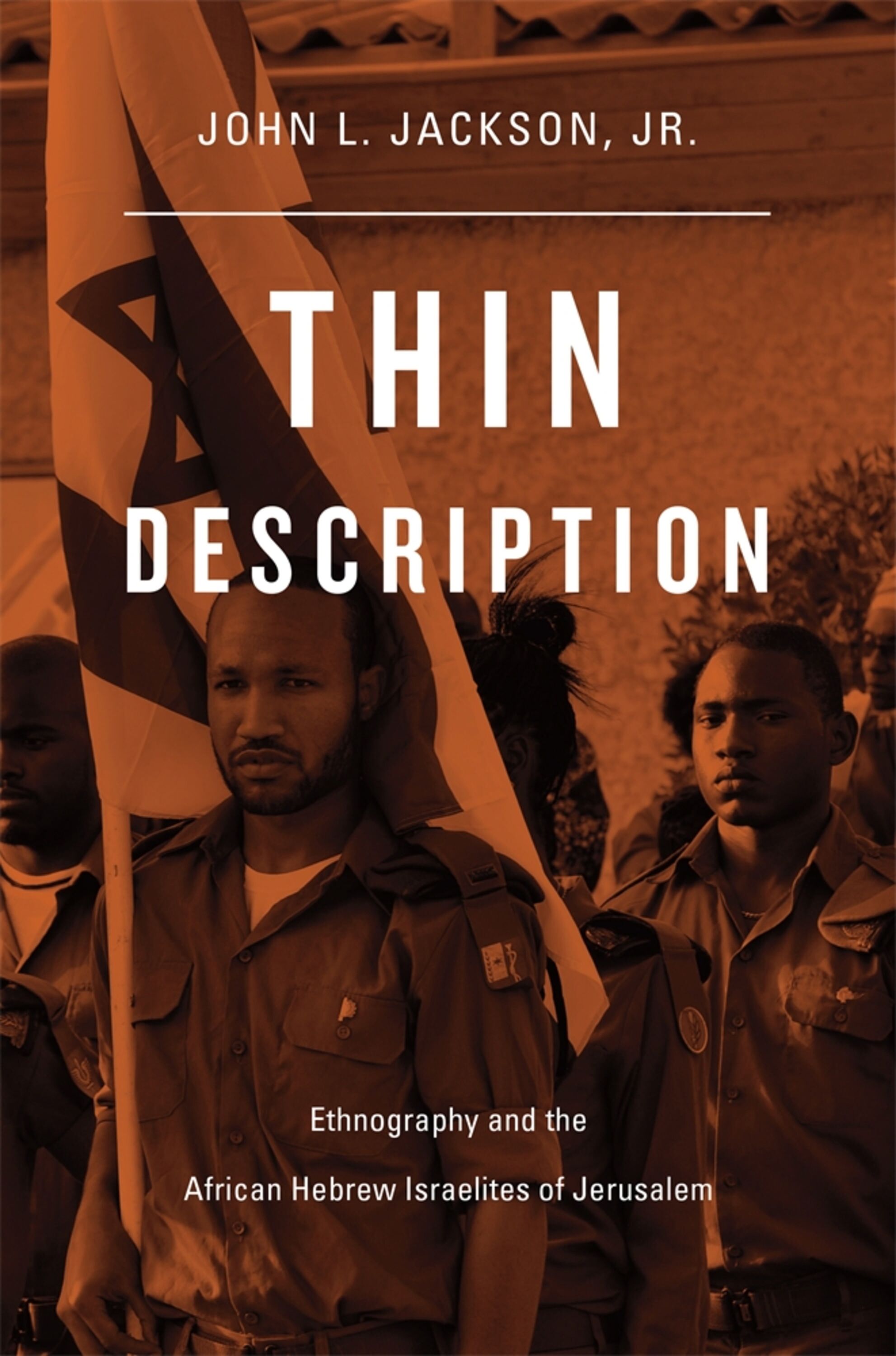
Thin description : ethnography and the African Hebrew Israelites of Jerusalem
African Hebrew Israelites of Jerusalem are often dismissed as a fringe cult, but John L. Jackson questions what \"fringe\" means when cultural practices of every stripe circulate freely on the Internet. He reveals how race, religion, and ethnographic representation must be understood anew in the 21st century lest we reenact past errors.
eBook

Televised redemption : Black religious media and racial empowerment
How Black Christians, Muslims, and Jews have used media to prove their equality, not only in the eyes of God but in society.
The institutional structures of white supremacy—slavery, Jim Crow laws, convict leasing, and mass incarceration—require a commonsense belief that black people lack the moral and intellectual capacities of white people. It is through this lens of belief that racial exclusions have been justified and reproduced in the United States. Televised Redemption argues that African American religious media has long played a key role in humanizing the race by unabashedly claiming that blacks are endowed by God with the same gifts of goodness and reason as whites—if not more, thereby legitimizing black Americans’ rights to citizenship.
If racism is a form of perception, then religious media has not only altered how others perceive blacks, but has also altered how blacks perceive themselves. Televised Redemption argues that black religious media has provided black Americans with new conceptual and practical tools for how to be in the world, and changed how black people are made intelligible and recognizable as moral citizens. In order to make these claims to black racial equality, this media has encouraged dispositional changes in adherents that were at times empowering and at other times repressive. From Christian televangelism to Muslim periodicals to Hebrew Israelite radio, Televised Redemption explores the complicated but critical redemptive history of African American religious media.
eBook

On Ethnographic Sincerity
This essay posits sincerity and humor as linked ways of politicizing the interactions that underpin all ethnographic encounters. This politicization is contrasted with conventional anthropological preoccupations with authenticity (and fetishizations of ethnographic writing), and it demands attention to the human bodies that constitute ethnographic intersubjectivity. Combining a discussion of Habermas’s public sphere with the exploits of a nineteenth‐century African American mesmerist and protoanthropologist, Paschal Randolph, I argue against one kind of “occulted anthropology” (the disembodied version attributed to Habermas) for an agential variety exemplified by Randolph’s differently framed investments in the political powers of occultist possibility. Instead of being seduced by would‐be objective attempts to access a disembodied (i.e., universal) subjectivity, I argue for a Paschal‐like reclamation of the vulnerable ethnographic body (in all of its contingent particularity), a reclamation that fuses rational minds to laughing bodies while opening up space for a critique of potentially impoverished conceptualizations of politics and political activity.
Journal Article

ETHNOGRAPHY IS, ETHNOGRAPHY AIN'T
Using a notion of \"the digital\" as one of its master metaphors, a version of the term reliant on Kara Keeling's discussion of \"digital humanism,\" this piece argues that there is something about the nonlinearities defining digitality's difference that might help us to think about recalibrations in the ethnographic project itself. From a discussion of Marlon Riggs's filmic depiction of his own death (as one way to talk about the nondigital) to a machine that uses digital technology to play with temporality in broadcast television, this article wants to ask what the changing social relations (and existential realities) predicated on the ubiquity of digital media might mean for ethnographic research and writing today. With the African Hebrew Israelites of Jerusalem as central ethnographic subjects, I argue that taking digitality seriously means redefining some of what ethnography is and ain't in a post—Writing Culture moment.
Journal Article

Racial paranoia : the unintended consequences of political correctness : the new reality of race in America
A provocative new paradigm of race relations in the twenty-first century, in which the overt racism of the past has been replaced by subconscious suspicions and whispered conspiracy theories.
eBook
Racial Paranoia: The Unintended Consequences of Political Correctness
In this courageous book, John L. Jackson, Jr. draws on current events as well as everyday interactions to demonstrate the culture of race-based paranoia and its profound effects on our lives. He explains how it is cultivated and reinforced, and how it complicates the goal of racial equality. In this paperback edition, Jackson explores the 2008 presidential election, weaving in examples ranging from the notoriousNew Yorkercover toSaturday Night Live's political parodies.
eBook


All Yah’s Children
Cet article évoque l’histoire de l’émigration des « Israélites africains hébreux de Jérusalem », un groupe d’Africains-Américains qui ont quitté les États-Unis pour l’Afrique de l’Ouest (puis pour l’Afrique du Nord-Est) à la fin des années 1960. Leur voyage reposait sur une forme de sensibilité afrocentriste, sur un mélange de réponses à l’appel de Marcus Garvey pour une politique centrée sur l’Afrique, et de revendications d’une altérité africaine ontologique. En somme, les mêmes revendications intellectuelles qui commençaient tout juste à être codifiées dans le monde universitaire américain par des académiques comme Molefi Kete Asante. Je soutiens que ces « Israélites africains hébreux » donnent à voir une forme complexe d’Afrocentrisme, une version hébraïcisée qui se conforme à certaines formes canoniques d’Afrocentrisme tout en échappant à d’autres. En outre, leurs conceptions du corps aident à expliquer le manque d’intérêt qu’ils ont suscité dans les discussions plus générales de l’Afrocentrisme et de ses relations historiques et institutionnelles avec d’autres formes de contre-discours afro-centrés.
Journal Article