
Catalogue Search | MBRL


Are you sure you want to remove the book from the shelf?

{{itemTitle}}
13,202
result(s) for
"Jackson, Peter A"
Sort by:

The Ambiguous Allure of the West
The Ambiguous Allure of the West examines the impact of Western imperialism on Thai cultural development from the 1850s to the present and highlights the value of postcolonial analysis for studying the ambiguities, inventions, and accommodations with the West that continue to enrich Thai culture. Since the mid-nineteenth century, Thais have adopted and adapted aspects of Western culture and practice in an ongoing relationship that may be characterized as semicolonial. As they have done so, the notions of what constitutes \"Thainess\" have been inflected by Western influence in complex and ambiguous ways, producing nuanced, hybridized Thai identities.The Ambiguous Allure of the West brings together Thai and Western scholars of history, anthropology, film, and literary and cultural studies to analyze how the protean Thai self has been shaped by the traces of the colonial Western Other. Thus, the book draws the study of Siam/Thailand into the critical field of postcolonial theory, expanding the potential of Thai Studies to contribute to wider debates in the region and in the disciplines of cultural studies and critical theory. The chapters in this book present the first sustained dialogue between Thai cultural studies and postcolonial analysis.By clarifying the distinctive position of semicolonial societies such as Thailand in the Western-dominated world order, this book bridges and integrates studies of former colonies with studies of the Asian societies that retained their political independence while being economically and culturally subordinated to Euro-American power.
eBook

Queer Bangkok
The Thai capital Bangkok is the unrivalled centre of the country’s gay, lesbian, and transgender communities. These communities are among the largest in Southeast Asia, and indeed in the world, and have a diversity, social presence, and historical depth that set them apart from the queer cultures of many neighbouring societies. The first years of the twenty-first century have marked a significant transition moment for all of Thailand’s LGBT cultures, with a multidimensional expansion in the geographical extent, media presence, economic importance, political impact, social standing, and cultural relevance of Thai queer communities. This book analyses the roles of the market and media—especially cinema and the Internet—in these transformations, and considers the ambiguous consequences that the growing commodification and mediatization of queer lives have had for LGBT rights in Thailand. A key finding is that in the early twenty-first century processes of global queering are leading to a growing Asianization of Bangkok’s queer cultures. This book traces Bangkok’s emergence as a central focus of an expanding regional network linking gay, lesbian, and transgender communities in Hong Kong, Singapore, Taiwan, Indonesia, the Philippines and other rapidly developing East and Southeast Asian societies.
eBook

First queer voices from Thailand : Uncle Go's advice columns for gays, lesbians and kathoeys
First Queer Voices from Thailand: Uncle Go’s Advice Columns for Gays, Lesbians and Kathoeys is a fully revised and substantially expanded edition of Peter Jackson’s highly regarded pioneering study of an Asian gay culture, Male Homosexuality in Thailand (1989). The hero of Jackson’s fascinating narrative is “Uncle Go”, pen name of the sexually libertarian but avowedly heterosexual editor of a popular magazine, whose “agony uncle” columns in the 1970s provided unique spaces in the national press for Thailand’s gays, lesbians and transgenders (kathoeys) to speak for themselves in the public domain. By allowing the voices of alternative sexualities to be heard, Uncle Go emerged as Thailand’s first champion of gender equality and sexual rights.
Peter Jackson translates and analyses selected correspondence published in Uncle Go’s advice columns, preserving and presenting important primary sources. In this new edition, Jackson has expanded his coverage to include not only letters from Thai gay men, but also those from lesbians and transgenders, thus capturing the full diversity of Thailand’s modern queer cultures at a key moment in their historical development when new understandings of sexual identities were first communicated to the wider community.
eBook

AsiaPacifiQueer
This interdisciplinary collection examines the shaping of local sexual cultures in the Asian Pacific region in order to move beyond definitions and understandings of sexuality that rely on Western assumptions. The diverse studies in AsiaPacifiQueer demonstrate convincingly that in the realm of sexualities, globalization results in creative and cultural admixture rather than a unilateral imposition of the Western values and forms of sexual culture. These essays range across the Pacific Rim and encompass a variety of forms of social, cultural, and personal expression, examining sexuality through music, cinema, the media, shifts in popular rhetoric, comics and magazines, and historical studies. By investigating complex processes of localization, interregional borrowing, and hybridization, the contributors underscore the mutual transformation of gender and sexuality in both Asian Pacific and Western cultures._x000B__x000B_Contributors are Ronald Baytan, J. Neil C. Garcia, Kam Yip Lo Lucetta, Song Hwee Lim, J. Darren Mackintosh, Claire Maree, Jin-Hyung Park, Teri Silvio, Megan Sinnott, Yik Koon Teh, Carmen Ka Man Tong, James Welker, Heather Worth, and Audrey Yue.
eBook

The Supernaturalization of Thai Political Culture: Thailand's Magical Stamps of Approval at the Nexus of Media, Market and State
Since the 1980s, new supernatural movements have become highly visible additions to Thailand's spiritual landscapes and religious marketplaces. Focused on supernatural intervention to bring success, wealth and prosperity in Thailand's expanding economy, these movements are often only tangentially related to orthodox Theravada Buddhist teachings and practice. These highly commodifìed wealth-oriented movements emerged in the context of Thailand's economic boom in the 1980s and 1990s, and have continued to grow in popularity and develop further through the 1997 Asian economic crisis and the political conflicts that have destabilized Thai society over the past decade. The large number of colourful special issues of Thai postage stamps devoted to supernatural cults of prosperity released since 2004 reflects the relocation of these movements from the margins to the centre of national religious practice. These stamp special issues also reflect a major shift in the regime of power over public imaging that depicts the participation of Thailand's economic, political and royal elites in new forms of supernatural ritual. This ritual has now been incorporated into state projects under the aegis of officially sponsored Theravada Buddhism. No longer kept hidden or private, elite participation in supernatural ritual is becoming an increasingly visible and politically significant dimension of the symbolism and exercise of power in early twenty-first-century Thailand.
Journal Article
Space, Theory, and Hegemony
The classical form of area studies based on the notion of culture-language areas has been critiqued by globalization theorists and poststructuralists as old-fashioned (pre-globalization) and theoretically naïve (empirical). However, the death of area studies would leave students of Asian societies in a theoretically and politically fraught situation. While the essentialism of classical area studies must be abandoned, the critiques presented by globalization and poststructuralist theorists often presume that capitalist globalization entails the erasure of borders, the homogenization of cultures, and the end of spatiality as a domain of theoretically significant difference. These views are critiqued as ideologically driven and empirically unfounded. Geography remains a theoretically significant domain of discursive and cultural difference under globalization. A theoretically sophisticated area studies project therefore remains an essential method for understanding the twenty-first century world.
Journal Article

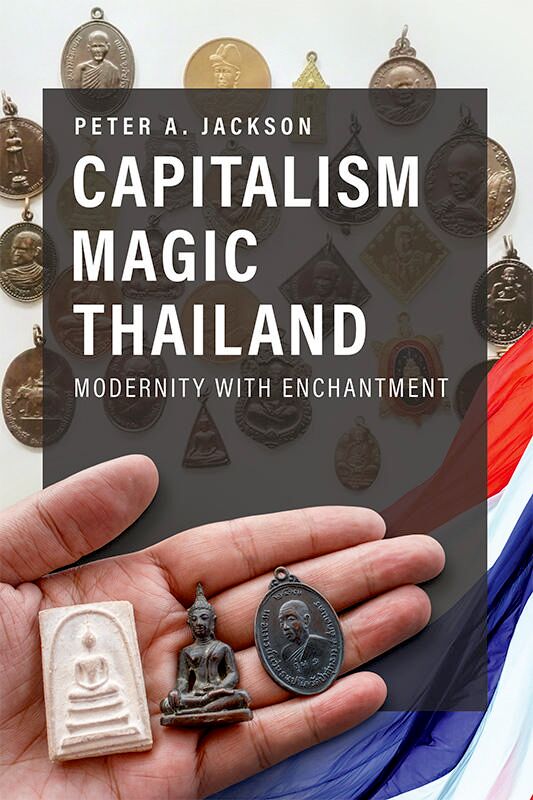
Capitalism magic Thailand : modernity with enchantment
By studying intersections among new cults of wealth, ritually empowered amulets and professional spirit mediumship—which have emerged together in Thailand's dynamic religious field in recent decades—Capitalism Magic Thailand explores the conditions under which global modernity produces new varieties of enchantment. Bruno Latour's account of modernity as a condition fractured between rationalizing ideology and hybridizing practice is expanded to explain the apparent paradox of new forms of magical ritual emerging alongside religious fundamentalism across a wide range of Asian societies. In Thailand, novel and increasingly popular varieties of ritual now form a symbolic complex in which originally distinct cults centred on Indian deities, Chinese gods and Thai religious and royal figures have merged in commercial spaces and media sites to sacralize the market and wealth production. Emerging within popular culture, this complex of cults of wealth, amulets and spirit mediumship is supported by all levels of Thai society, including those at the acme of economic and political power. New theoretical frameworks are presented in analyses that challenge the view that magic is a residue of premodernity, placing the dramatic transformations of cultic ritual centre stage in modern Thai history. It is concluded that modern enchantment arises at the confluence of three processes: neoliberal capitalism's production of occult economies, the auraticizing effects of technologies of mass mediatization, and the performative force of ritual in religious fields where practice takes precedence over doctrine.
eBook


An explosion of Thai identities: Global queering and re-imagining queer theory
This paper reflects on recent research on Thai discourses of gender and eroticism in order to problematize some of the universalist assumptions that have dominated discussion of the international proliferation of forms of erotic diversity. By mapping the proliferation of Thai gender/sex categories from the 1960s to the 1980s, the paper shows that Thai homoeroticisms are not converging towards Western models and points to the cultural limits of Foucauldian-modelled histories of sexuality. In particular, it demonstrates the inability of Foucauldian history of sexuality, and queer theoretical approaches drawing on Foucault, to account for shifts in Thai discourses in which gender and sexuality do not exist as distinct categories. Only when current feminist theories of gender and queer theories of sexuality are integrated so as to offer a unified account of the eroticization of gender, and the gendering of eroticism, will Western theoretical models be capable of mapping shifts in non-Western patterns of eroticism.
Journal Article