
Catalogue Search | MBRL


Are you sure you want to remove the book from the shelf?

{{itemTitle}}
131
result(s) for
"Jaffe, Andrew H"
Sort by:

The Simons Observatory: Beam Characterization for the Small Aperture Telescopes
We use time-domain simulations of Jupiter observations to test and develop a beam reconstruction pipeline for the Simons Observatory Small Aperture Telescopes. The method relies on a mapmaker that estimates and subtracts correlated atmospheric noise and a beam fitting code designed to compensate for the bias caused by the mapmaker. We test our reconstruction performance for four different frequency bands against various algorithmic parameters, atmospheric conditions, and input beams. We additionally show the reconstruction quality as a function of the number of available observations and investigate how different calibration strategies affect the beam uncertainty. For all of the cases considered, we find good agreement between the fitted results and the input beam model within an ∼1.5% error for a multipole range ℓ = 30–700 and an ∼0.5% error for a multipole range ℓ = 50–200. We conclude by using a harmonic-domain component separation algorithm to verify that the beam reconstruction errors and biases observed in our analysis do not significantly bias the Simons Observatory r-measurement
Journal Article

Concluding Remarks from a Cosmologist
I conclude the SCCC21 conference highlighting some of the contrasts we heard about, some specific topics (the statistics of random fields), and discuss how some of these play out in the analysis of cosmic microwave background data. I conclude with a hopeful look at the efficacy of blind analyses in the CMB and elsewhere in cosmology.
Journal Article
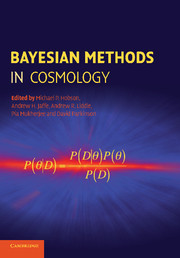
Bayesian Methods in Cosmology
In recent years cosmologists have advanced from largely qualitative models of the Universe to precision modelling using Bayesian methods, in order to determine the properties of the Universe to high accuracy. This timely book is the only comprehensive introduction to the use of Bayesian methods in cosmological studies, and is an essential reference for graduate students and researchers in cosmology, astrophysics and applied statistics. The first part of the book focuses on methodology, setting the basic foundations and giving a detailed description of techniques. It covers topics including the estimation of parameters, Bayesian model comparison, and separation of signals. The second part explores a diverse range of applications, from the detection of astronomical sources (including through gravitational waves), to cosmic microwave background analysis and the quantification and classification of galaxy properties. Contributions from 24 highly regarded cosmologists and statisticians make this an authoritative guide to the subject.
eBook

Constraining large-scale structure theories with the cosmic background radiation
The case is strong that cosmic microwave background (CMB) and large scale structure (LSS) observations can be combined to determine the theory of structure formation and the cosmological parameters that define it. We review: the relevant (10+) parameters associated with the inflation model of fluctuation generation and the matter content of the universe; the relation between LSS and primary and secondary CMB anisotropy probes as a function of wavenumber; how COBE constraints on energy injection rule out explosions as a dominant source of LSS; and how current anisotropy band-powers in multipole-space, at levels ca. 10−5)2, strongly support the gravitational instability theory and suggest the universe could not have reionized too early. We use Bayesian analysis methods to determine what current CMB and CMB+LSS data imply for inflation-based Gaussian fluctuations in tilted CDM, hCDM and oCDM model sequences with cosmological age 11 - 15 Gyr, consisting of mixtures of baryons, cold 'c' (and possibly hot 'h') dark matter, vacuum energy , and curvature energy 'o' in open cosmologies. For example, we find the slope of the initial spectrum is within about 5% of the (preferred) scale-invariant form when just the CMB data are used, and for CDM when LSS data are combined with CMB; with both, a non-zero value of is strongly preferred (ca. for a 13 Gyr sequence, similar to the value from SNIa). The oCDM sequence prefers tot < 1, but is overall much less likely than the flat ≠ 0 sequence with CMB+LSS. We also review the rosy forecasts of angular power spectra and parameter estimates from future balloon and satellite experiments when foreground and systematic effects are ignored to show where cosmic parameter determination can go with CMB information alone.
Journal Article

New troubles for inflation?
An analysis of inflationary models favored by theorists for the expansion of the Universe contradicts the predictions that the distribution of density perturbations in the early Universe should be Gaussian, which implies specific forms for the correlation between densities at several different points.
Journal Article
The Squealer: Sensification of model exploration and model misfit
We introduce a method for visual and auditory feedback when exploring the fit of a model to data. Starting with a best-fit curve fit to data, the user can drag the curve to a new position and the computer will emit a squeal, becoming louder and more unpleasant as the discrepancy between curve and data increases. We demonstrate with four examples: a two-parameter curve fit to golf putting data, a four-parameter curve fit to dilution assays, a fit to cosmological data sensitive to the parameters of the Big Bang model, and a nonparametric Gaussian process fit to temperature readings.
Paper
Kernel-Based Emulator for the 3D Matter Power Spectrum from CLASS
The 3D matter power spectrum, \\(P_(k,z)\\) is a fundamental quantity in the analysis of cosmological data such as large-scale structure, 21cm observations, and weak lensing. Existing computer models (Boltzmann codes) such as CLASS can provide it at the expense of immoderate computational cost. In this paper, we propose a fast Bayesian method to generate the 3D matter power spectrum, for a given set of wavenumbers, \\(k\\) and redshifts, \\(z\\). Our code allows one to calculate the following quantities: the linear matter power spectrum at a given redshift (the default is set to 0); the non-linear 3D matter power spectrum with/without baryon feedback; the weak lensing power spectrum. The gradient of the 3D matter power spectrum with respect to the input cosmological parameters is also returned and this is useful for Hamiltonian Monte Carlo samplers. The derivatives are also useful for Fisher matrix calculations. In our application, the emulator is accurate when evaluated at a set of cosmological parameters, drawn from the prior, with the fractional uncertainty, \\( P_/P_\\) centred on 0. It is also \\( 300\\) times faster compared to CLASS, hence making the emulator amenable to sampling cosmological and nuisance parameters in a Monte Carlo routine. In addition, once the 3D matter power spectrum is calculated, it can be used with a specific redshift distribution, \\(n(z)\\) to calculate the weak lensing and intrinsic alignment power spectra, which can then be used to derive constraints on cosmological parameters in a weak lensing data analysis problem. The software (\\(emuPK\\)) can be trained with any set of points and is distributed on Github, and comes with a pre-trained set of Gaussian Process (GP) models, based on 1000 Latin Hypercube (LH) samples, which follow roughly the current priors for current weak lensing analyses.
Paper
Cosmic topology. Part Ic. Limits on lens spaces from circle searches
Cosmic microwave background (CMB) temperature and polarization observations indicate that in the best-fit \\(\\) Cold Dark Matter model of the Universe, the local geometry is consistent with at most a small amount of positive or negative curvature, i.e., \\(_K1\\). However, whether the geometry is flat (\\(E^3\\)), positively curved (\\(S^3\\)) or negatively curved (\\(H^3\\)), there are many possible topologies. Among the topologies of \\(S^3\\) geometry, the lens spaces \\(L(p,q)\\), where \\(p\\) and \\(q\\) (\\(p>1\\) and \\(0
Paper
KiDS+VIKING-450 cosmology with Bayesian hierarchical model redshift distributions
Tomographic redshift distributions from photometric data are crucial ingredients in cosmic shear analysis, since they are required for the theoretical calculation of the signal based on the redshift distribution of the galaxies where the shear field is sampled. In this paper, we develop as a proof of concept Leistedt et al.'s template-based Bayesian Hierarchical Model framework into an application to weak lensing data by sampling the redshift distributions of the galaxies in the KiDS+VIKING-450 survey. We also use a principal component analysis to provide a set of representative templates drawn from a large superset. For computational tractability, subsets of \\(10^5\\) galaxies are chosen to determine the redshift distributions, and we test the sensitivity of the cosmological inference to the subset chosen, finding it to be subdominant compared to the statistical error. We marginalise over the inferred redshift distributions and find that the Bayesian method increases the clustering parameter compared with previous studies, alleviating the \\(S_8\\) tension with Planck, where \\(S_8_8_m/0.3=0.756 0.039\\), assuming flat \\(\\)CDM. The tension with Planck for this survey is reduced from \\(2.3\\) to \\(1.9\\). We also infer a value for the matter density, \\(_m=0.31 0.10\\).
Paper
Ultra-light axions and the kinetic Sunyaev-Zel'dovich Effect
Measurements of secondary cosmic microwave background (CMB) anisotropies, such as the Sunyaev-Zel'dovich (SZ) effect, will enable new tests of neutrino and dark sector properties. The kinetic SZ (kSZ) effect is produced by cosmological flows, probing structure growth. Ultra-light axions (ULAs) are a well-motivated dark-matter candidate. Here the impact of ULA dark matter (with mass \\(10^-27~ eV\\) to \\(10^-23~ eV\\)) on kSZ observables is determined, applying new analytic expressions for pairwise cluster velocities and Ostriker-Vishniac signatures in structure-suppressing models. For the future CMB-S4 and ongoing DESI galaxy surveys, the kSZ effect (along with primary anisotropies) will probe ULA fractions \\(_a = _axion/_ DM\\) as low as \\( 5\\%\\) if \\(m_a 10^-27~ eV\\) (at 95\\% C.L.), with sensitivity extending up to \\(m_a 10^-25~ eV\\). If reionization and the primary CMB can be adequately modeled, Ostriker-Vishniac measurements could probe values \\(_a 10^-3\\) if \\(10^-27~ eV m_a 10^-24~ eV\\), or \\(_a 1\\) if \\(m_a 10^-22~ eV\\), within the fuzzy dark matter window.
Paper