
Catalogue Search | MBRL


Are you sure you want to remove the book from the shelf?

{{itemTitle}}
4
result(s) for
"Jalloh, Charles, editor"
Sort by:

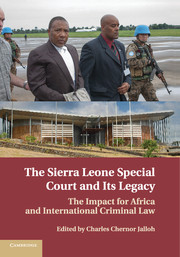
The Sierra Leone Special Court and its Legacy
The Special Court for Sierra Leone (SCSL) is the third modern international criminal tribunal supported by the United Nations and the first to be situated where the crimes were committed. This timely, important and comprehensive book is the first to critically assess the impact and legacy of the SCSL for Africa and international criminal law. Contributors include leading scholars and respected practitioners with inside knowledge of the tribunal, who analyze cutting-edge and controversial issues with significant implications for international criminal law and transitional justice. These include joint criminal enterprise; forced marriage; enlisting and using child soldiers; attacks against United Nations peacekeepers; the tension between truth commissions and criminal trials in the first country to simultaneously have the two; and the questions of whether it is permissible under international law for states to unilaterally confer blanket amnesties to local perpetrators of universally condemned international crimes.
eBook

Promoting accountability under international law for gross human rights violations in Africa : essays in honour of prosecutor Hassan Bubacar Jallow
Promoting Accountability under International Law for Gross Human Rights Violations in Africa reflects primarily upon the work of the International Criminal Tribunal for Rwanda in challenging impunity for serious crimes committed in Rwanda in 1994. The authors, among whom are leading scholars and practitioners of international law, draw lessons for future tribunals such as the permanent International Criminal Court.
eBook