
Catalogue Search | MBRL


Are you sure you want to remove the book from the shelf?

{{itemTitle}}
139
result(s) for
"James Diego Vigil"
Sort by:

The projects : gang and non-gang families in East Los Angeles
The Pico Gardens housing development in East Los Angeles has a high percentage of resident families with a history of persistent poverty, gang involvement, and crime. In some families, members of three generations have belonged to gangs. Many other Pico Gardens families, however, have managed to avoid the cycle of gang involvement. In this work, Vigil adds to the tradition of poverty research and elaborates on the association of family dynamics and gang membership. The main objective of his research was to discover what factors make some families more vulnerable to gang membership, and why gang resistance was evidenced in similarly situated non-gang-involved families. Providing rich, in-depth interviews and observations, Vigil examines the wide variations in income and social capital that exist among the ostensibly poor, mostly Mexican American residents. Vigil documents how families connect and interact with social agencies in greater East Los Angeles to help chart the routines and rhythms of the lives of public housing residents. He presents family life histories to augment and provide texture to the quantitative information. By studying life in Pico Gardens, Vigil feels we can better understand how human agency interacts with structural factors to produce the reality that families living in all public housing developments must contend with daily.
eBook
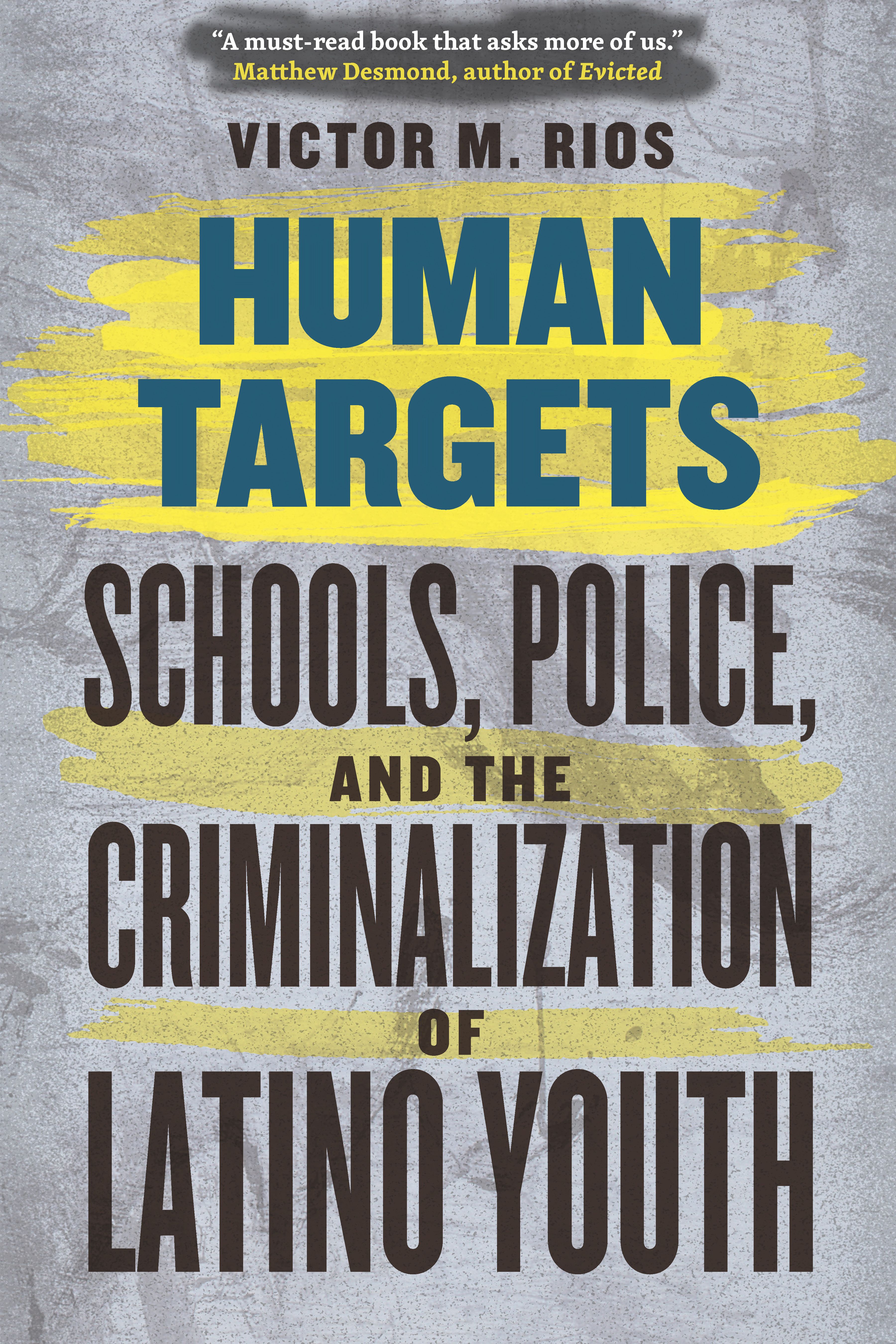
Human Targets
At fifteen, Victor Rios found himself a human target--flat on his ass amid a hail of shotgun fire, desperate for money and a place on the street.Faced with the choice of escalating a drug turf war or eking out a living elsewhere, he turned to a teacher, who mentored him and helped him find a job at an auto shop.
eBook

URBAN VIOLENCE AND STREET GANGS
What causes urban street gang violence, and how can we better understand the
forces that shape this type of adolescent and youth behavior? For close
to a century, social researchers have taken many different paths in attempting
to unravel this complex question, especially in the context of large-scale
immigrant adaptation to the city. In recent decades these researchers have
relied primarily on data gathered from survey quantitative approaches. This
review traces some of these developments and outlines how frameworks of
analysis have become more integrated and multidimensional, as ethnographic
strategies have come into vogue again. For the last couple of decades, either a
subculture of violence (i.e., the values and norms of the street gang embrace
aggressive, violent behavior) or a routine activities (i.e., hanging around
high crime areas with highly delinquent people) explanation dominated the
discussion. To broaden and deepen the picture, many other factors need to be
considered, such as ecological, socioeconomic, sociocultural, and
sociopsychological, particularly in light of the immigrant experience. A
multiple marginality framework lends itself to a holistic strategy that
examines linkages within the various factors and the actions and interactions
among them and notes the cumulative nature of urban street gang violence.
Questions that are addressed in this more integrated framework are: Where did
they settle? What jobs did they fill? How and why did their social
practices and cultural values undergo transformations? When and in what
ways did the social environment affect them? Finally, with whom did they
interact? In sum, in highlighting the key themes and features of what
constitutes urban street gang violence, this review suggests that the
qualitative style that relies on holistic information adds important details to
traditional quantitative data.
Journal Article

A Rainbow of Gangs
Winner, Best Book on Ethnic and Racial Politics in a
Local or Urban Setting , Organized Section on Race, Ethnicity, and
Politics of the American Political Science Association,
2002
This cross-cultural study of Los Angeles gangs
identifies the social and economic factors that lead to gang
membership and underscores their commonality across four ethnic
groups--Chicano, African American, Vietnamese, and
Salvadorian. With nearly 1,000 gangs and 200,000 gang
members, Los Angeles holds the dubious distinction of being the
youth gang capital of the United States. The process of street
socialization that leads to gang membership now cuts across all
ethnic groups, as evidenced by the growing numbers of gangs among
recent immigrants from Asia and Latin America.
This cross-cultural study of Los Angeles gangs identifies the
social and economic factors that lead to gang membership and
underscores their commonality across four ethnic groups-Chicano,
African American, Vietnamese, and Salvadorian. James Diego Vigil
begins at the community level, examining how destabilizing forces
and marginalizing changes have disrupted the normal structures of
parenting, schooling, and policing, thereby compelling many youths
to grow up on the streets. He then turns to gang members' life
stories to show how societal forces play out in individual lives.
His findings provide a wealth of comparative data for scholars,
policymakers, and law enforcement personnel seeking to respond to
the complex problems associated with gangs.
eBook


A rainbow of gangs : street cultures in the mega-city
With nearly 1,000 gangs and 200,000 gang members, Los Angeles holds the dubious distinction of being the youth gang capital of the United States. The process of street socialization that leads to gang membership now cuts across all ethnic groups, as evidenced by the growing numbers of gangs among recent immigrants from Asia and Latin America.This cross-cultural study of Los Angeles gangs identifies the social and economic factors that lead to gang membership and underscores their commonality across four ethnic groups—Chicano, African American, Vietnamese, and Salvadorian. James Diego Vigil begins at the community level, examining how destabilizing forces and marginalizing changes have disrupted the normal structures of parenting, schooling, and policing, thereby compelling many youths to grow up on the streets. He then turns to gang members' life stories to show how societal forces play out in individual lives. His findings provide a wealth of comparative data for scholars, policymakers, and law enforcement personnel seeking to respond to the complex problems associated with gangs.
eBook

The Projects
The Pico Gardens housing development in East Los Angeles has a high percentage of resident families with a history of persistent poverty, gang involvement, and crime. In some families, members of three generations have belonged to gangs. Many other Pico Gardens families, however, have managed to avoid the cycle of gang involvement.
In this work, Vigil adds to the tradition of poverty research and elaborates on the association of family dynamics and gang membership. The main objective of his research was to discover what factors make some families more vulnerable to gang membership, and why gang resistance was evidenced in similarly situated non-gang-involved families. Providing rich, in-depth interviews and observations, Vigil examines the wide variations in income and social capital that exist among the ostensibly poor, mostly Mexican American residents. Vigil documents how families connect and interact with social agencies in greater East Los Angeles to help chart the routines and rhythms of the lives of public housing residents. He presents family life histories to augment and provide texture to the quantitative information.
By studying life in Pico Gardens, Vigil feels we can better understand how human agency interacts with structural factors to produce the reality that families living in all public housing developments must contend with daily.
eBook

Acculturation and School Success: Understanding the Variability of Mexican American Youth Adaptation Across Urban and Suburban Contexts
This article concentrates on the educational experiences of urban and suburban Mexican American youth, from recent immigrants to those that have been in the United States for generations. The article seeks to unravel the relationship between acculturation and school success by offering a holistic and longitudinal approach of three time periods: 1974, 1988, and 2004. The dynamics of Mexican American acculturation and adaptation differ across populations (People), environmental settings (Place), and across the three time periods studied (Time). The diversity of physical space, social locations, and ethnic identities within the Mexican American population needs to be recognized within such an analysis. This article highlights policy and practice designed to impact the largest ethnic minority group in the United States, a population constantly facing changes.
Journal Article