
Catalogue Search | MBRL


Are you sure you want to remove the book from the shelf?

{{itemTitle}}
935
result(s) for
"Jay, Gregory S"
Sort by:


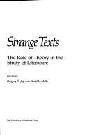
Revisionary interventions into the Americanist canon
Throughout the era of the Cold War a consensus reigned as to what constituted the great works of American literature. Yet as scholars have increasingly shown, and as this volume unmistakably demonstrates, that consensus was built upon the repression of the voices and historical contexts of subordinated social groups as well as literary works themselves, works both outside and within the traditional canon. This book is an effort to recover those lost voices. Engaging New Historicist, neo-Marxist, poststructuralist, and other literary practices, this volume marks important shifts in the organizing principles and self-understanding of the field of American Studies.
Originally published as a special issue of boundary 2, the essays gathered here discuss writers as diverse as Kate Chopin, Frederick Douglass, Emerson, Melville, W. D. Howells, Henry James, W. E. B. DuBois, and Mark Twain, plus the historical figure John Brown. Two major sections devoted to the theory of romance and to cultural-historical analyses emphasize the political perspective of \"New Americanist\" literary and cultural study.
Contributors. William E. Cain, Wai-chee Dimock, Howard Horwitz, Gregory S. Jay, Steven Mailloux, John McWilliams, Susan Mizruchi, Donald E. Pease, Ivy Schweitzer, Priscilla Wald, Michael Warner, Robert Weimann
eBook


Who should be responsible for Legionella
An environmental risk known as Legionella or Legionnaire's disease has been identified in 1976. Legionellae exist naturally throughout the environment, especially in water. Outbreaks of this disease involves the action of certain facilitators that serve as catalysts to Legionellae growth. Man-made structures such as cooling towers and evaporative condensers have been found to act as particularly able amplifiers, along with humidifiers, potable water heaters and holding tanks. A study was conducted to explore this issue from a legal perspective and determine the potential theories of liability, risk, and defenses to legal claims arising from this disease.
Journal Article

Other People's Holocausts: Trauma, Empathy, and Justice in Anna Deavere Smith's \Fires in the Mirror\
Jay offers an analysis of Anna Deavere Smith's Fires in the Mirror, which is a series of dramatic monologues. While Jay's analysis belongs to the general effort to connect Holocaust and cultural studies, he also aims to set the histories of African Americans and Jews within modernity in some sort of mutual relation by comparing slavery and the Holocaust.
Journal Article
Knowledge, Power, and the Struggle for Representation
Discusses the \"crisis in representation\" experienced in the humanities since the 1960s. Considers the relationship of academic knowledge to political power in terms of an ongoing struggle for representation. Recognizes higher education as a leading agent in redistributing access to representation in the public sphere. (HB)
Journal Article
The End of \American\ Literature: Toward a Multicultural Practice
Argues that the combined lessons of critical theory, classroom practice, and contemporary history dictate not only a revision of the curriculum and pedagogy of \"American\" literature courses, but a forceful uprooting of the conceptual model defining the field itself. Suggests the construction of a multicultural and dialogical paradigm for the study of writing in the United States. (RS)
Journal Article

American Literature and the New Historicism: The Example of Frederick Douglass
The trend of the New Historicism in American literature, steeped in poststructuralism and desirous to return to historical criticism, is applied to the writings of Frederick Douglass.
Journal Article
