
Catalogue Search | MBRL


Are you sure you want to remove the book from the shelf?

{{itemTitle}}
45
result(s) for
"Jean Durning"
Sort by:

Seattle in Black and White
Seattle was a very different city in 1960 than it is today. There were no black bus drivers, sales clerks, or bank tellers. Black children rarely attended the same schools as white children. And few black people lived outside of the Central District. In 1960, Seattle was effectively a segregated town.
Energized by the national civil rights movement, an interracial group of Seattle residents joined together to form the Seattle chapter of the Congress of Racial Equality (CORE). Operational from 1961 through 1968, CORE had a brief but powerful effect on Seattle. The chapter began by challenging one of the more blatant forms of discrimination in the city, local supermarkets. Located within the black community and dependent on black customers, these supermarkets refused to hire black employees. CORE took the supermarkets to task by organizing hundreds of volunteers into shifts of continuous picketers until stores desegregated their staffs. From this initial effort CORE, in partnership with the NAACP and other groups, launched campaigns to increase employment and housing opportunities for black Seattleites, and to address racial inequalities in Seattle public schools. The members of Seattle CORE were committed to transforming Seattle into a more integrated and just society.
Seattle was one of more than one hundred cities to support an active CORE chapter. Seattle in Black and White tells the local, Seattle story about this national movement. Authored by four active members of Seattle CORE, this book not only recounts the actions of Seattle CORE but, through their memories, also captures the emotion and intensity of this pivotal and highly charged time in America s history.
For more information visit: http://seattleinblackandwhite.org/
eBook
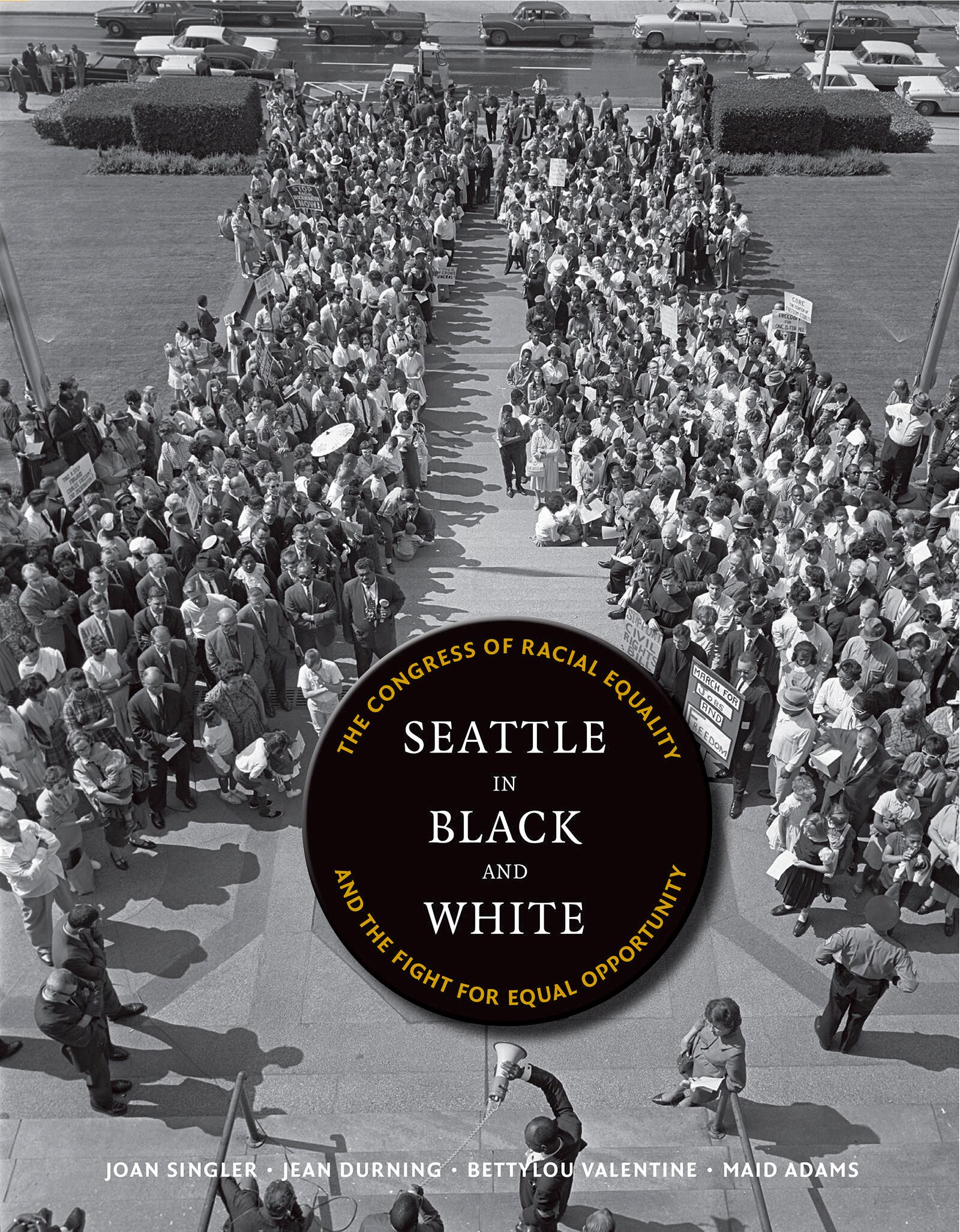
Seattle in Black and White
Seattle was a very different city in 1960 than it is today. There were no black bus drivers, sales clerks, or bank tellers. Black children rarely attended the same schools as white children. And few black people lived outside of the Central District. In 1960, Seattle was effectively a segregated town.Energized by the national civil rights movement, an interracial group of Seattle residents joined together to form the Seattle chapter of the Congress of Racial Equality (CORE). Operational from 1961 through 1968, CORE had a brief but powerful effect on Seattle. The chapter began by challenging one of the more blatant forms of discrimination in the city, local supermarkets. Located within the black community and dependent on black customers, these supermarkets refused to hire black employees. CORE took the supermarkets to task by organizing hundreds of volunteers into shifts of continuous picketers until stores desegregated their staffs. From this initial effort CORE, in partnership with the NAACP and other groups, launched campaigns to increase employment and housing opportunities for black Seattleites, and to address racial inequalities in Seattle public schools. The members of Seattle CORE were committed to transforming Seattle into a more integrated and just society.Seattle was one of more than one hundred cities to support an active CORE chapter. Seattle in Black and White tells the local, Seattle story about this national movement. Authored by four active members of Seattle CORE, this book not only recounts the actions of Seattle CORE but, through their memories, also captures the emotion and intensity of this pivotal and highly charged time in America's history.A V Ethel Willis White BookFor more information visit: http://seattleinblackandwhite.org/
eBook

TAXI COMPANIES AND UNIONS
At Farwest and Graytop cab companies, every single driver was white. Concurrent with the Drive for Equal Employment in Downtown Seattle (DEEDS), Seattle CORE turned a spotlight on these all-white workforces. As early as October 1963, CORE had begun investigating the taxi companies. Jean Adams attempted to meet with representatives of each company to gather statistics on the number of employees, the various job categories, and the number of minorities employed (see table 4.1). She then reported this information to the general membership. Yellow Cab was eager to talk with Jean, as their workforce of four hundred employees included thirty-five
Book Chapter
BLACK POWER AND SEATTLE CORE
Black Power! Two words that, until the mid-1960s, were seldom spoken in the same sentence. A revolutionary idea that took the racial lexicon to a new level in terms of self-identity—from colored to Negro to Black. The idea that African Americans had power, were powerful, could exert power, was a call to action that challenged the nonviolence of the 1960s civil rights movement.
The first mention of Black Power in Seattle CORE appeared in the July 24, 1966, Corelator, reporting on an all-day retreat on July 23 at Seattle University. Participants reaffirmed CORE’s mandate of nonviolent direct action and
Book Chapter
DIRECT ACTION TO END SEGREGATED HOUSING
Is it ever just for the public to vote on withholding rights from a portion of the citizenry? Is it ever ethical to deny rights based on a popular vote? CORE did not confront this underlying moral aspect of the referendum—neither when the city council sent the open-housing ordinance to the voters nor during the campaign. Religious leaders urged support for open housing on moral grounds, as did CORE, but we did not directly address the basic ethical question, a question that our democracy still faces. Instead, CORE attempted to win the hearts and minds of the public by
Book Chapter
SEGREGATED HOUSING IN SEATTLE
A proposed law against discrimination “would compel you to rent to . . . non white persons who could be prostitutes, criminals and otherwise dangerous to you and your tenants and unless you could prove . . . these activities, you would also lose the privilege of evicting them,” according to an inflammatory warning that the Apartment Operators Association sent to its members.¹ Blatant stereotypes like this helped perpetuate the fears of the white community. Similarly, the real estate industry endorsed the belief that black neighbors had a negative effect on property values, and that once a black family moved
Book Chapter
THE FORMATION OF SEATTLE CORE
As the nation, in the late 1950s and early 1960s, watched nightly TV coverage of the struggle for civil rights in the South, we saw the vicious treatment of black people who asserted their rights as Americans. We saw people walking in Montgomery, Alabama, for a year in 1955–56 until they could get fair seating on the buses. We saw bayonets drawn against black high school students in Little Rock, Arkansas, in September 1957. We saw black college students denied service at the Woolworth lunch counter in Greensboro, North Carolina, in February 1960. Inspired by their example, disciplined students
Book Chapter
BOYCOTT AND FREEDOM SCHOOLS
School attendance was an almost-sacred obligation. Awards were given for attendance as well as for grades. A proposal to take students out of school to press for integration flew in the face of basic public values. Yet, at a special meeting on February 17, 1966, CORE’s Executive Board recommended that we help lead a boycott of Seattle schools. The membership voted yes—with not one dissenting vote. CORE would take on this project. The boycott would not be just a couple of days to skip school but would provide a quality integrated education, to be called Freedom Schools. The very
Book Chapter
SEATTLE’S SEGREGATED SCHOOLS
In the South, laws had required separate schools for black students. In the North, segregated housing produced the same result. Unable to purchase homes elsewhere, minority families were concentrated in one small geographic area of Seattle. School assignments were based on neighborhoods, so elementary schools in the Central Area were overwhelmingly black. Despite the Supreme Court’s 1954 Brown v. Board of Education decision that separate schools were inherently unequal, Seattle schools in 1961 were still, in fact, segregated. The civil rights community was convinced that integrating the school system was essential to improve educational levels. Furthermore, integrated schools would provide
Book Chapter
MAINTAINING THE ORGANIZATION
Seattle CORE’s first activity, in 1961, was to support a jail-bound Freedom Rider. Jail, per se, was not his choice, but jail was Southern segregationists’ response to lunch counter sit-ins, to attempts to integrate buses, and to voter registration and other civil rights activity. Dr. Martin Luther King Jr.’ s “Letter from the Birmingham Jail” became one of the most famous statements of the movement. So spending time in jail for the cause of civil rights became a badge of honor to some activists. One Baptist minister on the picket line was heard to say that he “hoped that he
Book Chapter