
Catalogue Search | MBRL


Are you sure you want to remove the book from the shelf?

{{itemTitle}}
128
result(s) for
"Jennifer C. Lena"
Sort by:

Entitled : discriminating tastes and the expansion of the arts
\"This book examines the process by which the American arts expanded, over the course of more than a century, to include not just \"classical\" arts like opera and portraiture, but forms of folk, vernacular, and popular culture\"-- Provided by publisher.
Book

Classification as Culture: Types and Trajectories of Music Genres
Questions of symbolic classification have been central to sociology since its earliest days, given the relevance of distinctions for both affiliation and conflict. Music and its genres are no exception, organizing people and songs within a system of symbolic classification. Numerous studies chronicle the history of specific genres of music, but none document recurrent processes of development and change across musics. In this article, we analyze 60 musics in the United States, delineating between 12 social, organizational, and symbolic attributes. We find four distinct genre types-Avant-garde, Scene-based, Industry-based, and Traditionalist. We also find that these genre types combine to form three distinct trajectories. Two-thirds originate in an Avant-garde genre, and the rest originate as a scene or, to our surprise, in an Industry-based genre. We conclude by discussing a number of questions raised by our findings, including the implications for understanding symbolic classification in fields other than music.
Journal Article

Banding Together
Why do some music styles gain mass popularity while others thrive in small niches?Banding Togetherexplores this question and reveals the attributes that together explain the growth of twentieth-century American popular music. Drawing on a vast array of examples from sixty musical styles--ranging from rap and bluegrass to death metal and South Texas polka, and including several created outside the United States--Jennifer Lena uncovers the shared grammar that allows us to understand the cultural language and evolution of popular music.
What are the common economic, organizational, ideological, and aesthetic traits among contemporary genres? Do genres follow patterns in their development? Lena discovers four dominant forms--Avant-garde, Scene-based, Industry-based, and Traditionalist--and two dominant trajectories that describe how American pop music genres develop. Outside the United States there exists a fifth form: the Government-purposed genre, which she examines in the music of China, Serbia, Nigeria, and Chile. Offering a rare analysis of how music communities operate, she looks at the shared obstacles and opportunities creative people face and reveals the ways in which people collaborate around ideas, artworks, individuals, and organizations that support their work.
eBook
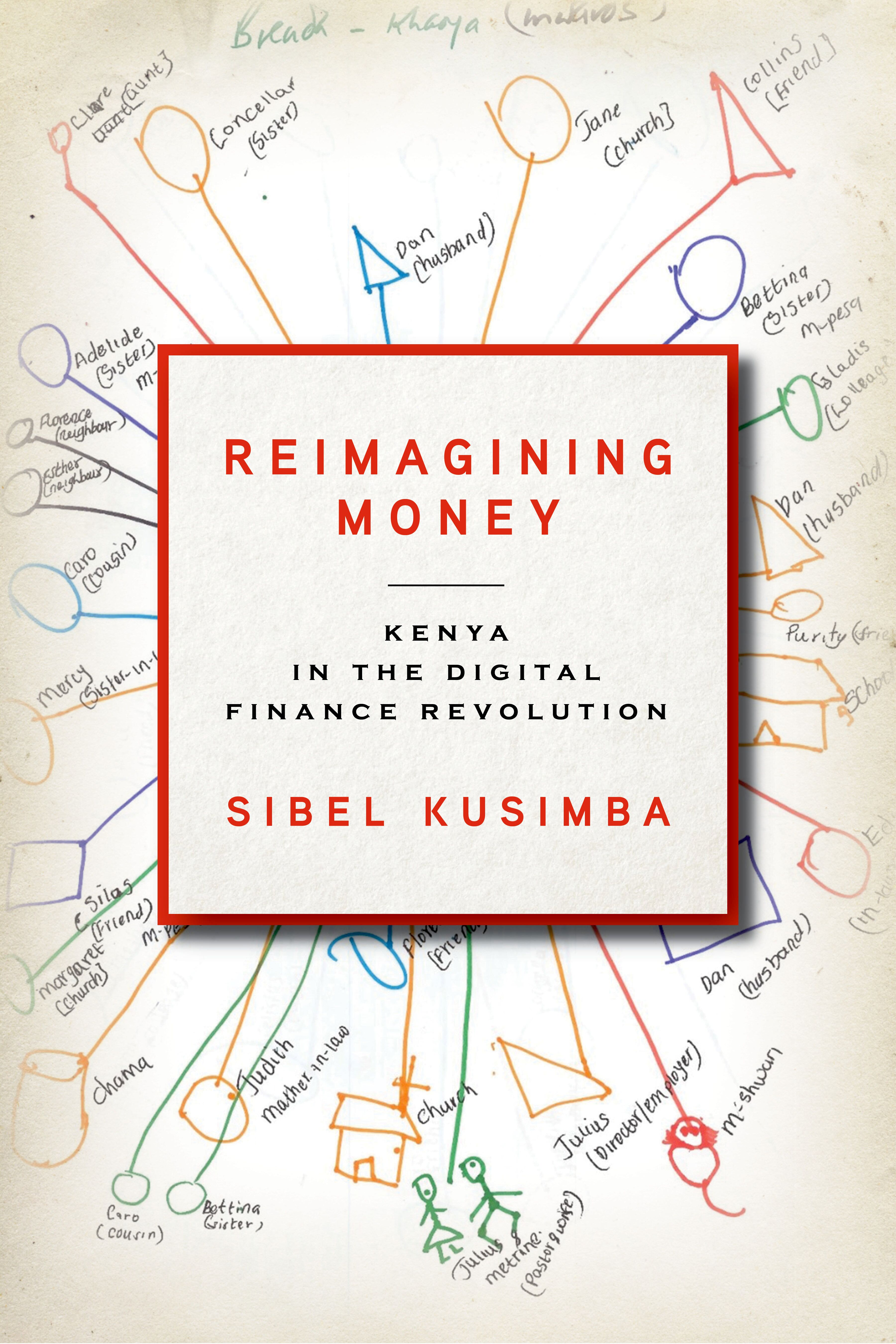
Reimagining money : Kenya in the digital finance revolution
Technology is rapidly changing the way we think about money. Digital payment has been slow to take off in the United States but is displacing cash in countries as diverse as China, Kenya, and Sweden. In Reimagining Money, Sibel Kusimba describes the rise of M-Pesa, and offers a rich portrait of how this technology changes the economic and social landscape, allowing users to create webs of relationships as they exchange, pool, borrow, lend, and share digital money in user-built networks. These networks, Kusimba argues, will shape the future of financial technologies and their impact on poverty, inclusion, and empowerment. She describes how urban and transnational migrants maintain a presence in rural areas through money gifts; how families use crowdfunding software to assemble donations for emergency medical care; and how new financial groups invest in real estate and fund weddings. The author presents fascinating accounts that challenge accepted wisdom by examining the notion of money as wealth-in-people—an idea long-cultivated in sub-Saharan Africa and now brought to bear on the digital age with homegrown financial technologies such as digital money transfer, digital microloans, and crowdfunding. The book concludes by proposing a new theory of money that can be applied to designing better financial technologies in the future.
eBook

Social Context and Musical Content of Rap Music, 1979–1995
There is a link between the context of production and the content of rap music singles. This research finds that when independent labels owned most of the charted singles, lyrics emphasized features of the local environment and hostility to corporate music production and values. In contrast, the major-label dominated market featured lyrics blending \"street\" credibility and commercial success in the \"hustler\" protagonist. I contribute a new finding to research on market concentration and musical diversity: artists' reactions to the market effects musical content.
Journal Article

Creativity Narratives Among College Students: Sociability and Everyday Creativity
Despite foundations in early pragmatism, research on social patterning of creative action has been scarce in the multidisciplinary literature on creativity. We address this by exploring how students perceive their creative contributions to college life. By analyzing narratives, we find that the majority of creativity is associated with everyday experiences and social interactions, in contrast to a popular and scholarly focus on extraordinary individual achievement in domains like art and science. We also find strong trends in sociability as students negotiate both \"where they stand\" with regards to those around them as well as \"how they stand out\" as individuals.
Journal Article
Music Genres
I start every semester in my Sociology of Hip-Hop and Rap Music course by asking the students to tell me a story about the origins of this musical style. The collective narrative that emerges, cobbled together from episodes of VH1’sBehind the Music, Vibe Magazinearticles, and song lyrics, is that rap music’s origins lie in the desire of inner-city, poor, black men to document their lives and critique the social order that blocks progress for our nation’s minorities. In criticism of this, a second group of students argue that this political narrative is a smoke screen, masking and justifying
Book Chapter

valuing art
In September 2008, Damien Hirst became the first famous, living artist to sell his work directly through an auction house, bypassing the gallery system. This direct-to-auction approach demonstrates that the boundary between auction houses and dealers is being breached and suggests that the value of art may become more defined by the market than the experts. [PUBLICATION ABSTRACT]
Journal Article
Three Musics, Four Genres
Music histories are full of hints that there is a pattern to the evolution of communities of sound. In an early history of bluegrass music I find one such allusion:
[bluegrass] Musicians . . . share certain characteristics. Growing up in areas which were the source of mountain music, the men were taught to pick and sing by friends and neighbors. Some first gained reputations over local radio shows, then moved to larger stations, and finally found national prominence. Timing played a crucial part in success: being at the right time at the right place led to joining “name” bands
Book Chapter
The Government-purposed Genre
Thus far, I have focused on documenting musical genre forms in the United States. In this chapter, I expand our view to include music produced in other countries. A preliminary survey of the popular music of countries with widely differing political economies, music cultures, and levels of development revealed that the four genre forms (Avant-garde, Scene-based, Industry-based, and Traditionalist) do exist to greater or lesser degrees across the globe, but there proved to be another widely distributed form that I did not find when I initially examined twentieth-century U.S. musical styles.
In a number of countries, popular genres receive substantial
Book Chapter