
Catalogue Search | MBRL


Are you sure you want to remove the book from the shelf?

{{itemTitle}}
21
result(s) for
"Jerard, Jolene"
Sort by:

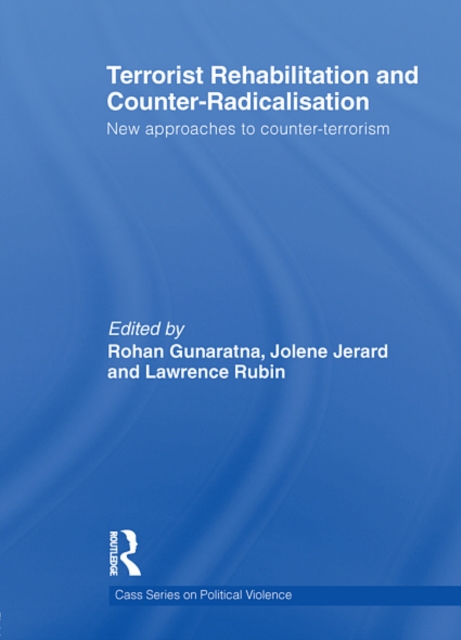
Terrorist Rehabilitation and Counter-Radicalisation
This book seeks to explore the new frontiers in counter-terrorism research, analyses and practice, focusing on the imperative to rehabilitate terrorists.
The post-9/11 world is in a very early stage of global rehabilitation both of terrorists and criminals. Nonetheless, some correctional rehabilitation programs have led convicted and suspected terrorists to express remorse, repent, and recant their violent ideologies and re-enter mainstream politics, religion and society. Although operational counter-terrorism initiatives have received both investment and attention, strategic counter-terrorism initiatives that ultimately end violence including terrorism but require patience and sustained efforts have been neglected by governments and received inadequate public coverage. This book is an early attempt to examine a few case studies both by practitioners and scholars. This book provides a better understanding of the process of deradicalization, and will be the first step towards exploring the development of tools necessary to examine and address challenges faced by practitioners.
This book will be of much interest to students of terrorism and political violence, radical Islam, conflict resolution, war and conflict studies and IR/Security Studies.
eBook

Countering extremism : building social resilience through community engagement
\"This unique work is the first to address the subject of community engagement strategies in countering extremism, and explores the development and research of these strategies. In so doing it demystifies the process of community engagement, while simultaneously extolling the virtues of the ground breaking strategies to have been effectively employed in Asia, the Middle East, and the West. The book then proceeds to examine the efforts of community engagement made by several countries against their unique operational and geopolitical environments. Finally, detailed reference is made to the role and work of the media and non-government organizations to have conducted effective community engagement efforts. With contributions from authors of diverse backgrounds, including media, the social services, security, and academia, this book will be of interest to both the general public and to researchers. \"--Publisher's website.
Book

Countering extremism
This unique work is the first to address the subject of community engagement strategies in countering extremism, and explores the development and research of these strategies. In so doing it demystifies the process of community engagement, while simultaneously extolling the virtues of the ground breaking strategies to have been effectively employed in Asia, the Middle East, and the West.
The book then proceeds to examine the efforts of community engagement made by several countries against their unique operational and geopolitical environments. Finally, detailed reference is made to the role and work of the media and non-government organizations to have conducted effective community engagement efforts.
With contributions from authors of diverse backgrounds, including media, the social services, security, and academia, this book will be of interest to both the general public and to researchers.
eBook
Terrorism in indonesia: an examination of ten radical groups
The study is based on the hypothesis that there are forces of influence that push a group from extremism to terrorism. While not all groups make the shift to terrorism, there are inherent forces within the radical group that influence the course of action undertaken by groups. The study examines 10 radical groups in Indonesia and explores the question: How do ideology, leadership and group dynamics play a significant role in the radical groups in Indonesia? The study explored groups within a broad cross-section of terrorist and extremist groups that have either been in operation or are currently in operation in Indonesia The groups examined were Lashkar Jihad (LJ), Jemaah Islamiyah (JI), Darul Islam (DI), Front Pembela Islam (FPI), Negara Islam Indonesia (NII), Hizbut Tahrir Indonesia (HT), Majelis Mujahideen Indonesia (MMI), Jamaah Anshorut Tauhid (JAT), Al Qaeda Indonesia (AI) and Mujahideen Indonesia Timur (MIT). The study highlights that groups are able to sustain themselves on the path of terrorism if there is a unique confluence of a politicised ideology, presence of influential leadership and group dynamics. Based on 124 interviews and questionnaires of terrorist and extremist leadership and cadre, the study sheds light on unique dynamics within these groups in Indonesia. In an examination of the 10 radical groups, this study shows that the very factors that often influences the radicalisation of individuals on the pathway of terrorism – ideology, charismatic leadership and community affiliation through group dynamics also in turn influence the course of action of groups as a whole.
Dissertation


Terrorist Rehabilitation and Counter-Radicalisation
This book seeks to explore the new frontiers in counter-terrorism research, analyses and practice, focusing on the imperative to rehabilitate terrorists. The post-9/11 world is in a very early stage of global rehabilitation both of terrorists and criminals. Nonetheless, some correctional rehabilitation programs have led convicted and suspected terrorists to express remorse, repent, and recant their violent ideologies and to re-enter mainstream politics, religion and society. Although operational counter-terrorism initiatives have received both investment and attention, strategic counter-terrorism initiatives that ultimately end violence require patience and sustained efforts have been neglected by governments and received inadequate public coverage. This book is an early attempt to examine a few case studies both by practitioners and scholars. It provides a better understanding of the process of deradicalisation, and will be the first step towards exploring the development of tools necessary to examine and address challenges faced by practitioners. This book will be of much interest to students of terrorism and political violence, radical Islam, conflict resolution, war and conflict studies and IR/security studies.
Book