
Catalogue Search | MBRL


Are you sure you want to remove the book from the shelf?

{{itemTitle}}
447
result(s) for
"Johnson, Arthur J."
Sort by:
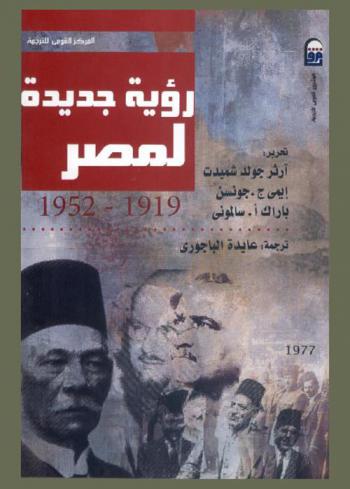
رؤية جديدة لمصر (1919-1952)
يعرض كتاب رؤية جديدة لمصر 1919-1952 جوانب جديدة من العصر الملكي الدستوري، عادة ما يتم تجاهلها أثناء دراسة تاريخ مصر. وهو يشير إلى أن كثيرا من التغيرات المحلية والإقليمية السياسية والاجتماعية والثقافية التي يعزى الفضل فيها إلى ثورة 1952 تعود في حقيقة الأمر إلى عقود ما قبل ثورة يوليو، ويناقش الكتاب وجهة النظر السائدة بأن مفاهيم تلك الحقبة تمثل جزءا أصيلا في تشكيل الدولة الحديثة والتحول الاجتماعي. كما يؤكد أن ثورات مصر الحقيقية كانت امتدادا لعمليات طويلة بزغت خلال عقود عديدة قبل 1952، وأن قادة ثورة 1952 استفادوا من تلك التطورات. ويتضمن هذا الكتاب أيضا مناقشة لقضايا سياسية محلية وللسياسة الخارجية والإصلاح العسكري والتعليمي والاجتماعي والطبقي، وذلك من منظور جديد.
Book

Community Resilience Learning Collaborative and Research Network (C-LEARN): Study Protocol with Participatory Planning for a Randomized, Comparative Effectiveness Trial
This manuscript presents the protocol and participatory planning process for implementing the Community Resilience Learning Collaborative and Research Network (C-LEARN) study. C-LEARN is designed to determine how to build a service program and individual client capacity to improve mental health-related quality of life among individuals at risk for depression, with exposure to social risk factors or concerns about environmental hazards in areas of Southern Louisiana at risk for events such as hurricanes and storms. The study uses a Community Partnered Participatory Research (CPPR) framework to incorporate community priorities into study design and implementation. The first phase of C-LEARN is assessment of community priorities, assets, and opportunities for building resilience through key informant interviews and community agency outreach. Findings from this phase will inform the implementation of a two-level (program-level and individual client level) randomized study in up to four South Louisiana communities. Within communities, health and social-community service programs will be randomized to Community Engagement and Planning (CEP) for multi-sector coalition support or Technical Assistance (TA) for individual program support to implement evidence-based and community-prioritized intervention toolkits, including an expanded version of depression collaborative care and resources (referrals, manuals) to address social risk factors such as financial or housing instability and for a community resilience approach to disaster preparedness and response. Within each arm, the study will randomize individual adult clients to one of two mobile applications that provide informational resources on services for depression, social risk factors, and disaster response or also provide psychoeducation on Cognitive Behavioral Therapy to enhance coping with stress and mood. Planned data collection includes baseline, six-month and brief monthly surveys for clients, and baseline and 12-month surveys for administrators and staff.
Journal Article

Surrealism is His Forte
\"Lucky, lucky, lucky.\" That's how pointer, photographer, musician, prize-winning filmmaker and trumpet-saxophone-flute player Robert Torrence III describes his life thus far.
Newspaper Article
Surrealism is His Forte
\"Lucky, lucky, lucky.\" That's how pointer, photographer, musician, prize-winning filmmaker and trumpet-saxophone-flute player Robert Torrence ill describes his life thus for.
Newspaper Article

Sojourner: Black Voices in the Age of AIDS
Other voices that will haunt you and reverberate in your mind include Floyd Dunn, who advises that gay black men must \"start carving out a new Black Gay Man who is not afraid, ashamed or apathetic about himself or the world...WE MUST HAVE AND KEEP OUR OWN AGENDA.\" Vernon Maulsby's poem \"After the News Got Out\" describes a mother \"armed with a Bible, her whole attitude a latex glove.\" Guy Mark Foster, whose talent makes you ask \"Where's his novel?\" contributes an impressive short story, \"Legacy\" and ends his story \"Lasius Niger\" with the biting last line \"The motherfucka can't really exist. And if He does, then the hell with His ass.\"
Magazine Article
Death, Life, Love - and Roy Cohn
Humorous (\"I heard on the radio how to give blowjobs,\" says Harper), witty (\"You know you've hit rock bottom when even drag is a drag,\" a be-lesioned [Prior] remarks sadly), ironic (\"In my church we don't believe in homosexuals,\" says one Mormon character who receives the reply. \"In my church we don't believe in Mormons\"), said (\"I try to learn to live dead, just numb,\" says [Joe], and very real (\"Power is the object, not being tolerated,\" [Louis] proclaims), reading this clever play whets one's appetite to see it onstage in its fully-realized and intended form.
Magazine Article
Naming Desire: Homoeroticism in the Works of Williams and Masculinity in the Mind of Miller
While [Arthur Miller] gained accolades for his depictions of straight white males and their dilemmas, [Williams] focused on \"the disenfranchised and the outsider\" and the \"valorization of feminine desire.\" [David Savran] discusses the veiled and sometimes blatant treatment of homoerotic desire in Williams' popular works (A Streetcar Named Desire and Cat on a Hot Tin Roof) and dismisses the dismissive and inaccurate criticism that Williams' \"women\" were really men in drag. The book also provides valuable discussions of many of Williams' short stories - which usually get scant attention in comparison to his plays - which dealt more directly with Williams' take on homoerotic desire than his plays. With that said, let me warn you that this tantalizingly-titled book is far from being as accessible and exciting as you might anticipate because of its stiff style and format. In his introduction, David Savran says his goal is to \"take apart vigorously and replace\" the widely disseminated view of Miller and Williams as respectively \"personify(ing) masculine play writing and \"a feminine, or even vaguely aberrant theater.\"
Magazine Article