
Catalogue Search | MBRL


Are you sure you want to remove the book from the shelf?

{{itemTitle}}
4
result(s) for
"Johnston, Sarah Iles, 1957- author"
Sort by:

The story of myth
Greek myths have long been admired as beautiful, thrilling stories but dismissed as serious objects of belief, even for the Greeks themselves. Indeed, for centuries scholars have argued that the stories that the Greeks handed down to us--the epics, the tragedies and the other compelling works that the Greeks left behind--obscure the 'real' myths that supposedly inspired them, and have striven to excavate their hidden meanings. The Story of Myth, however, argues that it was precisely their nature as stories--as gripping tales, starring vivid characters--that enabled myths to do their most important work: to create and sustain belief in the gods and heroes that populated them, thus forming the basis of Greek religion. By drawing on recent work in narratology, sociology and folklore studies and by comparing Greek myths to other narratives--not only the myths of other cultures such as the ancient Near East, but fairy tales, fantasy works, 19th century ghost stories, modern novels, and television series, as well--author Sarah Iles Johnston reveals the subtle yet powerful ways in which the myths forged enduring bonds between their characters and their audience members, created coherent story-worlds, and made it possible to believe in extraordinary gods.-- Provided by publisher
Book

Ancient Greek divination
The first English-language survey of ancient Greek divinatory methods, Ancient Greek Divination offers a broad yet detailed treatment of the earliest attempts by ancient Greeks to seek the counsel of the gods.
eBook

Restless dead : encounters between the living and the dead in ancient Greece
During the archaic and classical periods, Greek ideas about the dead evolved in response to changing social and cultural conditions--most notably changes associated with the development of the polis, such as funerary legislation, and changes due to increased contacts with cultures of the ancient Near East. In Restless Dead, Sarah Iles Johnston presents and interprets these changes, using them to build a complex picture of the way in which the society of the dead reflected that of the living, expressing and defusing its tensions, reiterating its values and eventually becoming a source of significant power for those who knew how to control it. She draws on both well-known sources, such as Athenian tragedies, and newer texts, such as the Derveni Papyrus and a recently published lex sacra from Selinous. Topics of focus include the origin of the goes (the ritual practitioner who made interaction with the dead his specialty), the threat to the living presented by the ghosts of those who died dishonorably or prematurely, the development of Hecate into a mistress of ghosts and its connection to female rites of transition, and the complex nature of the Erinyes. Restless Dead culminates with a new reading of Aeschylus' Oresteia that emphasizes how Athenian myth and cult manipulated ideas about the dead to serve political and social ends.
eBook
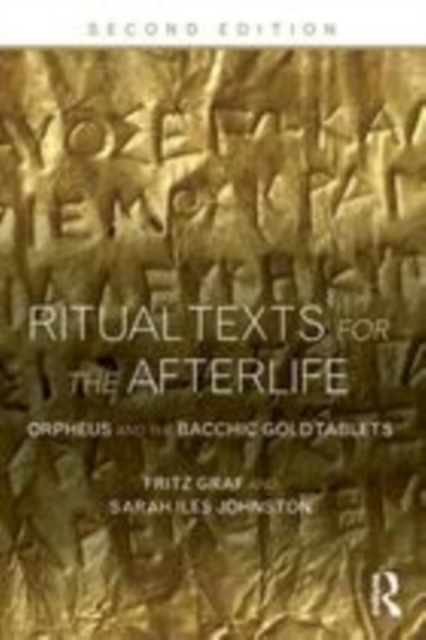
Ritual Texts for the Afterlife
Fascinating texts written on small gold tablets that were deposited in graves provide a unique source of information about what some Greeks and Romans believed regarding the fate that awaited them after death, and how they could influence it. These texts, dating from the late fifth century BCE to the second century CE, have been part of the scholarly debate on ancient afterlife beliefs since the end of the nineteenth century. Recent finds and analysis of the texts have reshaped our understanding of their purpose and of the perceived afterlife.
he tablets belonged to those who had been initiated into the mysteries of Dionysus Bacchius and relied heavily upon myths narrated in poems ascribed to the mythical singer Orpheus. After providing the Greek text and a translation of all the available tablets, the authors analyze their role in the mysteries of Dionysus, and present an outline of the myths concerning the origins of humanity and of the sacred texts that the Greeks ascribed to Orpheus. Related ancient texts are also appended in English translations. Providing the first book-length edition and discussion of these enigmatic texts in English, and their first English translation, this book is essential to the study of ancient Greek religion.
eBook