
Catalogue Search | MBRL


Are you sure you want to remove the book from the shelf?

{{itemTitle}}
730
result(s) for
"Jones, Toby"
Sort by:
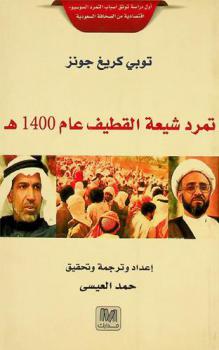
تمرد شيعة القطيف عام 1400 هـ = Qatifs Shia rebellion in 1400 H
الكتاب يحلل الأوضاع الدينية والسياسية والاقتصادية التي دفعت لحصول تمرد القطيف في عام 1979 والذي تزامن مع ثورة الخميني واحتلال جهيمان للحرم المكي، لا شك أنها كانت لحظات حرجة مرت بها المملكة السعودية لكن حكمة الملك خالد دفعت لتحسين الأحوال الاقتصادية في الأحساء والقطيف وتطمين الشيعة فيها مما أدى لنسيان مشروع الثورة الإسلامية العالمية والاندماج في المشروع الوطني بحذر، على أمل أن لا تقضي على ذلك كله الطموحات الطائفية المتطرفة.
Book

Toxic War and the Politics of Uncertainty in Iraq
The long American war on Iraq is not over. In a country ravaged for more than two decades by crippling sanctions and military occupation, the social, cultural, and political-economic legacies of war seem unending. Perhaps even more disturbing, Iraqis now face widespread environmental destruction and a dystopian environmental future. The ecological wages of America's long war in Iraq are partly the consequence of “routine” violence, resulting from the systemic destruction of vital electrical, water, and sewage infrastructure over two decades. It is possible to imagine that Iraq's cities and villages can be rebuilt. But even if it finds its way to the kind of political accommodation that makes reconstruction possible, parts of the country face other pernicious long-term environmental threats, among the most dangerous being the hidden toxic and radiological dangers that have settled in Iraqi bodies and deep in its landscape.
Journal Article


The Time Course of Activation of Object Shape and Shape+Colour Representations during Memory Retrieval
Little is known about the timing of activating memory for objects and their associated perceptual properties, such as colour, and yet this is important for theories of human cognition. We investigated the time course associated with early cognitive processes related to the activation of object shape and object shape+colour representations respectively, during memory retrieval as assessed by repetition priming in an event-related potential (ERP) study. The main findings were as follows: (1) we identified a unique early modulation of mean ERP amplitude during the N1 that was associated with the activation of object shape independently of colour; (2) we also found a subsequent early P2 modulation of mean amplitude over the same electrode clusters associated with the activation of object shape+colour representations; (3) these findings were apparent across both familiar (i.e., correctly coloured - yellow banana) and novel (i.e., incorrectly coloured - blue strawberry) objects; and (4) neither of the modulations of mean ERP amplitude were evident during the P3. Together the findings delineate the timing of object shape and colour memory systems and support the notion that perceptual representations of object shape mediate the retrieval of temporary shape+colour representations for familiar and novel objects.
Journal Article

Embracing Crisis in the Gulf
All claims to the contrary, the Persian Gulf monarchies have been deeply affected by the Arab revolutionary ferment of 2011-2012. Bahrain may be the only country to experience its own sustained upheaval, but the impact has also been felt elsewhere. Demands for a more participatory politics are on the rise, as are calls for the protection of rights and formations of various types of civic and political organization. Although these demands are not new, they are louder than before, including where the price of dissent is highest in Saudi Arabia, Oman and even the usually hushed United Arab Emirates. The resilience of a broad range of activists in denouncing autocracy and discomfiting autocrats is inspirational. As yet, there are no cracks in the foundation of Gulf order, but the edifice no longer appears adamantine. This state of affairs poses a historic challenge to the orders number-one guarantor, the United States. The task is not, as some might think, to reconcile the Obama administrations professed affinity for Arab democracy with the fact of its firm alliance with the states that the activists are working to open up. It is to aid those states in managing their domestic crisis so that the regional order can remain intact.
Journal Article

Beneficial effects of verbalization and visual distinctiveness on remembering and knowing faces
We examined the effect of verbally describing faces upon visual memory. In particular, we examined the locus of the facilitative effects of verbalization by manipulating the visual distinctiveness ofthe to-be-remembered faces and using the remember/know procedure as a measure of recognition performance (i.e., remember vs. know judgments). Participants were exposed to distinctive faces intermixed with typical faces and described (or not, in the control condition) each face following its presentation. Subsequently, the participants discriminated the original faces from distinctive and typical distractors in a yes/no recognition decision and made remember/know judgments. Distinctive faces elicited better discrimination performance than did typical faces. Furthermore, for both typical and distinctive faces, better discrimination performance was obtained in the description than in the control condition. Finally, these effects were evident for both recollection- and familiarity-based recognition decisions. We argue that verbalization and visual distinctiveness independently benefit face recognition, and we discuss these findings in terms of the nature of verbalization and the role of recollective and familiarity-based processes in recognition.
Journal Article

Limitations of mpox lateral flow tests in assessing orthopoxvirus immunity
[...]in 2022 a global outbreak of Clade IIb mpox occurred spreading primarily within gay, bisexual, and other men-who-have-sex-with-men with more than 98 000 cases and 183 deaths across 118 countries.2 Clade I mpox remains isolated to endemic countries, such as the Democratic Republic of the Congo, but still causes considerable outbreaks.3 The Bavarian Nordic IMVANEX (ie, Jynneos) smallpox vaccine has been recommended by public health authorities worldwide because of its cross-protection against mpox disease. [...]while there is ongoing spread of mpox, there is a requirement for rapid diagnosis of cases (IgM detection) to confirm antibody status and inform on patient vaccination recommendations in at-risk individuals (eg, booster recommendations), or to conduct serosurveillance studies to establish the true spread of disease in a population. Serious considerations and validation should be made regarding the reliability and accuracy of such LFDs before they are recommended for widespread use in public health initiatives or population-level surveillance studies. 100 (2·50–100) 95·24 (74·37–99·28) Negative predictive value (%; 95% CI) 23·81 (23·81–23·81) 23·94 (22·85–25·08) 20·45 (19·57–21·37) 21·62 (21·62–21·62) 27·59 (24·60–30·79) 23·81 (23·81–23·81) 23·61 (22·73–24·52) 20·00 (20·00–20·00) 21·92 (21·34–22·51) 28·85 (24·38–33·76) Table Characteristics and performance of mpox lateral flow devices
Journal Article

A Short Proof of the Uniform Smoothness of Certain Lebesgue Spaces
This note gives a short, direct proof of the uniform smoothness of L
p
spaces with
. Current proofs in the literature use the uniform convexity of the L
p
spaces and the duality between convexity and smoothness. As a corollary, using duality, we obtain the uniform convexity of the L
p
spaces with
, which is the notoriously \"difficult\" range, without recourse to Clarkson's second inequality. The method of proof also gives the power-type of the modulus of smoothness of L
p
spaces with
; this is known and was stated by J. Lindenstrauss and L. Tzafriri in Classical Banach Spaces II in Chapter 1, Section e. The proof was postponed to Vol. III, but this was never written.
Journal Article
Sources of error in picture naming under time pressure
We used a deadline procedure to investigate how time pressure may influence the processes involved in picture naming. The deadline exaggerated errors found under naming without deadline. There were also category differences in performance between living and nonliving things and, in particular, for animals versus fruit and vegetables. The majority of errors were visuallyand semantically related to the target (e. celery-asparagus), and there was a greater proportion of these errors made to living things. Importantly, there were also more visual-semantic errors to animals than to fruit and vegetables. In addition, there were a smaller number of pure semantic errors (e.g., nut-bolt), which were made predominantly to nonliving things. The different kinds of error were correlated with different variables. Overall, visual-semantic errors were associated with visual complexity and visual similarity, whereas pure semantic errors were associated with imageability and age of acquisition. However, for animals, visual-semantic errors were associated with visual complexity, whereas for fruit and vegetables they were associated with visual similarity. We discuss these findings in terms of theories of category-specific semantic impairment and models of picture naming.
Journal Article

America, Oil, and War in the Middle East
The US-led invasion of Iraq in 2003 and the American military occupation there represented only the latest stage of American militarism in the Middle East. While more considerable in scale, duration, and devastation than previous military misadventures in the region, the Iraq War was the outgrowth of several decades of strategic thinking and policy making about oil. It is true, of course, that terrorism and especially the attacks of Sep 11, 2001, helped accelerate the drive to war in 2003, but to focus too much on 9/11 is to overlook and discount the ways that oil and oil producers have long been militarized, the role oil has played in regional confrontation for almost four decades, and the connections between the most recent confrontation with Iraq and those of the past. Oil and war have become increasingly interconnected in the Middle East. Here, Jones talks about the relationship between oil and war in the Middle East.
Journal Article