
Catalogue Search | MBRL


Are you sure you want to remove the book from the shelf?

{{itemTitle}}
61
result(s) for
"Jouannet, Emmanuelle"
Sort by:

A short introduction to international law
\"In our globalised world the sources and actors of international law are many and its growth prolific and disorderly. International law governs the actions of states on matters as long-established as diplomatic immunity or as recent as the War on Terror, and it now impacts upon the lives of ordinary citizens in areas as diverse as banking and investment, public health and the protection of the environment. In this accessible introduction Emmanuelle Tourme Jouannet explains the latest developments in international law in the light of its history and culture, presenting it as an instrument both for dominance and for change that adjusts and balances the three pillars of the United Nations Charter: the prohibition of the use of force; economic, social and sustainable development; and human rights\"-- Provided by publisher.
Book
The Liberal-Welfarist Law of Nations
Although portrayed as a liberal law of co-existence of and co-operation between states, international law has always been a welfarist law, too. Emerging in eighteenth-century Europe, it soon won favour globally. Not only did it minister to the interests of states and their concern for stability, but it was also an interventionist law designed to ensure the happiness and well-being of peoples. Hence international law initially served as a secularised eschatological model, replacing the role of religion in ensuring the proper ordering of mankind, which was held to be both one and divided. That initial vision still drives our post-Cold War globalised world. Contemporary international law is neither a strictly welfarist law nor a strictly liberal law, but is in fact a liberal-welfarist law. In the conjunction of these two purposes lies one of the keys to its meaning and a partial explanation for its continuing ambivalence.
eBook

The politics of international law
Today, international law is everywhere. Wars are declared and conducted in its name, and in its name rights are both protected and renounced. It is also international law which determines who owns and uses the world's scarcest resources. Thus, international law is part of a dangerous and unjust world - a part of how we are governed globally. But, it can also be used to challenge aspects of this world and to give voice to projects which seek to transform the institutions of global governance.
eBook

WHAT IS THE USE OF INTERNATIONAL LAW? INTERNATIONAL LAW AS A 21ST CENTURY GUARDIAN OF WELFARE
4 Everyone agrees that international law should promote peace, justice, economic development, and human rights, and combat world poverty.
Journal Article
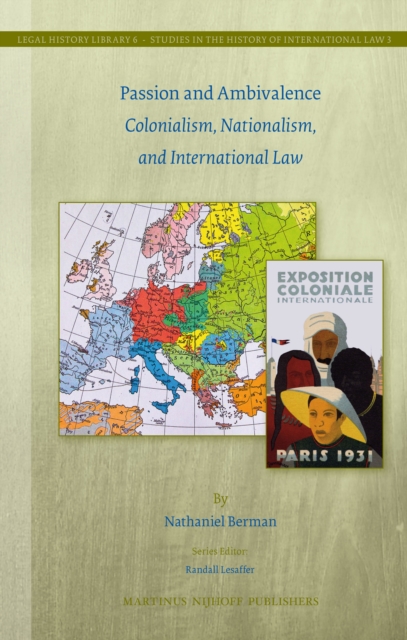
Passion and ambivalence : colonialism, nationalism, and international law
Tracing our current preoccupation with nationalist, ethnic, and religious conflict to the \"cultural Modernist\" revolutions of the early twentieth century, this volume draws on cultural studies, postcolonial theory, and psychoanalysis to offer a radical reinterpretation of contemporary international law's origins.
eBook