
Catalogue Search | MBRL


Are you sure you want to remove the book from the shelf?

{{itemTitle}}
130
result(s) for
"Kaeuper, Richard W"
Sort by:


Holy Warriors
The medieval code of chivalry demanded that warrior elites demonstrate fierce courage in battle, display prowess with weaponry, and avenge any strike against their honor. They were also required to be devout Christians. How, then, could knights pledge fealty to the Prince of Peace, who enjoined the faithful to turn the other cheek rather than seek vengeance and who taught that the meek, rather than glorious fighters in tournaments, shall inherit the earth? By what logic and language was knighthood valorized?In Holy Warriors, Richard Kaeuper argues that while some clerics sanctified violence in defense of the Holy Church, others were sorely troubled by chivalric practices in everyday life. As elite laity, knights had theological ideas of their own. Soundly pious yet independent, knights proclaimed the validity of their bloody profession by selectively appropriating religious ideals. Their ideology emphasized meritorious suffering on campaign and in battle even as their violence enriched them and established their dominance. In a world of divinely ordained social orders, theirs was blessed, though many sensitive souls worried about the ultimate price of rapine and destruction.Kaeuper examines how these paradoxical chivalric ideals were spread in a vast corpus of literature from exempla and chansons de geste to romance. Through these works, both clerics and lay military elites claimed God's blessing for knighthood while avoiding the contradictions inherent in their fusion of chivalry with a religion that looked back to the Sermon on the Mount for its ethical foundation.
eBook

Kings, Knights and Bankers
In Kings, Knights, and Bankers, Richard Kaeuper presents a lifetime of medieval research on Italian financiers, English kingship, chivalric violence, and knightly piety. His foundational work on public finance connects Italian merchant banking with the growth of state power at the turn of the fourteenth century. Subsequent articles on law and order offer measured contributions to the continuing debate over the growth of governance and its relationship with contemporary disorder. He also convincingly proves that knights, the foremost military professionals of the medieval world, considered their prowess as both a source of honor and of sanctification. All interested in the history of medieval chivalry, governance, piety, and public finance can learn from this impressive collection of articles.
eBook

Prowess, piety, and public order in medieval society : studies in honor of Richard W. Kaeuper
This festschrift in Richard Kaeuper's honor brings together scholars from across disciplines to engage with three salient concerns of medieval society - knightly prowess and violence, lay and religious piety, and public order and government - from a variety of perspectives.
eBook


Law, governance, and justice : new views on medieval constitutionalism
How law and governance operated in Medieval England--and whether contemporaries saw justice in its operations--have long generated scholarly discussions. Thirteen scholars, established and younger figures, historians and literary analysts, offer their new views in this volume.
eBook

Literature as Essential Evidence for Understanding Chivalry
A former colleague used to insist that there are really only two questions we need to ask: “says who?” and “so what?” Were we to refine these admittedly rough questions into “what are our legitimate sources?” and “how do they help us understand the past?” we might secure more general agreement. But rough or smooth, we are stuck with them and they continue to generate useful debate. These are the questions I want to address in relationship to chivalry, a topic of great interest to all medievalists and certainly to the members of De Re Militari. I expect to generate debate. In the process I will likely have to draw on evidence I have tapped before, but who can doubt in the twenty-first century that recycling is a virtue?My general position will be known to any who have read books and articles I have written, but just for clarity let me announce a thesis, that sine qua non that is so often merely sine in student essays – and, yes, in the occasional professional paper. I am convinced of the legitimacy of reading chivalric literature as historical evidence; I believe that use of these sources is, in fact, necessary to an understanding of chivalry; and I take chivalry to be the basic organizing code of the lay elite of Europe for perhaps half a millennium. The issues at hand are not trivial.
Book Chapter
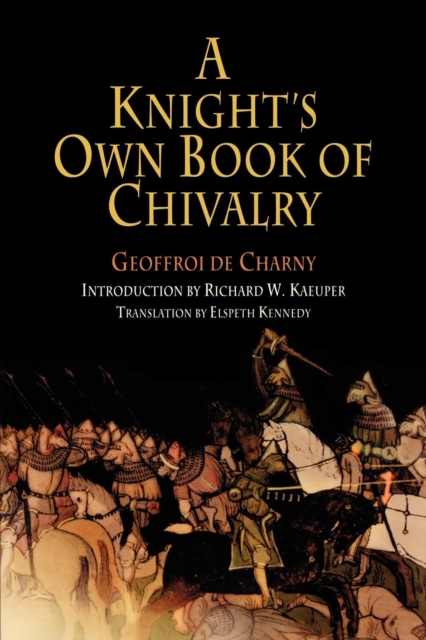
A knight's own book of chivalry
Composed at the height of the Hundred Years War by Geoffroi de Charny, one of the most respected knights of his age, A Knight's Own Book of Chivalry is an invaluable guide to fourteenth-century knighthood.
eBook
