
Catalogue Search | MBRL


Are you sure you want to remove the book from the shelf?

{{itemTitle}}
2,167
result(s) for
"Kaiser, David"
Sort by:

The blue line imperative : what managing for value really means
\"A groundbreaking guide to making profitable business decisions. Do you wonder why your value initiatives aren't providing the payoff you'd hoped for? Could it be because you've been thinking about value all wrong? According to the authors of this groundbreaking guide, there's a very good chance that you have. Using examples from leading companies worldwide, they explain why every decision a company makes either creates value or detracts from it, and why, if they hope to survive and thrive in today's increasingly competitive global marketplace, company leaders must make value-creation the centrepiece of every business decision. Authors Kaiser and Young have dubbed this approach \"Blue-Line Management,\" (BLM), and in this entertaining, highly accessible book, they delineate BLM principles and practices and show you how to implement them in your company. Explains why the failure to properly define and assess value often makes it difficult for the people who manage businesses to effect long-term success Offers guidelines for making the satisfaction of customer needs and wants--i.e. value creation--the driver of all business activities The authors are respected academics at INSEAD, the world's largest and most respected graduate business school, with campuses in Europe, Asia and the Middle East \"-- Provided by publisher.
Book

Effects of biofouling on the sinking behavior of microplastics
Although plastic is ubiquitous in marine systems, our current knowledge of transport mechanisms is limited. Much of the plastic entering the ocean sinks; this is intuitively obvious for polymers such as polystyrene (PS), which have a greater density than seawater, but lower density polymers like polyethylene (PE) also occur in sediments. Biofouling can cause large plastic objects to sink, but this phenomenon has not been described for microplastics <5 mm. We incubated PS and PE microplastic particles in estuarine and coastal waters to determine how biofouling changes their sinking behavior. Sinking velocities of PS increased by 16% in estuarine water (salinity 9.8) and 81% in marine water (salinity 36) after 6 weeks of incubation. Thereafter sinking velocities decreased due to lower water temperatures and reduced light availability. Biofouling did not cause PE to sink during the 14 weeks of incubation in estuarine water, but PE started to sink after six weeks in coastal water when sufficiently colonized by blue mussels Mytilus edulis, and its velocity continued to increase until the end of the incubation period. Sinking velocities of these PE pellets were similar irrespective of salinity (10 vs. 36). Biofilm composition differed between estuarine and coastal stations, presumably accounting for differences in sinking behavior. We demonstrate that biofouling enhances microplastic deposition to marine sediments, and our findings should improve microplastic transport models.
Journal Article


Effective theories for a nonrelativistic field in an expanding universe: Induced self-interaction, pressure, sound speed, and viscosity
A
bstract
A massive, nonrelativistic scalar field in an expanding spacetime is usually approximated by a pressureless perfect fluid, which leads to the standard conclusion that such a field can play the role of cold dark matter. In this paper, we systematically study these approximations, incorporating subleading corrections. We provide two equivalent effective descriptions of the system, each of which offers its own advantages and insights: (i) A nonrelativistic effective field theory (EFT) with which we show that the relativistic corrections induce an effective self-interaction for the nonrelativistic field. As a byproduct, our EFT also allows one to construct the exact solution, including oscillatory behavior, which is often difficult to achieve from the exact equations. (ii) An effective (imperfect) fluid description, with which we demonstrate that, for a perturbed Friedmann-Lemaître- Robertson-Walker (FLRW) universe: (a) The pressure is small but nonzero (and positive), even for a free theory with no tree-level self-interactions. (b) The sound speed of small fluctuations is also nonzero (and positive), reproducing already known leading-order results, correcting a subdominant term, and identifying a new contribution that had been omitted in previous analyses. (c) The fluctuations experience a negative effective bulk viscosity. The positive sound speed and the negative bulk viscosity act in favor of and against the growth of overdensities, respectively. The net effect may be considered a smoking gun for ultra-light dark matter.
Journal Article

Beyond Schrödinger-Poisson: nonrelativistic effective field theory for scalar dark matter
A
bstract
Massive scalar fields provide excellent dark matter candidates, whose dynamics are often explored analytically and numerically using nonrelativistic Schrödinger-Poisson (SP) equations in a cosmological context. In this paper, starting from the nonlinear and fully relativistic Klein-Gordon-Einstein (KGE) equations in an expanding universe, we provide a systematic framework for deriving the SP equations, as well as relativistic corrections to them, by integrating out ‘fast modes’ and including nonlinear metric and matter contributions. We provide explicit equations for the leading-order relativistic corrections, which provide insight into deviations from the SP equations as the system approaches the relativistic regime. Upon including the leading-order corrections, our equations are applicable beyond the domain of validity of the SP system, and are simpler to use than the full KGE case in some contexts. As a concrete application, we calculate the mass-radius relationship of solitons in scalar dark matter and accurately capture the deviations of this relationship from the SP system towards the KGE one.
Journal Article

سلوك التحدي لدى الأطفال الصغار : الفهم والوقاية والاستجابة الفاعلة
يتناول كتاب (سلوك التحدي لدى الأطفال الصغار : ...) والذي قام بتأليفه (باربارا كيسر، جودي سكلار راسمنسكي) في حوالي (621) صفحة من القطع المتوسط المحتويات التالية : الفصل الأول : ما سلوك التحدي ؟، الفصل الثاني : عوامل المخاطرة، الفصل الثالث : عوامل وقائية، الفصل الرابع : السلوك والخ، الفصل الخامس : العلاقة، العلاقة، العلاقة، الفصل السادس : باب الثقافة، الفصل السابع : منع سلوك التحدي : السياق الاجتماعي، الفصل الثامن : منع سلوك التحدي : الحيز الطبيعي، الأعمال الروتينية .. والانتقالات (التحركات) واستراتيجيات التدريس، الفصل التاسع : الإرشاد والتوجيه، الفصل العاشر : التقييم الأدائي والدعم السلوكي الموجب، الفصل الحادي عشر، الفصل الشامل (الحصري)، الفصل الثاني عشر : العمل مع العائلات والخبراء الآخرين، الفصل الثالث عشر : التنمر.
Book

Bed bug infestations: prevalence, correlates, and cross-sectional association with psychological symptoms in a large sample of tenants in Montreal, Canada
Background
The resurgence of bed bugs is a major challenge to public health and housing authorities and is a social justice issue. Bed bugs are environmentally communicable, cause ill health, and decrease quality of life. Bed bug infestations are socially patterned, disproportionately affecting people facing vulnerability; they are more prevalent in high-density multi-unit housing environments. While bed bugs can cause cutaneous and allergic reactions along with other health reactions, the biggest health impacts of bed bugs appear to be psychological. To contribute to the limited number of studies documenting the prevalence of exposure to bed bugs and mental health impacts in general populations, this study reports on the prevalence of exposure to bed bugs in a large sample of tenants and measures the association between bed bug exposure and psychological symptoms.
Methods
This cross-sectional study set in Montreal, Canada, uses data on 5,000 tenants aged ≥ 18 years from the 2017 Montreal Housing Survey. Exposure to bed bugs in the year preceding the interview was self-reported by tenants. The 2-item Generalized Anxiety Disorder scale and the 2-item Patient Health Questionnaire-2 were used to measure anxiety and depression, respectively. Association between exposure to bed bugs and psychosocial symptoms was assessed using logistic regression adjusted for sociodemographic characteristics and housing conditions.
Results
Four percent of tenants reported being exposed to bed bugs in the year preceding the survey. In unweighted analysis, the odds of anxiety (OR: 1.72; 95%CI: 1.12, 2.64), depression (OR: 1.83; 95%CI: 1.20, 2.78), and anxiety and/or depression (OR: 1.69; 95%CI: 1.16, 2.44) were significantly higher for those exposed to bed bugs, independently of the sociodemographic characteristics and housing conditions of the survey respondents. In weighted analysis, the effect sizes were reduced. Exposure to bed bugs was marginally (
p
= 0.087) associated with higher odds of reporting anxiety and/or depression (OR: 1.53; 95%CI: 0.94, 2.50).
Conclusions
Findings reinforce the significant social inequalities in exposure to bed bugs and contribute to growing evidence that bed bug exposure is a risk factor for psychological symptoms. Coordinated, intersectoral actions that are attentive to social justice issues are needed to monitor and control bed bug infestations.
Journal Article
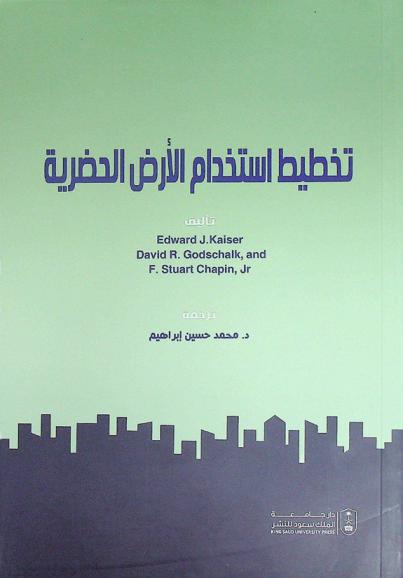
تخطيط استخدام الأرض الحضرية
يسعى هذا الكتاب إلى تقديم اطار شامل لفهم وتطبيق تخطيط استخدام الأرض الحضرية من تأليف Edward J. Kaiser وDavid R. Godschalk، يستعرض تطور التخطيط الحضري في الولايات المتحدة على مدى القرن العشرين وانعكاساته الحديثة في التصميم والسياسات والإدارة المجتمعية. يعرض الفصول الأولى الأسس النظرية لمفاهيم التخطيط والإدارة المحلية لاستخدام الأراضي ثم ينتقل إلى أهمية نظم المعلومات التخطيطية المتعلقة بالسكان والاقتصاد والبيئة والبنية التحتية والأراضي والخدمات المشتركة. يشرح الكتاب بالتفصيل كيفية صياغة الخطط المسبقة التي تحدد الاتجاهات المستقبلية مثل تصنيف الأراضي، وتصميم المناطق السكنية والتجارية وخطط المرافق، وصولاً إلى إدارة النمو وتقييم الآثار والتطبيق العملي. ويؤكد على دمج التنمية المستدامة من خلال مراعاة الاقتصاد والبيئة والعدالة الاجتماعية في تصميم السياسات وتوظيف تقنيات الدعم الرقمي والمشاركة المجتمعية في صنع الرؤية. والهدف هو توفير دليل عملي ونظري موجه للمهنيين وصناع القرار لتصميم وتنفيذ خطط حضرية فعالة مستدامة تراعي أولويات مختلف الجهات المعنية.
BOOK
Towards a fair, reliable, and practical verification framework for Blue Carbon-based CDR
While the (re-)establishment of Blue Carbon Ecosystems (BCE) is seen as an important tool to mitigate climate change, the credibility of such nature-based solutions has been marred by recent revelations ranging from weak accounting to malpractice. In light of this, there is a clear need to develop monitoring, reporting and verification (MRV) systems towards the reliable, practical, and accurate accounting of additional and durable carbon dioxide removal (CDR). We propose the development of a Blue Carbon Ecosystem Digital Twin (BCE-DT) as a practical solution, integrating real-time data and models into What-If Scenarios of CDR aimed at the quantification of CDR additionality and durability. Critically, such a solution would be amenable to projects across a broad range in spatial scale and ecosytem type. In parallel, we propose the creation of an independent and not-for-profit Standards Development Organization (SDO) for the management of this Digital Twin and oversight of the certification process based on MRV. Considering the interwoven nature of the scientific and policy/legal needs we raise, an improved dialogue and collaboration between the scientific and policy communities is clearly needed. We argue that this BCE-DT, along with its oversight and implementation by a SDO, would fit this niche and support the fair and accurate implementation of MRV critically needed for BCE-based CDR to proceed.
Journal Article