
Catalogue Search | MBRL


Are you sure you want to remove the book from the shelf?

{{itemTitle}}
1,931
result(s) for
"Kay, Sarah"
Sort by:


Prototypical words for core categories in French and English: Vocabulary as a window to culture
The Challenge Vocabulary is often presented as a simple list of paired (L2: L1) items for a category, but does this approach overlook that the most prototypical words may be culture‐specific? Can authentic native speaker data enrich the selection and presentation of lexical items and allow learners to explore culture through vocabulary? While some guiding principles have been proposed for the selection and presentation of vocabulary, it is unclear whether these notions have been applied systematically, particularly in ways that highlight cultural nuances. To explore the cultural foundations of vocabulary, this study garnered prototypical words for Hexagonal French (the French of France) and American English for fundamental categories such as “Breakfast foods and beverages” and “Professions, jobs, and trades.” An elicitation task based on Prototype Theory and Lexical Availability invited 100 native speakers to spontaneously recall keywords for core categories to compare prototypical vocabulary in French and English. The items that were salient for speakers of the two languages were often quite different, provoking hypotheses about culture and category conceptualization. The data highlight possibilities not only for vocabulary selection and presentation in pedagogical resources, but also for activities allowing learners to explore cultural differences from the beginning of a language curriculum.
Journal Article


Landsat 9 Thermal Infrared Sensor-2 (TIRS-2) Pre- and Post-Launch Spatial Response Performance
The launch of Landsat 9 (L9) on 27 September 2021 marks the ongoing commitment of the Landsat mission to delivering users with calibrated Earth observations for fifty years. The two imaging sensors on L9 are the Thermal Infrared Sensor-2 (TIRS-2) and the Operational Land Imager-2 (OLI-2). Shortly after launch, the image data from OLI-2 and TIRS-2 were evaluated for both radiometric and geometric quality. This paper provides a synopsis of the evaluation of the spatial response of the TIRS-2 instrument. The assessment focuses on determining the instrument’s ability to detect a perfect knife edge. The spatial response was evaluated both pre- and post-launch. Pre-launch testing was performed at NASA Goddard Space Flight Center (GSFC) under flight-like thermal vacuum (TVAC) conditions. On orbit, coastline targets were identified to evaluate the spatial response and compared against Landsat 8 (L8). The pre-launch results indicate that the spatial response of the TIRS-2 sensor is consistent with its predecessor on board L8, with no noticeable decline in image quality to compromise any TIRS science objectives. Similarly, the post-launch analysis shows no apparent degradation of the TIRS-2 focus during the launch and the initial operational timeframe.
Journal Article

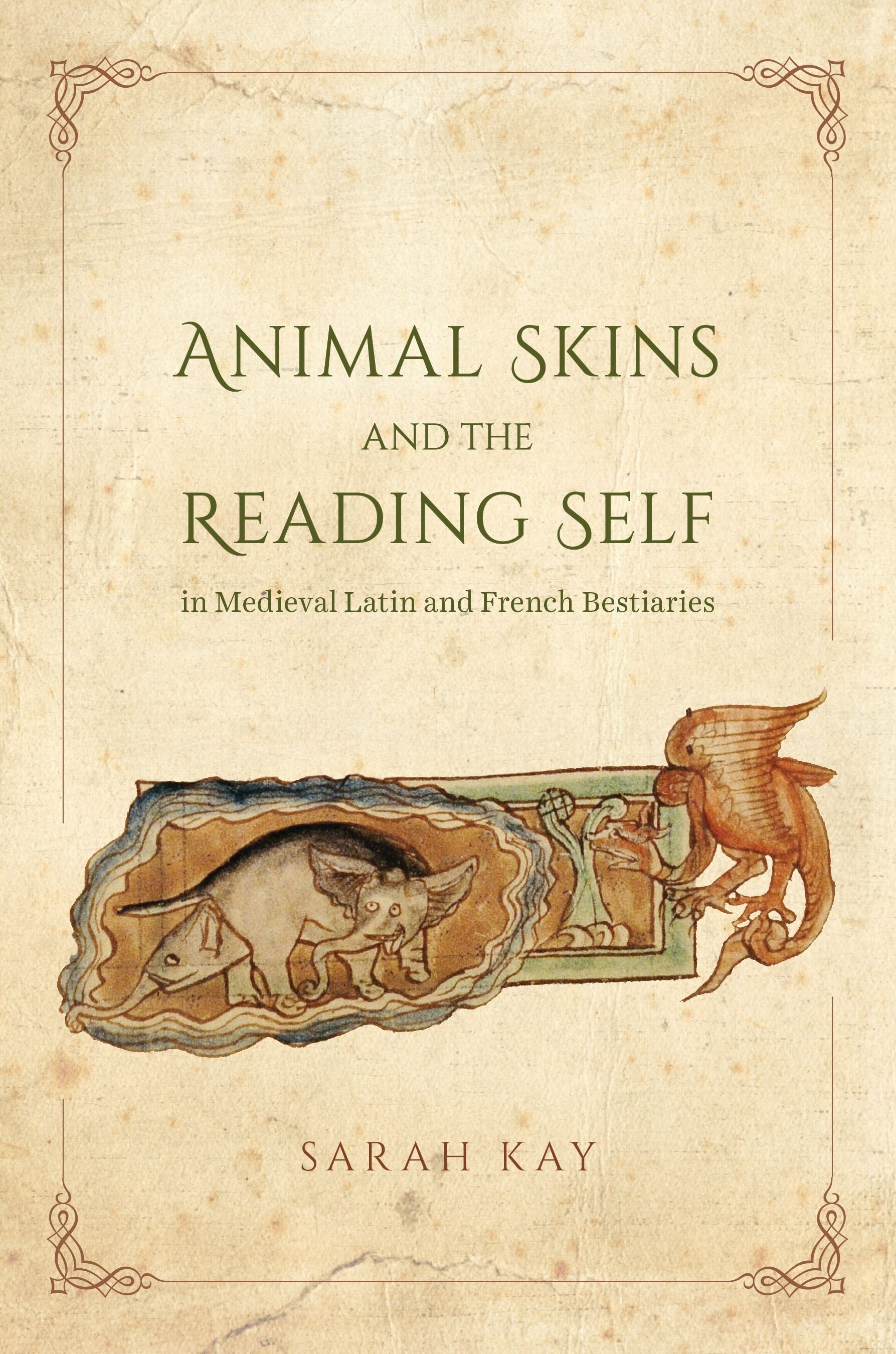
Animal Skins and the Reading Self in Medieval Latin and French Bestiaries
Just like we do today, people in medieval times struggled with the concept of human exceptionalism and the significance of other creatures. Nowhere is this more apparent than in the medieval bestiary. Sarah Kay's exploration of French and Latin bestiaries offers fresh insight into how this prominent genre challenged the boundary between its human readers and other animals.
Bestiaries present accounts of animals whose fantastic behaviors should be imitated or avoided, depending on the given trait. In a highly original argument, Kay suggests that the association of beasts with books is here both literal and material, as nearly all surviving bestiaries are copied on parchment made of animal skin, which also resembles human skin. Using a rich array of examples, she shows how the content and materiality of bestiaries are linked due to the continual references in the texts to the skins of other animals, as well as the ways in which the pages themselves repeatedly—and at times, it would seem, deliberately—intervene in the reading process. A vital contribution to animal studies and medieval manuscript studies, this book sheds new light on the European bestiary and its profound power to shape readers' own identities.
eBook

Construction of the secondary care administrative records frailty (SCARF) index and validation on older women with operable invasive breast cancer in England and Wales: a cohort study
ObjectivesStudies that use national datasets to evaluate the management of older women with breast cancer are often constrained by a lack of information on patient fitness. This study constructed a frailty index for use with secondary care administrative records and evaluated its ability to improve models of treatment patterns and overall survival in women with breast cancer.DesignRetrospective cohort study.ParticipantsWomen aged ≥50 years with oestrogen receptor (ER) positive early invasive breast cancer diagnosed between 2014 and 2017 in England.MethodsThe secondary care administrative records frailty (SCARF) index was based on the cumulative deficit model of frailty, using International Statistical Classification of Diseases, Injuries and Causes of Death, 10th revision codes to define a set of deficits. The index was applied to administrative records that were linked to national cancer registry datasets. The ability of the SCARF index to improve the performance of regression models to explain observed variation in the rate of surgery and overall survival was evaluated using Harrell’s c-statistic and decision curve analysis. External validation was performed on a dataset of similar women diagnosed in Wales.ResultsThe SCARF index captured 32 deficits that cover functional impairment, geriatric syndromes, problems with nutrition, cognition and mood, and medical comorbidities. In the English dataset (n=67 925), the prevalence of frailty in women aged 50–69, 70–79 and ≥80 years was 15%, 28% and 47%, respectively. Adding a frailty measure to regression models containing age, tumour characteristics and comorbidity improved their ability to: (1) discriminate between whether a woman was likely to have surgery and (2) predict overall survival. Similar results were obtained when the models were applied to the Welsh cohort (n=4 230).ConclusionThe SCARF index provides a simple and consistent method to identify frailty in population level data and could help describe differences in breast cancer treatments and outcomes.
Journal Article

Parrots and Nightingales
The love songs of Occitan troubadours inspired a rich body of courtly lyric by poets working in neighboring languages. For Sarah Kay, these poets were nightingales, composing verse that is recognizable yet original. But troubadour poetry also circulated across Europe in a form that is less well known but was more transformative. Writers outside Occitania quoted troubadour songs word for word in their original language, then commented upon these excerpts as linguistic or poetic examples, as guides to conduct, and even as sources of theological insight. If troubadours and their poetic imitators were nightingales, these quotation artists were parrots, and their practices of excerption and repetition brought about changes in poetic subjectivity that would deeply affect the European canon. The first sustained study of the medieval tradition of troubadour quotation,Parrots and Nightingalesexamines texts produced along the arc of the northern Mediterranean-from Catalonia through southern France to northern Italy-through the thirteenth century and the first half of the fourteenth. Featuring extensive appendices of over a thousand troubadour passages that have been quoted or anthologized,Parrots and Nightingalestraces how quotations influenced the works of grammarians, short story writers, biographers, encyclopedists, and not least, other poets including Dante and Petrarch. Kay explores the instability and fluidity of medieval textuality, revealing how the art of quotation affected the transmission of knowledge and transformed perceptions of desire from the \"courtly love\" of the Middle Ages to the more learned formulations that emerged in the Renaissance.Parrots and Nightingalesdeftly restores the medieval tradition of lyric quotation to visibility, persuasively arguing for its originality and influence as a literary strategy.
eBook

Mechanisms of Cigarette Smoke Effects on Human Airway Smooth Muscle
Cigarette smoke contributes to or exacerbates airway diseases such as asthma and COPD, where airway hyperresponsiveness and airway smooth muscle (ASM) proliferation are key features. While factors such as inflammation contribute to asthma in part by enhancing agonist-induced intracellular Ca(2+) ([Ca(2+)]i) responses of ASM, the mechanisms by which cigarette smoke affect ASM are still under investigation. In the present study, we tested the hypothesis that cigarette smoke enhances the expression and function of Ca(2+) regulatory proteins leading to increased store operated Ca(2+) entry (SOCE) and cell proliferation. Using isolated human ASM (hASM) cells, incubated in the presence and absence cigarette smoke extract (CSE) we determined ([Ca(2+)]i) responses and expression of relevant proteins as well as ASM proliferation, reactive oxidant species (ROS) and cytokine generation. CSE enhanced [Ca(2+)]i responses to agonist and SOCE: effects mediated by increased expression of TRPC3, CD38, STIM1, and/or Orai1, evident by attenuation of CSE effects when siRNAs against these proteins were used, particularly Orai1. CSE also increased hASM ROS generation and cytokine secretion. In addition, we found in the airways of patients with long-term smoking history, TRPC3 and CD38 expression were significantly increased compared to life-long never-smokers, supporting the role of these proteins in smoking effects. Finally, CSE enhanced hASM proliferation, an effect confirmed by upregulation of PCNA and Cyclin E. These results support a critical role for Ca(2+) regulatory proteins and enhanced SOCE to alter airway structure and function in smoking-related airway disease.
Journal Article