
Catalogue Search | MBRL


Are you sure you want to remove the book from the shelf?

{{itemTitle}}
24
result(s) for
"Keith E. Hedges"
Sort by:
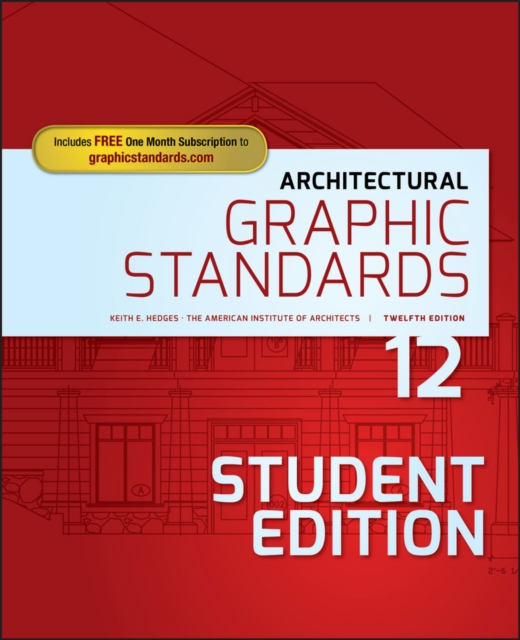
Architectural graphic standards
The gold-standard design and documentation reference for students Architectural Graphic Standards, Student Edition condenses key information from the definitive industry reference to provide students with a powerful learning resource. Covering design and documentation for a variety of projects, this book offers extensive visuals backed by expert discussion to prepare students for work in a modern professional practice. This new 12th edition has been significantly updated to provide the latest information on important architectural developments and movements, with detailed coverage of sustainability, economy, technology, and more alongside current building standards and best practices. The companion website features sample curricula, student exercises, and classroom projects to aid the understanding of developing designers, and links to additional resources include professional associations, manufacturers' websites, and architectural articles to help students stay up-to-date as the field continues to evolve. Architectural Graphic Standards is the gold-standard reference for practicing architects, engineers, and builders; this Student Edition introduces key elements in a way that's relevant to the budding designer, along with ancillary materials that facilitate internalization. Delve into the design and documentation process for building materials and elements, as used in today's real-world practice Discover the latest advances in sustainability, digital fabrication, building information modeling, and more Learn the building standards and best practices for a wide variety of architectural details Examine thousands of illustrations, richly detailed graphics, PowerPoint slides, and links to additional resources Simply \"knowing\" graphic and documentation standards is not enough; future architects and engineers must develop an instinctual understanding and reflexive use of much of this material. Architectural Graphic Standards, Student Edition provides the depth and breadth of coverage they need, and the expert guidance that will help them succeed.
eBook

Architectural Graphic Standards, Student Edition
ARCHITECTURAL GRAPHIC STANDARDS THE LANDMARK UPDATE OF THE MOST RECOGNIZED STUDENT RESOURCE IN ARCHITECTURE The Student Edition of the iconic Architectural Graphic Standards has been a rite of passage for architecture, building, and engineering students for more than eighty years.
eBook

THE HEALING POWERS OF NATURE IN JOPLIN’S CUNNINGHAM PARK
May 22, 2011, was supposed to be a day to celebrate, as high school graduates in Joplin, Missouri, tossed their caps into the air. But the Sunday graduation ceremony quickly turned to tragedy when a tornado barreled down through the middle of the city, killing 161 residents (SPC-NOAA 2015; Kansas City Star 2011). The entire community felt the impact of the tornado’s destructive path (Letner 2011). Yet after the tragedy, Joplin community members, along with a flood of volunteers from nearby Drury University and beyond, generated multiple “civic waves” of recovery.
This chapter describes Drury University’s design-build of historic Cunningham
Book Chapter
Introduction to Architectural Structures: Lessons Learned from Parti Pris Pedagogy
Introduction to Architectural Structures: Lessons Learned from a Reverse Parti Pris PedagogyThe academy recognizes mathematics as the primary challenge confronting architecturalstructures educators in the liberal arts environments. Although there is considerable polaritybetween architectural and engineering discourse in structures pedagogy, the germaneness ofmathematics is not the fundamental problem. The psychology of how we learn has changed.Structures education is frequently modeled in an explicit bottoms-up approach through thegradual accrual of prerequisite knowledge. However, this is consistent with how we learn underthe older associationist-behaviorist paradigm, rather than the newer cognitive paradigm.Scientific psychologists recognize that the schemata of the learner are more important than theprerequisite knowledge. The cognitive paradigm suggests that explicit information precedes thediscovery of implicit knowledge in a top-down approach. This is in harmony with the lifeexperiences inside the dominant studio culture, whereby the parti pris is borne prior to theformalized solution. A need exists to explore a pedagogy that commences with the central idea ofarchitectural structures.This paper outlines a new approach for a structures pedagogy that reverses the content sequencein an introductory architectural structures course at a private liberal arts institution. A participantobservation study was performed in the narrative tradition to document thirty second-yeararchitecture students studying in either an associationist-behaviorist sequential course contentsequence or a cognitive reverse content parti pris sequence. The findings indicate that thereverse pedagogy induces higher scores in each exam, has a greater capacity to integrate thebroader structural concepts in affiliated design studio outcomes, and that the student evaluationswere significantly higher. The educational lessons learned are provided in the form of reflectionsin the areas of course instruction, content, and student outcomes.
Conference Proceeding
The 2010 Haiti Earthquake: Real-Time Disaster Inquiry in the Classroom
The 2010 Haiti earthquake: Real-time disaster inquiry in the classroomAbstractCivil engineering education commonly has classroom instructional strategies that includesynchronous engagements between the instructor and the learner, but seldom has synchronousexperiences between the learner and real-time external phenomena. As a consequence, therelevant conclusions from academia and practice are available in the public domain. Whenengineering programs lack courses engaging real-time phenomena, they may inhibit studentsfrom thinking critically and formulating their own opinions and conclusions drawn from liveevents. A need exists for exploring synchronous, or real-time, student engagement between asignificant event, such as a disaster phenomenon, and the academic experience.This paper explores a natural disaster as a real-time course inquiry and its semester longimmersion into the structures classroom at a private liberal arts university. The disaster was the2010 Haiti earthquake. A qualitative research design was deployed with a teacher’s story andparticipant observation study to document forty-four third-year architecture students studying adisaster event unfolding concurrently within the course timeframe. The rationale is to provide aholistic interpretation of the course through the collective perspectives of the teacher and thestudents. The findings indicate that students envision earthquake events as either a structuralphenomenon with cultural implications or a cultural phenomenon with structural implications.The educational lessons learned from implementing a real-time disaster inquiry in the classroomare provided. These are in the form of reflections in the areas of course instruction, content, andstudent outcomes.
Conference Proceeding