
Catalogue Search | MBRL


Are you sure you want to remove the book from the shelf?

{{itemTitle}}
69
result(s) for
"Kelly, Thomas Forrest"
Sort by:


Ornamental melismas in Aquitanian introits
Melismas are used to decorate the performance of introits in the early manuscripts of East Francia and of the region of Aquitaine. The former group includes melismas attached to the ends of phrases in manuscripts of the tenth and eleventh centuries. The Aquitanian practice, apart from a few introits that resemble the East Frankish usage, is to add substantial melismas – not the same as those used by the East Franks – to the final soloistic doxology, as a sort of flourish indicating the final reprise. These melismas are sometimes found in tonaries, perhaps for general application to any introit in the mode, and sometimes attached to individual introits. Melismas from Aquitanian tonaries, graduals and tropers are catalogued and described. These melismas are evidently portable, often being used for more than one occasion.
Journal Article


The Exultet in Southern Italy
The Exultet rolls of southern Italy are parchment scrolls containing text and music for the blessing of the great Easter candle; they contain magnificent illustrations, often turned upside down with respect to the text so that they can be seen by observers. The Exultet in Southern Italy provides a broad perspective on this phenomenon that has long attracted the interest of those interested in medieval art, liturgy, and music. This book considers these documents in the cultural and liturgical context in which they were made, and provides a perspective on all aspects of this particularly southern Italian practice. While previous art-historical studies have concentrated on the illustrations in these rolls, Kelly's book also looks at the particular place of the Exultet in changing ceremonial practices, provides background on the texts and music used in southern Italy, and inquires into the manufacture and purpose of the Exultets--why they were made, who owned them, and how they were used.
eBook
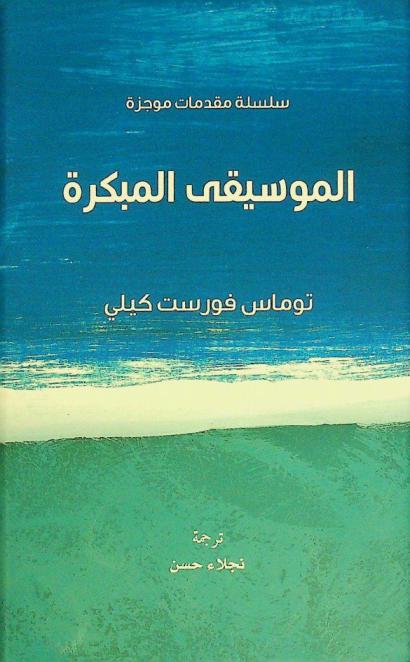
الموسيقى المبكرة
كتاب \"الموسيقى المبكرة\" هو جزء من سلسلة \"مقدمات موجزة\" والمكتوب بواسطة توماس فورست كيلي، يتناول الكتاب موسيقى الفترة القديمة، التي تشمل الفترة من العصور الوسطى المبكرة إلى العصور الوسطى المتأخرة، والعصور النهضوية، يسلط الكتاب الضوء على تطور الموسيقى في هذه الفترات الزمنية، ويناقش الأساليب الموسيقية والأدوات المستخدمة في تلك الحقب الزمنية، كما يعرض كيفية تأثير الأحداث التاريخية والتغيرات الاجتماعية والثقافية على تطور الموسيقى خلال هذه الفترات.
Book


Poetry for Music: The Art of the Medieval Prosula
Among the literary arts of the Middle Ages, the creation of texts within strict parameters held a fascination for many poets. Acrostic poems, tricky meters, frequent rhyme, and other limitations often spurred those who sought expression in words.
Journal Article

OLD-ROMAN CHANT AND THE RESPONSORIES OF NOAH: NEW EVIDENCE FROM SUTRI
Among the manuscript fragments in the Archivio comunale of Sutri (Province of Viterbo), Italy, are four consecutive folios of an Old-Roman antiphoner of the later eleventh century. The two bifolios are now identified as fragments 141 (Frammenti teologici 40) and 141bis (Frammenti teologici 41). These fragments, which preserve music for the feasts of Sexagesima, Quinquagesima and Ash Wednesday, are remnants of what appears to be the oldest witness of Old-Roman music for the office. When added to the two surviving antiphoners (London, British Library, Add. MS 29988, of the twelfth century, and Vatican City, Biblioteca Apostolica Vaticana, MS San Pietro B 79, of the end of the twelfth century) and two recently discovered fragments (in Frosinone and Bologna), the Sutri fragments bring to five the number of Old-Roman antiphoners of which at least some evidence survives. It begins to appear that manuscripts of this music were once not so rare. The Sutri fragments show some unusual liturgical characteristics that provide new information on the Roman liturgy; I will discuss these aspects shortly.
Journal Article
