
Catalogue Search | MBRL


Are you sure you want to remove the book from the shelf?

{{itemTitle}}
259
result(s) for
"Kessler-Harris, Alice"
Sort by:


In Pursuit of Equity
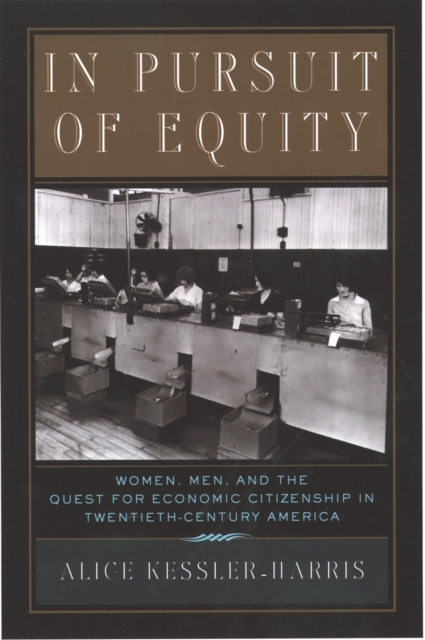
Few historians have contributed more to our understanding of the history of women, and women’s effect on history, than Alice Kessler-Harris. Author of the classic Out to Work, she is one of the country’s leading scholars of gender, the economy, and public policy. In this volume, Kessler-Harris pierces the skin of arguments and legislation to grasp the preconceptions that have shaped the experience of women: a “gendered imagination” that has defined what men and women alike think of as fair and desirable. In this brilliant account that traces social policy from the New Deal to the 1970s, she shows how a deeply embedded set of beliefs has distorted seemingly neutral social legislation to further limit the freedom and equality of women. Government rules generally sought to protect women from exploitation, even from employment itself; but at the same time, they attached the most important benefits to wage work. To be a real citizen, one must earn—and most policymakers (even female ones) assumed from the beginning that women were not, and should not be breadwinners. Kessler-Harris traces the impact of this gender bias in the New Deal programs of Social Security, unemployment insurance, and fair labor standards, in Federal income tax policy, and the new discussion of women’s rights that emerged after World War II. “For generations,” she writes, “American women lacked not merely the practice, but frequently the idea of individual economic freedom.” Only in the 1960s and ’70s did old assumptions begin to break down—yet the process is far from complete. Even today, with women closer to full economic citizenship than ever before, Kessler-Harris’s insights offer a keen new understanding of the issues that dominate the headlines, from the marriage penalty in the tax code to the glass ceiling in corporate America.
eBook

Why Biography?
Kessler-Harris discusses why she chose to write a biography about Lillian Hellman. Hellman remained in such constant and lively dialogue with several of the key social and political currents of her day that makes her life intriguing. She offers access to four arenas that are central to understanding the direction of twentieth-century American society: the revolutionary transformation of sexual life and gender roles; the swirling political currents produced by the challenge of socialism and communism and the tensions of the Cold War; the fluctuating and contested nature of identity and its political uses; and the impact of a newly vibrant culture of celebrity. Through Hellman, she understood a little more fully the politics of the 1950s and after, and something of their larger role in shaping the worldviews of ordinary citizens and intellectuals alike.
Journal Article

Capitalism, Democracy, and the Emancipation of Belief
Kessler-Harris talks about the relationship of democracy to equality. If participants in the Wisconsin demonstrations and those in the Occupy movement imagine themselves as part of a struggle for democracy, their protests are grounded in claims to equality that hearken back to the nineteenth century. As they march, participants invoke an expansive idea of democracy that relies on the ability of ordinary folk to exercise their voices through the ballot box, to be sure, but also through trade unions, communities, and public demonstrations. The banners that call for recognition suggest a protean view of equality that is measured by the loss of economic security and expanding income and wealth gaps between the richest and the poorest. Rising levels of inequality, the occupiers argue, inhibit the exercise of democratic participation. The cry of \"the 99 percent\" calls attention to the distortions that money imposes on the political realm. Protesting the power and influence of the wealthiest members of society, demonstrators specifically deride the notion that their collective lack of economic resources leaves them content to cede power to an oligarchy of wealth.
Journal Article
Gender Identity and the Gendered Process
Kessler-Harris comments on Carnelia H. Dayton and Lisa Levenstein's essay about the US women's and gender history. She asserts that she was struck by the authors' suggestion that white and black women draw differently on gender, sometimes making use of it to affirm state power and at other times resisting (in the case of black women) its implications. Only when the authors come to the second part of their essay, however, one could understand the implications of the work on the body for reshaping US history. Tacitly reverting to the older usage of gender, they reveal how the project of interpreting US history writ large relies on the work of historians whose main concerns lie in the relationships of gender to power or powerlessness. One lucid example of this lies in their illustrations of how US diplomacy has relied on gendered cultural representations and how the early twentieth-century imperial project was rooted in particularly masculine conceptions of the nation that, in turn, were rooted in domestic self-images.
Journal Article
The So-What Question
Historian Gerda Lerner called the kind of history people started out with contributions history. They had an obligation, she insisted, to prove that the history of women could be written by excavating the sources that demonstrated not only that women had been present in history but that their absence impoverished the historical enterprise. Women, she wrote, had not simply been adjuncts to history; they had been an essential component of it. Those early excavations opened the field up to the hostile question asked by many of male colleagues and later taken up by Lerner. In 1970, the years when the author worked with Lerner most closely, they (they embattled historians of women) were happy to answer that question simply: adding women, they argued, enriches their knowledge. As Suzanne Lebsock often said, it makes people smarter. They proudly celebrated the recovery of lost women, especially of previously invisible women of color, of the poor, of the wage-earning minority.
Journal Article


An Interview with Alice Kessler-Harris
An interview with author Alice Kessler-Harris is presented. Kessler-Harris said that the family connection, in some ways perversely, made me want to learn more about Jewish history, and that's because the specifically Jewish experience was not part of my growing up. My parents, as I've often said, were refugees. They were smuggled out of Prague through Poland by the Communist Party and its networks. They left in April of 1939, after the Germans had entered Prague, and they were able to leave because my mother's family was heavily involved with the Czech Communist Party. This is one of the stories I tell. I did. I wanted to learn about being Jewish. There was one big synagogue in Cardiff, the Cathedral Street Synagogue. One day after school I went to the synagogue just to see it, and somebody said to me, \"What do you want little girl?\" I said I wanted to learn about being Jewish, and so this person took me to the person who I learned was the melamed, the teacher.
Journal Article